Soft lithography has become one of the most influential fabrication approaches in microfluidics. It enables the creation of microscale and nanoscale structures using flexible materials instead of rigid silicon-based processes. This technique has opened the door to rapid prototyping of lab-on-a-chip systems, biological platforms, and complex fluidic architectures at low cost and with relatively simple equipment.
Unlike conventional microfabrication methods developed for electronics, soft lithography is particularly suited for biological and chemical applications where flexibility, material compatibility, and ease of fabrication are essential.
In this article, we explore the fundamentals of soft lithography, outline its core fabrication processes, review the main techniques involved, and discuss its advantages, limitations, and key applications in microfluidics.
What is Soft Lithography?
Soft lithography refers to a group of microfabrication techniques that use elastomeric (soft, flexible) materials to replicate or print micro- and nanostructures. Unlike traditional lithography methods that rely primarily on light exposure, soft lithography techniques use molded stamps, casts, or replicas to transfer patterns onto substrates.
At its core, the method typically involves creating a patterned master (often using photolithography) and then replicating this structure using a polymer such as polydimethylsiloxane (PDMS), a widely used material in microfluidic device fabrication. Once cured and removed from the master, the elastomeric replica can be used to form microchannels, imprint surface features, or build functional devices on substrates such as glass, silicon, or polymer materials.
To better understand why this approach is widely adopted, the next section explores the key advantages of soft lithography in microfluidics.
Core Principles of Soft Lithography
Elastomeric Materials
A key feature of soft lithography is the use of soft polymers that can deform slightly while maintaining high-resolution structures. These elastomeric materials are capable of accurately reproducing fine details from a master mold, making them particularly suitable for microfluidics and biological applications.
Pattern Transfer Mechanisms
Instead of directly removing material through etching, soft lithography relies on physical processes such as molding, stamping, and capillary-driven filling to transfer patterns. This approach enables repeated replication of structures from a single master.
Phenomena such as surface tension, polymer curing, and conformal contact play a critical role in ensuring precise pattern transfer and structural fidelity at the microscale.
Soft Lithography Process Step-by-Step
The fabrication of microfluidic devices using soft lithography follows a structured sequence of steps, starting from the creation of a master mold to the final assembly of the device.

Master Mold Fabrication (Photolithography & Photoresist)
The process begins with the fabrication of a master mold, typically using photolithography. A photoresist such as SU-8 or SQ™ is patterned on a silicon wafer using UV light and a photomask. This step defines the geometry and dimensions of the microchannels with high precision.
PDMS Casting and Curing
A liquid polymer, typically Sylgard 184 PDMS (base and curing agent), is mixed and poured over the master mold. The material is then degassed to remove air bubbles, and cured at an elevated temperature until it solidifies into an elastomeric replica that carries the inverse of the original pattern.
Demolding and Replica Formation
Once cured, the solid PDMS layer is carefully peeled off from the master mold. The resulting structure contains a negative replica of the original pattern, forming the microchannel network.
Plasma Bonding and Device Assembly
To create a functional microfluidic device, the patterned PDMS layer is bonded to a substrate such as glass or another PDMS layer. This is typically achieved using oxygen plasma treatment, which activates the surfaces and creates a strong, permanent seal.
Materials Used in Soft Lithography
Soft lithography relies on a combination of elastomeric polymers, photoresists, and solid substrates to fabricate microfluidic devices. Each material plays a specific role in defining, replicating, and assembling microscale structures.
PDMS (Polydimethylsiloxane)
PDMS is the most widely used material in soft lithography, particularly in microfluidics. It is a silicone-based elastomer formed by mixing a base polymer with a curing agent, which then crosslinks into a flexible solid.
Its popularity in microfluidics comes from several key properties:
- optical transparency (useful for microscopy and imaging)
- biocompatibility and low toxicity (suitable for biological applications)
- chemical stability and inertness
- mechanical flexibility, allowing easy demolding
- permeability to gases, which can be beneficial for cell culture
PDMS also enables rapid prototyping, as it can be easily cast, cured, and reused multiple times.
💡 Alternative to PDMS: Flexdym
Flexdym is a newer thermoplastic elastomer used as an alternative to PDMS in soft lithography-based microfluidics. It offers self-sealing assembly, high optical transparency, and strong resistance to tearing, while maintaining excellent biocompatibility. It also shows minimal small-molecule absorption, better surface stability, easier bonding, and higher scalability compared to PDMS.
SU-8 Photoresist
SU-8 is commonly used to create the initial master structures because it can form high-aspect-ratio microfeatures with good stability.
It is a negative photoresist commonly used to fabricate the master mold via photolithography. When exposed to UV light through a photomask, the exposed regions become crosslinked and remain after development, forming high-aspect-ratio structures.
SU-8 masters serve as templates for PDMS casting in most soft lithography workflows.
💡 Alternative to SU-8 Photoresist: SQ™
KEM LAB SQ™ is a negative epoxy photoresist designed as a high-performance alternative to SU-8 in microfluidic soft lithography. It offers improved optical transparency, better cleanliness, and higher lot-to-lot consistency, while maintaining full compatibility with standard SU-8 processing workflows. These properties make KEM LAB SQ™ particularly suitable for producing reliable and high-quality master molds for PDMS-based microfluidic devices.
Silicon Wafers and Polymer Substrates
Silicon serves as a base for master fabrication, while other substrates such as glass or polymers are used for final device assembly.
Silicon wafers are typically used as the base substrate for fabricating SU-8 master molds due to their flatness and compatibility with photolithography processes.
For final device assembly, substrates can include:
- glass slides (common for optical transparency and rigidity)
- PDMS layers (for fully polymer-based devices)
- other polymers depending on the application
These substrates are bonded to the patterned PDMS layer to seal microchannels and create functional microfluidic devices.
Types of Soft Lithography Techniques
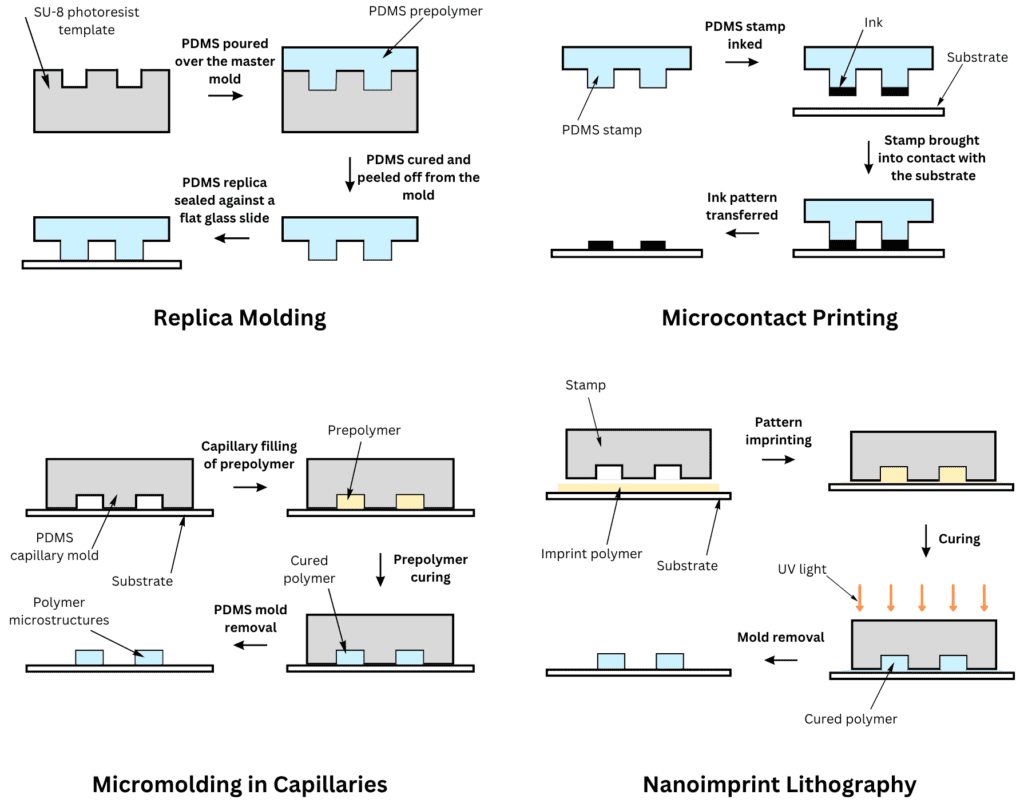
Soft lithography is not a single method but a collection of techniques that use elastomeric molds or stamps to transfer patterns at the micro- and nanoscale. Each technique relies on a different mechanism, making them suitable for specific microfluidic applications.
Replica Molding (REM)
Replica molding is the most commonly used soft lithography technique in microfluidics. In this approach, a liquid polymer such as PDMS is poured over a master mold, cured, and then peeled off to obtain a structured replica.
It is widely used to fabricate microfluidic channels because it is simple, reliable, and allows the same master to be reused multiple times.
Microcontact Printing (µCP)
Microcontact printing uses a PDMS stamp coated with a molecular ink to transfer patterns onto a substrate. Only the raised regions of the stamp come into contact with the surface, enabling selective deposition.
This technique is particularly useful for surface patterning, such as positioning proteins, cells, or biomolecules with controlled spatial organization.
Micromolding in Capillaries (MIMIC)
Micromolding in capillaries relies on capillary forces to fill the channels of a PDMS mold with a liquid prepolymer. Once the material cures, the mold is removed, leaving behind patterned microstructures.
It is well suited for creating continuous structures over large areas and for applications requiring precise fluid filling without external pressure.
Nanoimprint Lithography
Nanoimprint lithography is used to fabricate structures at the nanoscale by mechanically pressing a patterned mold into a material layer. After curing or solidification, the mold is removed, leaving high-resolution features.
Although more advanced, this technique extends soft lithography to applications requiring extremely fine pattern resolution.
Advantages of Soft Lithography for Microfluidic Devices
Soft lithography plays an important role in microfluidics because it enables precise fabrication of microscale channels while remaining accessible and flexible. Compared to traditional microfabrication techniques, it offers several key advantages:
- Low-cost microfabrication – enables quick production of microfluidic chips without relatively expensive infrastructure
- Rapid prototyping of microfluidic chips – allows fast design iteration and testing of new channel geometries
- High compatibility with biological applications – suitable for handling cells, proteins, and biochemical reagents in lab-on-a-chip systems
- Minimal reliance on cleanroom facilities – most fabrication steps can be performed in standard laboratory environments once the master mold is prepared
- High-resolution microchannel fabrication – enables precise control of fluid flow and microscale structures
- Versatility in materials and design – supports a wide range of polymers and complex 2D/3D microfluidic architectures
Because of these advantages, soft lithography has become a widely adopted technique for developing microfluidic devices in research fields such as biomedical engineering, chemical analysis, and diagnostics.
Limitations of Soft Lithography
Despite its many advantages, soft lithography also presents several limitations that can impact its use in certain microfluidic applications:
- Dependence on master fabrication – requires initial use of photolithography or similar methods to create high-quality master molds
- Resolution depends on materials and master quality – the final feature size is influenced by the precision of the master mold and the properties of the elastomer
- Resolution constraints for nanoscale features – achieving extremely fine structures can be challenging compared to advanced lithography techniques
- Limited material compatibility – commonly used materials like PDMS can absorb small molecules and are not suitable for all solvents
- Gas permeability of PDMS – while beneficial for cell culture, it can lead to evaporation or contamination in some microfluidic experiments
- Mechanical deformation risks – the flexibility of elastomers can cause channel distortion under high pressure or mechanical stress
- Scalability limitations for mass production – less suited for large-scale industrial manufacturing compared to rigid thermoplastics
In practice, these limitations rarely outweigh its benefits, which is why soft lithography is still a go-to method for microfluidic device development, particularly in early-stage research and testing.
Applications of Soft Lithography in Microfluidics
Soft lithography’s flexibility and ease of fabrication make it suitable for a broad range of microfluidic applications.
- Lab-on-a-chip systems – used for integrating multiple laboratory functions on a single microfluidic platform for chemical analysis and diagnostics
- Cell culture and organ-on-chip models – enables controlled microenvironments for studying cellular behavior and mimicking physiological conditions
- Droplet microfluidics – supports precise generation and manipulation of tiny droplets for high-throughput assays and single-cell analysis
- Drug screening and biomedical research – used in microfluidic platforms for testing drug responses and studying biological interactions at the microscale.
Soft Lithography vs Photolithography in Microfabrication
| Feature | Soft Lithography | Photolithography |
|---|---|---|
| Cost | Low | High |
| Equipement | Simple lab setup | Cleanroom required |
| Materials | PDMS, polymers | Silicon, photoresists |
| Applications | Microfluidics, biology | Microelectronics |
Soft lithography and photolithography are complementary microfabrication techniques with different strengths. Photolithography is a light-based process widely used in the semiconductor industry to create highly precise patterns on rigid substrates like silicon, but it requires cleanroom facilities and expensive equipment.
Soft lithography, in contrast, relies on elastomeric materials such as PDMS to replicate patterns from a master mold. It is simpler, more cost-effective, and better suited for rapid prototyping and biological microfluidic applications.
While photolithography excels in large-scale semiconductor manufacturing, soft lithography is preferred for flexible, low-cost microfluidic device development.
💡 Conclusion
Soft lithography is a core microfabrication technique in microfluidics, enabling fast, low-cost production of complex microscale structures. Its flexibility, simplicity, and compatibility with biological applications make it a preferred method for lab-on-a-chip and biomedical device fabrication, despite some material and resolution limitations.
Stay tuned for more insights on soft lithography, microfabrication, PDMS microfluidics, and other techniques driving innovation in microfluidic devices 🔬!
📧 If you have any questions or feedback, please feel free to contact us at contact@darwin-microfluidics.com.
❓ FAQ: Soft Lithography in Microfluidics
Q1: What is soft lithography in microfluidics?
Soft lithography is a microfabrication technique that uses elastomeric materials, such as PDMS, to replicate micro- and nanoscale patterns for microfluidic device fabrication.
Q2: How does soft lithography work?
Soft lithography works by casting or molding a liquid polymer over a patterned master mold, which is then cured and peeled off to create a structured replica.
Q3: What is soft lithography used for?
Soft lithography is used to fabricate microfluidic devices, lab-on-a-chip systems, organ-on-chip platforms, and other microscale biomedical and chemical devices.
Q4: Why is soft lithography widely used in microfluidics?
It is widely used because it enables fast, low-cost fabrication of flexible microfluidic devices with good design adaptability.
Q5: What materials are used in soft lithography?
Common materials in soft lithography include PDMS for device fabrication and SU-8 photoresist for creating master molds.
Q6: What are the advantages of soft lithography over photolithography?
Soft lithography is more cost-effective, easier to use outside cleanroom environments, and better suited for biological applications, while photolithography is mainly used for high-volume semiconductor manufacturing.
Q7: Can soft lithography be used for mass production?
Soft lithography is mainly used for prototyping and research rather than large-scale industrial production.
Q8: Why is PDMS commonly used in soft lithography?
PDMS is commonly used because it is flexible, transparent, biocompatible, and easy to mold.
Q9: Is soft lithography suitable for nanoscale fabrication?
Yes, soft lithography can achieve nanoscale features, but it typically requires specialized techniques and high-quality master molds.
Q10: Do you need a cleanroom for soft lithography?
Only for making the initial master; most steps can be done in a standard lab.

🔗 References
Zhao, Xiao-Mei, Xia, Younan & Whitesides, George M. (1997). Soft lithographic methods for nano-fabrication. Journal of Materials Chemistry, 7(7), 1069–1074. https://doi.org/10.1039/A700145B
McDonald, J. Cooper & Whitesides, George M. (2002). Poly(dimethylsiloxane) as a Material for Fabricating Microfluidic Devices. Accounts of Chemical Research, 35(7), 491–499. https://doi.org/10.1021/ar010110q
Kim, Pilnam & Kwon, Keon Woo & Park, Min & Lee, Sung & Kim, Sun Min & Suh, Kahp. (2008). Soft Lithography for Microfluidics: a Review. Biochip Journal. 2(1).
Qin, D., Xia, Y. & Whitesides, G. Soft lithography for micro- and nanoscale patterning. Nat Protoc 5, 491–502 (2010). https://doi.org/10.1038/nprot.2009.234