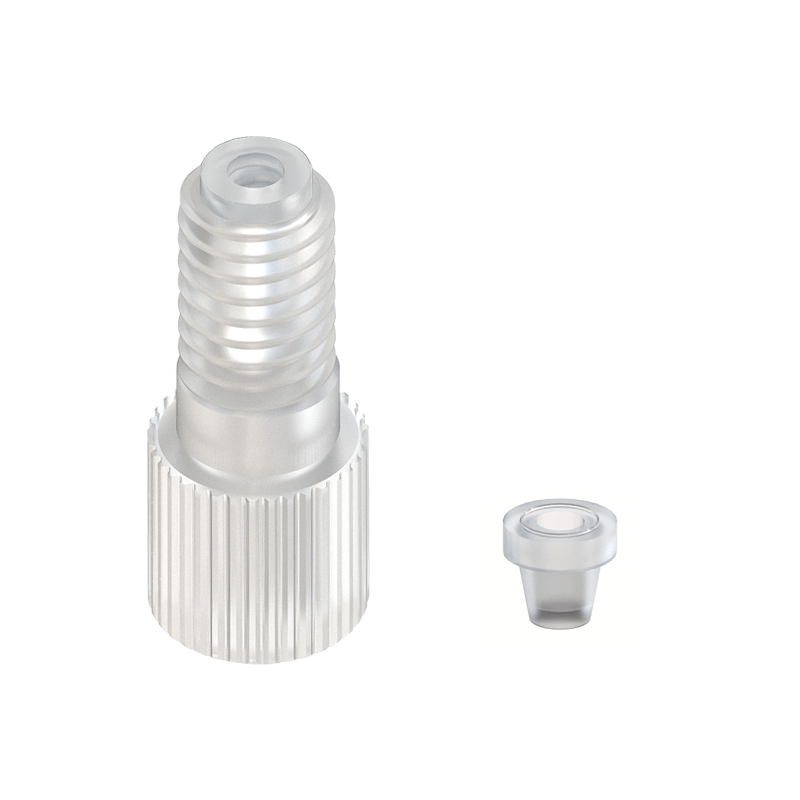

Material selection plays an important role in the performance of microfluidic systems. Tubing, fittings, and fluid-handling components must resist aggressive chemicals, maintain dimensional stability, and perform consistently under a wide range of operating conditions. To meet these requirements, PTFE (Polytetrafluoroethylene) and ETFE (Ethylene Tetrafluoroethylene) are two fluoropolymers widely used across microfluidic applications.
Although both materials offer excellent chemical resistance and the low surface energy associated with fluoropolymers, they differ significantly in mechanical strength, flexibility, temperature resistance, and transparency. These differences can directly influence the performance of microfluidic devices, particularly in systems exposed to mechanical stress or elevated temperatures.
Beyond microfluidics, PTFE and ETFE are widely used in chemical processing, aerospace, electronics, medical devices, and industrial fluid-handling systems. This article compares their key properties and highlights the differences that matter most, helping you choose the right material for your microfluidic and industrial applications.
PTFE vs ETFE: Quick Comparison Table
The table below compares the key properties of PTFE and ETFE, providing a side-by-side overview of their mechanical performance, chemical resistance, thermal characteristics, and other factors relevant to microfluidic and industrial applications.
| Property | PTFE | ETFE | Preferred Material |
|---|---|---|---|
| Chemical Resistance | Excellent inertness to most chemicals | Excellent | PTFE |
| Coefficient of Friction | 0.03–0.05 | 0.3 | PTFE |
| Coefficient of Thermal Expansion (between 21 and 100°C) | 14 × 10⁻⁵ /K | 12.6 × 10⁻⁵ /K | ETFE |
| Compressive Strength | 11–13 MPa | 38 MPa | ETFE |
| Cost | Relatively inexpensive | Less expensive | ETFE |
| Density | 2.2 g/cm³ | 1.7 g/cm³ | - |
| Dielectric Strength | ~20 kV/mm | 70 kV/mm | ETFE |
| Elongation | 350–400% | 200% | PTFE |
| Flexural Modulus | 345–620 MPa | 1 GPa | ETFE |
| Hardness (Shore D) | ~55 | 68 | ETFE |
| Service Temperature (Continuous) | -200°C to 260°C | -100°C to 155°C | PTFE |
| Tensile Strength | 24.8 MPa | 40 MPa | ETFE |
| Thermal Conductivity | ~0.25 W/m·K | ~0.24 W/m·K | PTFE |
| Transparency | Opaque | Highly transparent | ETFE |
| Water Absorption | less than 0.01% | 0.007% | ETFE |
💡 Note: The values presented in this table are for reference purposes only. Actual properties may vary depending on the supplier, as factors such as size, grade, and brand can influence performance. Both PTFE and ETFE are often available with customized specifications to meet specific application requirements.
PTFE vs ETFE: Material Overview
To better understand how PTFE and ETFE perform in microfluidics and other domains, it is useful to examine their key properties, characteristics, and typical use cases.
About PTFE
PTFE (Polytetrafluoroethylene) is a fully fluorinated polymer known under the trade name Teflon. It has exceptional chemical resistance, an extremely low coefficient of friction, excellent thermal stability, a non-stick surface, and high wear resistance. PTFE also offers outstanding resistance to moisture and most aggressive chemicals, allowing it to perform in demanding laboratory and industrial environments. Its broad operating temperature range makes it a dependable material for a wide variety of microfluidic and industrial applications.
About ETFE
ETFE (Ethylene Tetrafluoroethylene) is a partially fluorinated copolymer valued for its high mechanical strength, toughness, and resistance to abrasion. It performs well under repeated mechanical stress, making it suitable for components that may experience impact, vibration, or frequent handling. ETFE also offers excellent resistance to UV radiation and weathering, allowing it to maintain its properties in demanding outdoor environments. Its good chemical resistance and broad operating temperature range make it a suitable material for many microfluidic and industrial applications.
Side-by-Side Comparison
Although PTFE and ETFE belong to the same fluoropolymer family, they differ noticeably in mechanical performance, chemical and thermal resistance, cost, and typical applications.
Mechanical Properties
PTFE is softer and more flexible than ETFE. Its higher elongation allows it to bend more easily without permanent deformation, while its extremely low coefficient of friction minimizes wear and reduces flow resistance inside tubing.
ETFE, on the other hand, is considerably stronger and more rigid. It offers higher tensile and compressive strength, greater hardness, and better resistance to abrasion and impact. These characteristics make ETFE well suited for microfluidic components that experience mechanical loads, repeated handling, or demanding operating conditions.
Chemical & Thermal Resistance
Both PTFE and ETFE provide excellent chemical resistance, making them suitable for handling a wide range of aggressive acids, bases, and solvents commonly found in laboratory and industrial environments.
PTFE has the advantage when operating temperatures become extreme. It remains stable across a much wider continuous temperature range, up to 260°C, while also offering exceptional chemical inertness and extremely low water absorption.
ETFE has a lower continuous service temperature compared to PTFE, but it provides excellent resistance to UV radiation, weathering, and outdoor exposure.
Cost
ETFE is generally the more economical option, offering excellent mechanical performance at a lower material cost. PTFE is typically more expensive, reflecting its unmatched chemical inertness, wider operating temperature range, and ultra-low coefficient of friction.
Typical Applications
PTFE is widely used for microfluidic tubing, seals, gaskets, valves, and fittings where maximum chemical resistance, high-temperature performance, and low friction are essential. It is also commonly found in chemical processing equipment, laboratory systems, electrical insulation, and non-stick industrial applications.
ETFE is commonly used for microfluidic connectors, transparent tubing, structural components, wire insulation, and systems exposed to mechanical stress or outdoor environments. Its combination of toughness, transparency, and weather resistance also makes it popular in aerospace, electronics, architectural membranes, and solar energy applications.

How to Choose Between PTFE and ETFE?
Choosing between PTFE and ETFE depends less on which material performs "better" overall, and more on which best fits the functional requirements of your application. Below are common scenario-based recommendations to help guide your selection.
1. If mechanical strength and durability are critical:
ETFE performs better thanks to its higher tensile and compressive strength, greater hardness, and superior abrasion resistance. It is better suited for connectors, fittings, and structural components exposed to mechanical loads or repeated handling.
2. If maximum chemical resistance is required:
PTFE is the preferred choice. It is virtually inert to almost all chemicals, including highly aggressive acids, bases, and solvents, making it ideal for demanding chemical processing and microfluidic applications where material compatibility is critical.
3. If operating conditions involve very high temperatures:
PTFE is the better option because it maintains its mechanical and chemical properties across a much wider continuous temperature range, up to approximately 260°C, whereas ETFE is limited to around 155°C.
4. If cost is a deciding factor:
ETFE is generally the more economical material. It provides excellent mechanical performance and very good chemical resistance at a lower cost.
5. If transparency or visual inspection is important:
ETFE is the preferred choice. Unlike opaque PTFE, ETFE is naturally transparent, making it easier to observe fluid flow or inspect components during operation.
👉 In short:
- Choose PTFE when outstanding chemical resistance, high-temperature performance, and low friction are your top priorities.
- Choose ETFE when mechanical strength, transparency, durability, and lower material cost are more important.
PTFE vs ETFE: Frequently Asked Questions
A closer look at common questions helps clarify which material is best suited for specific microfluidic and industrial applications.
Q1: Which material is stronger, PTFE or ETFE?
ETFE provides significantly higher tensile and compressive strength, along with greater hardness and abrasion resistance. It is better suited for applications where mechanical durability is important.
Q2: Which material has better chemical resistance, PTFE or ETFE?
Both materials offer excellent chemical resistance, but PTFE is considered one of the most chemically inert plastics available. It withstands a broader range of aggressive chemicals and is preferred for the most demanding chemical environments.
Q3: Which material is more transparent, PTFE or ETFE?
ETFE is naturally transparent, allowing fluid flow to be easily monitored. PTFE is opaque and is therefore not suitable for applications requiring visual inspection.
Q4: Which material tolerates higher temperatures, PTFE or ETFE?
PTFE offers a much wider continuous operating temperature range, remaining stable from approximately -200°C to 260°C. ETFE performs well but is generally limited to continuous service temperatures of about 155°C.
Q5: Which material is more cost-effective, PTFE or ETFE?
ETFE is generally less expensive while still offering excellent mechanical properties and good chemical resistance. PTFE typically costs more because of its exceptional chemical inertness and superior high-temperature performance.
Q6: When should I choose ETFE over PTFE?
Choose ETFE when strength and durability are more important than maximum chemical resistance. Its higher mechanical performance, transparency, and lower cost make it an excellent choice for connectors, structural components, and fluid-handling systems that experience repeated handling or mechanical stress.
Q7: When should I choose PTFE over ETFE?
Choose PTFE when your application involves highly aggressive chemicals, very high operating temperatures, or requires the lowest possible friction. It is the preferred material for chemically demanding microfluidic systems, laboratory equipment, and industrial fluid-handling applications.
💡 Conclusion
PTFE and ETFE are two widely used fluoropolymers in microfluidics and industrial applications. PTFE stands out for its exceptional chemical resistance, high-temperature performance, and ultra-low friction, while ETFE offers greater mechanical strength, transparency, and cost efficiency. Understanding the strengths of each material helps you select the right option for your components, helping improve performance and service life.
Stay tuned for more deep dives into material choices for microfluidics, comparing tubing, connectors, and other component materials to help you make the best selection 🔬!
📧 If you have any questions or feedback, please feel free to contact us at contact@darwin-microfluidics.com.

🔗 References
- Curbell Plastics. ETFE Material Overview.
https://www.curbellplastics.com/materials/plastics/etfe/ - SAB Cables. ETFE, FEP, and PFA Technical Data.
https://sab-cables.com/donnees-techniques/etfe-fep-pfa/ - Insulation Tubings. Difference Between PTFE, FEP, PFA, and ETFE.
https://fr.insulation-tubings.com/info/difference-between-ptfe-fep-pfa-etfe-66488620.html - Greater Wire. Differences Between FEP, PFA, PTFE, and ETFE.
https://www.greaterwire.com/news/differences-between-fep-pfa-ptfe-and-etfe-i-85205012.html - PVDF Resin. Comparison of Properties: PTFE, PFA, FEP, ETFE.
http://fr.pvdfresin.com/news/comparison-of-properties-ptfe-pfa-fep-etfe-74345015.html - HT Cable Wire. PTFE, FEP, PFA, ETFE Comparison.
https://www.htcablewire.com/fr/blog/ptfe-fep-pfa-etfe-comparison-1