
La lithographie douce englobe une famille de techniques de microfabrication qui utilisent des moules, des tampons ou des répliques en élastomère pour créer des structures à l'échelle micro et nanométrique. Plutôt que de reposer exclusivement sur les procédés de fabrication des semi-conducteurs conventionnels, ces méthodes permettent la fabrication de dispositifs microfluidiques par des approches de moulage, d'impression et de transfert de motifs, permettant ainsi de fabriquer des structures micro-échelles complexes avec une haute précision.
Parce que les différentes applications microfluidiques nécessitent des géométries de canal variées, des propriétés de surface spécifiques et des résolutions de fabrication différentes, plusieurs techniques de lithographie douce ont été développées. Chaque méthode offre des avantages précis en fonction de la structure souhaitée, du matériau et des exigences de fabrication.
Dans cet article, nous explorons les principales techniques de lithographie douce utilisées pour la fabrication de dispositifs microfluidiques, ainsi que leurs avantages et leurs applications clés.
Moulage par réplique (REM)
Le moulage par réplique est la technique de lithographie douce la plus largement utilisée en microfluidique. Il est couramment employé pour fabriquer des microcanaux, des chambres de réaction et des réseaux fluidiques avec une haute précision dimensionnelle.
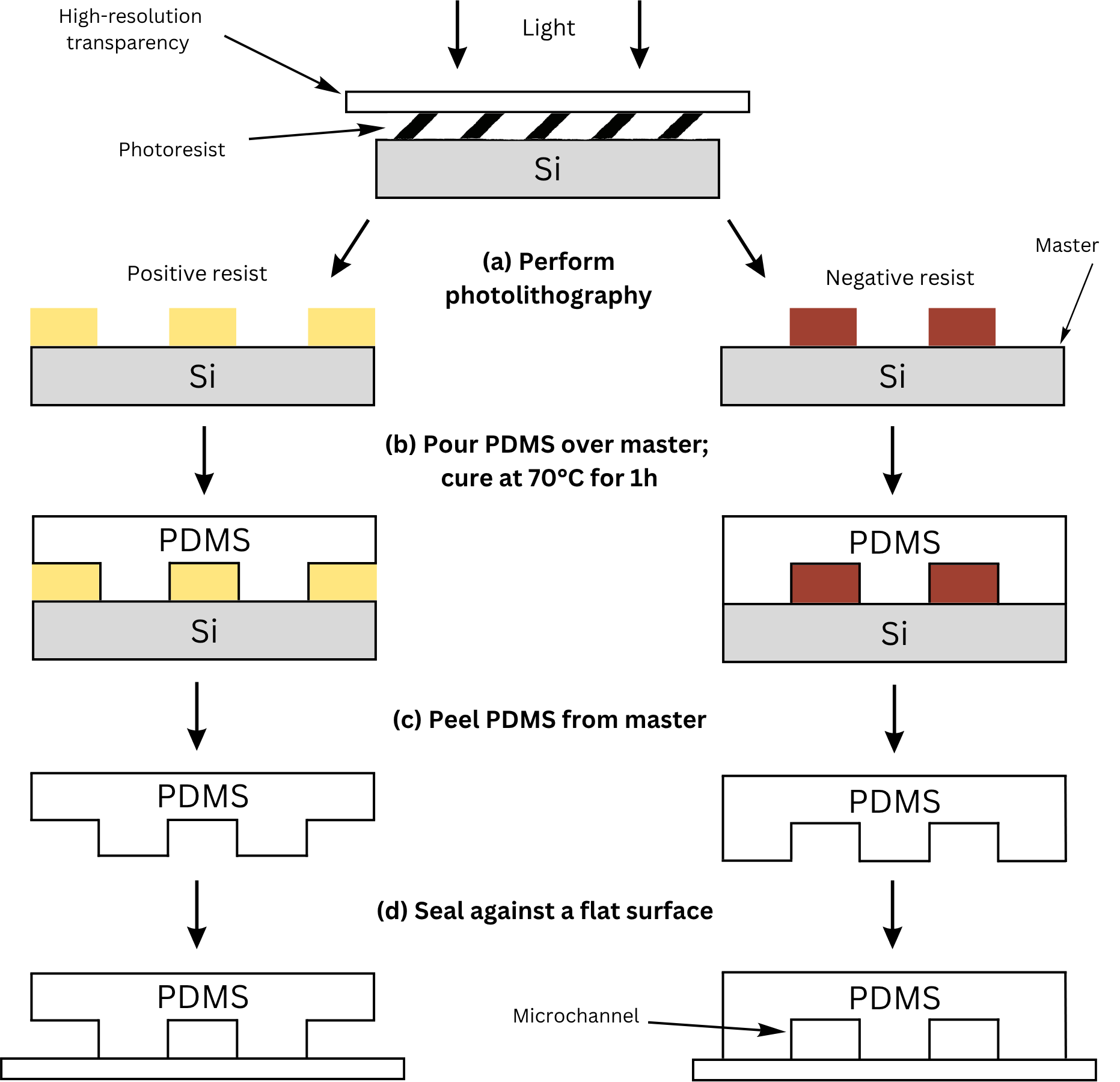
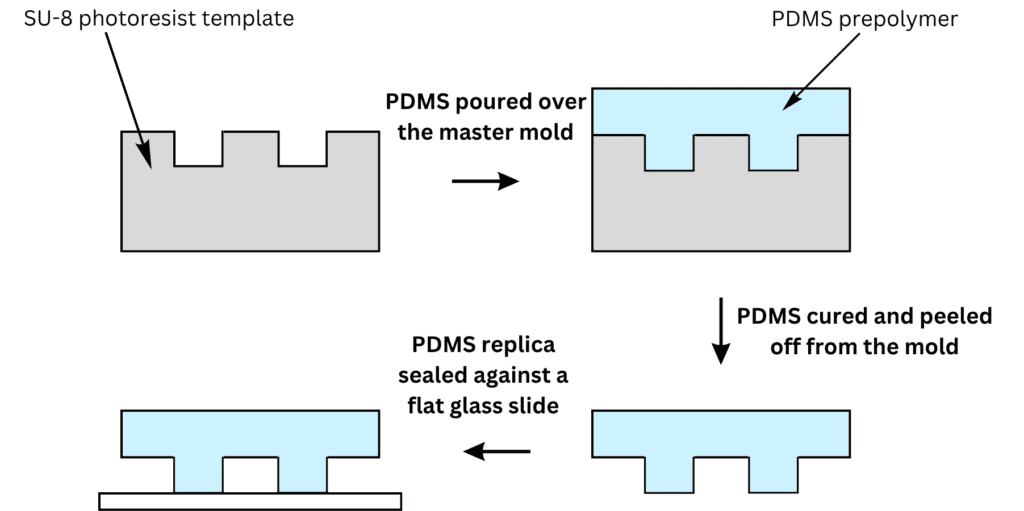
Le processus commence par un moule maître, généralement produit par photolithographie sur un wafer de silicium. Un fluide élastomère tel que le PDMS est versé sur le maître, durci, puis retiré pour créer une réplique contenant l'inverse des caractéristiques d'origine.
Avantages du moulage par réplique
Plusieurs caractéristiques rendent le moulage par réplique particulièrement attractif pour la fabrication de puces microfluidiques :
- Reproduction haute fidélité des structures à micro-échelle
- Excellente transparence optique lors de l'utilisation de PDMS
- Adapté au prototypage rapide
- Faible coût de fabrication
- Réutilisabilité du moule maître
🚨 Limitations : La qualité des structures obtenues par moulage par réplique dépend fortement de la précision du moule maître. De plus, les matériaux couramment utilisés tels que le PDMS peuvent présenter un gonflement par les solvants, une absorption moléculaire ou une déformation mécanique dans certaines applications.
Applications typiques du moulage par réplique
En microfluidique, le moulage par réplique est principalement utilisé pour fabriquer des microcanaux, des dispositifs de laboratoire sur puce (lab-on-a-chip), des systèmes d'organes sur puce, des plates-formes de culture cellulaire et d'autres plates-formes à fluide à base de PDMS après scellement sur un substrat.
Impression par microcontact (µCP)
L'impression par microcontact est une technique de transfert de motifs qui utilise un tampon en élastomère pour déposer des molécules sur une surface selon un agencement contrôlé.
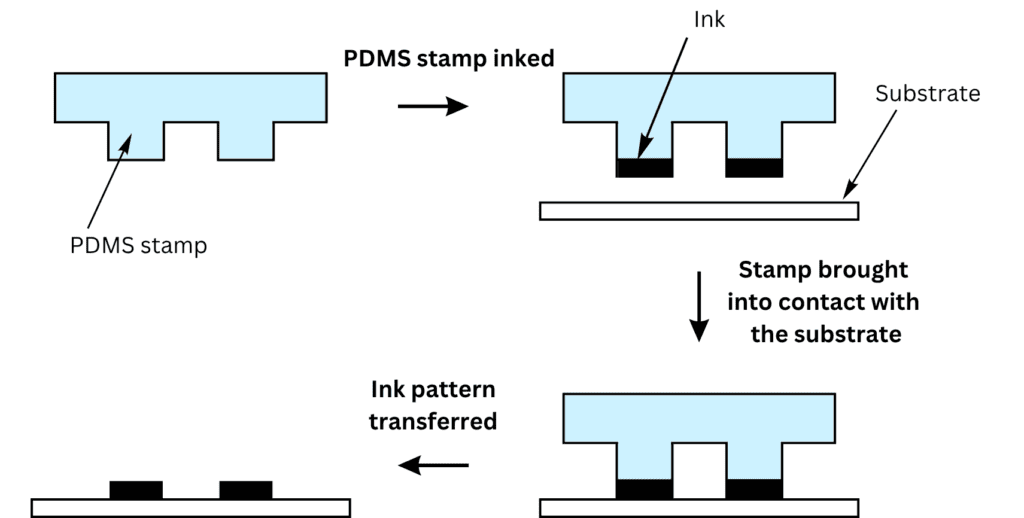
Un tampon en PDMS structuré est enduit d'une « encre » moléculaire et mis en contact avec un substrat pour transférer des molécules sélectionnées sur la surface. Le motif transféré peut contenir des protéines, de l'ADN, des nanoparticules ou d'autres matériaux fonctionnels.
Contrairement au moulage par réplique, qui crée des structures physiques, l'impression par microcontact est principalement utilisée pour concevoir la chimie de surface et les interfaces biologiques.
Avantages de l'impression par microcontact
Plusieurs propriétés rendent l'impression par microcontact particulièrement adaptée à la structuration biomoléculaire et à l'ingénierie de surface dans les applications biologiques et microfluidiques :
- Fonctionnalisation de surface précise
- Contrôle spatial élevé du positionnement des biomolécules
- Compatible avec les matériaux biologiques
- Procédé de fabrication économique
🚨 Limites : L'impression par microcontact peut souffrir d'une fidélité de motif réduite sur de grandes surfaces, d'un transfert d'encre non uniforme et d'une déformation du tampon en élastomère, ce qui peut affecter la reproductibilité dans certaines applications.
Applications typiques de l'impression par microcontact
L'impression par microcontact est couramment utilisée pour la structuration de protéines, la fabrication de biosenseurs, les substrats de culture cellulaire et la fonctionnalisation de surface dans les applications biomédicales et microfluidiques.
Micro-moulage dans des capillaires (MIMIC)
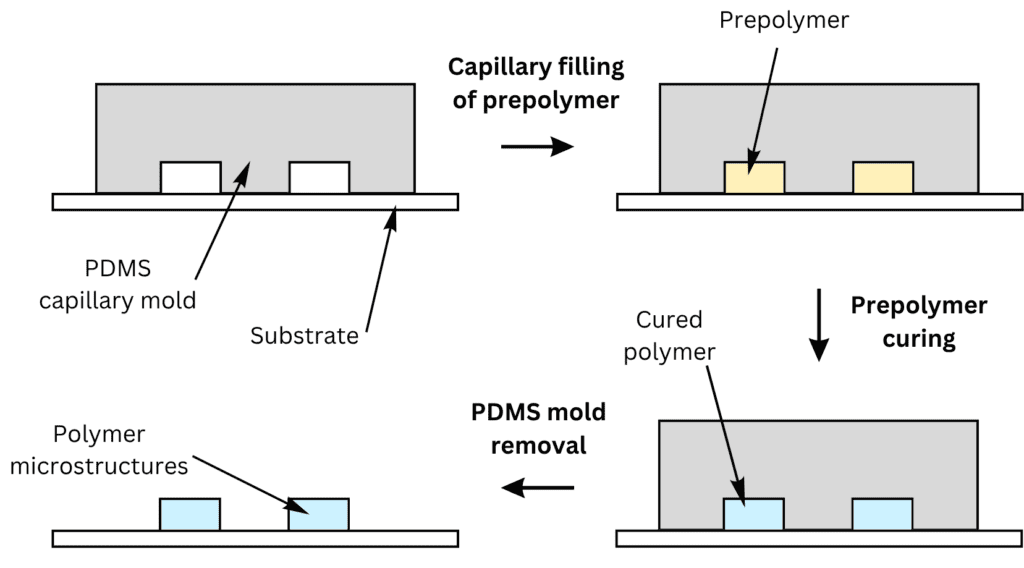
Le micro-moulage dans des capillaires (MIMIC) est une méthode de lithographie douce qui utilise les forces capillaires pour guider des matériaux liquides dans des microstructures prédéfinies.
Un moule en PDMS est placé sur un substrat, créant un réseau de canaux vides. Un prépolymère liquide est introduit à l'entrée du canal et remplit spontanément la structure par action capillaire avant la réticulation.
Le procédé ne nécessitant ni pompage externe ni systèmes de pression, le MIMIC offre une approche simple pour fabriquer des microstructures continues.
Avantages du micro-moulage dans des capillaires
Plusieurs caractéristiques rendent le micro-moulage dans des capillaires particulièrement adapté à la fabrication de microstructures continues et de géométries microfluidiques complexes :
- Fabrication à faible coût
- Capacité à créer des structures à grand rapport de forme
- Bon contrôle des dimensions des structures
- Compatible avec divers matériaux polymères
🚨 Limitations : Le MIMIC repose sur un remplissage capillaire efficace, ce qui le rend sensible à la formation de bulles d'air, à un remplissage incomplet et aux variations des propriétés de mouillage de surface.
Applications typiques du micromoulage en capillaires
Le micromoulage en capillaires est couramment utilisé pour la fabrication de canaux microfluidiques, de microréacteurs, de dispositifs de type laboratoire sur puce et de plateformes d'administration de médicaments nécessitant des microstructures structurées en continu.
Moulage par microtransfert (µTM)
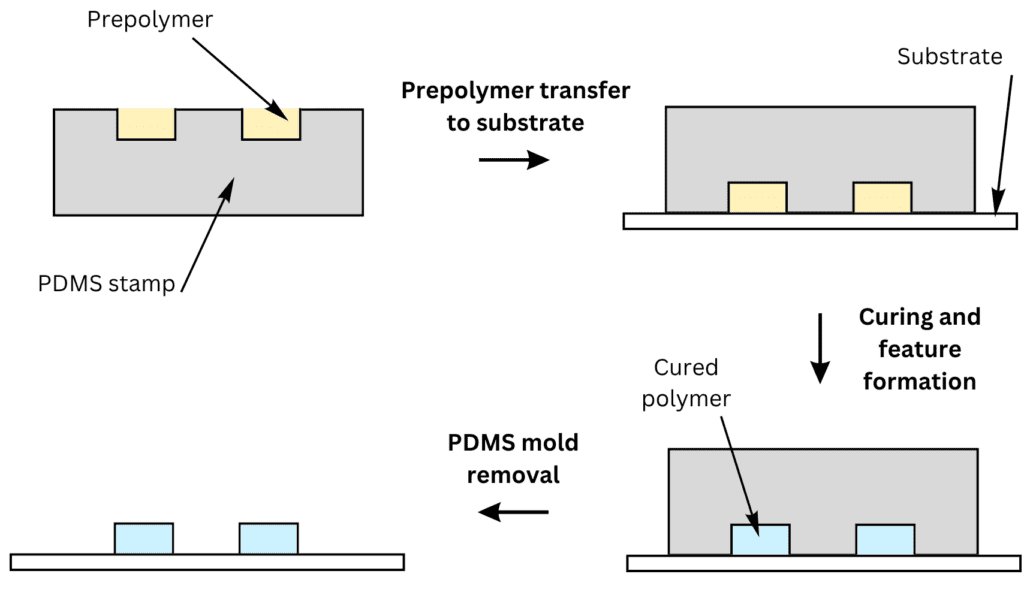
Le moulage par microtransfert est une technique de réplication dans laquelle un prépolymère liquide est déposé dans un moule structuré puis transféré sur un substrat.
Après cuisson, le matériau transféré forme des structures à l'échelle micrométrique avec une haute résolution et une bonne fidélité structurelle. Cette technique est particulièrement utile lorsque plusieurs matériaux ou des architectures multicouches sont nécessaires.
Le moulage par micro-transfert permet la fabrication de géométries complexes tout en maintenant des conditions de traitement relativement simples.
Avantages du moulage par micro-transfert
L'utilisation croissante du moulage par micro-transfert en microfabrication est drive par plusieurs avantages clés :
- Réplication de motifs à haute résolution
- Adapté aux dispositifs microfluidiques multicouches
- Large compatibilité des matériaux
- Faible coût de fabrication
- Bonne uniformité des motifs
🚨 Limitations : Le moulage par micro-transfert nécessite un alignement précis du moule et un transfert de matière contrôlé. Des défauts tels qu'un remplissage incomplet ou un désalignement des couches peuvent altérer les performances du dispositif.
Applications typiques du moulage par micro-transfert
Le moulage par micro-transfert est couramment utilisé pour fabriquer des dispositifs microfluidiques multicouches, des structures polymères à motifs, des dispositifs à base d'hydrogel et des microsystèmes nécessitant une réplication de motifs à haute résolution.
Lithographie par nano-impression
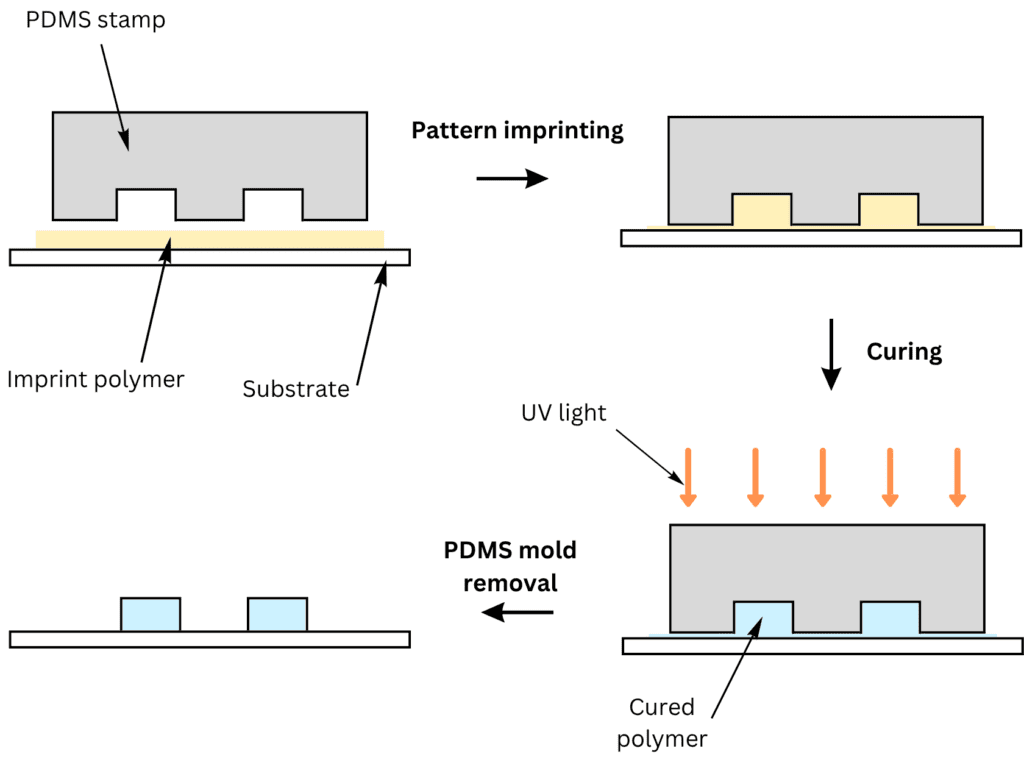
La lithographie par nano-impression étend les principes de la lithographie molle à la fabrication à l'échelle nanométrique. Dans cette technique, un moule texturé embosse mécaniquement une fine couche de polymère pour générer des nanostructures dotées d'une résolution extrêmement élevée.
Le procédé permet d'obtenir des structures bien en deçà des dimensions généralement accessibles par les approches de microfabrication standard, ce qui le rend particulièrement attractif pour la nanofluidique et les applications avancées de biosensoring.
Avantages de la lithographie par nano-impression
La lithographie par nano-impression suscite un intérêt significatif en micro- et nanofabrication en raison de plusieurs avantages clés :
- Capacité de résolution à l'échelle nanométrique
- Fidélité et précision élevées des motifs
- Excellente uniformité des structures à travers les motifs
- Adaptmée à la fabrication sur de grandes surfaces
- Compatibilité avec les applications de dispositifs nanofluidiques
🚨 Limitations : La lithographie par nano-impression requiert des moules de haute précision et des conditions de traitement contrôlées ; de plus, des défis tels que l'usure du moule, les défauts de motifs et la flexibilité limitée dans la structuration 3D peuvent restreindre certaines applications.
Applications typiques de la lithographie par nano-impression
La lithographie par nano-impression est couramment employée pour la nanofabrication de dispositifs photoniques, de biosenseurs, de composants nanoélectroniques et de systèmes nanofluidiques nécessitant un modelage nanométrique précis.
Autres techniques de lithographie molle
Bien que les techniques décrites ci-dessus représentent les approches les plus largement utilisées, plusieurs autres méthodes de lithographie molle ont émergé pour des applications de microfabrication et de microfluidique spécialisées. Bien que moins courantes, ces approches peuvent offrir des avantages uniques selon le matériau, la géométrie ou les exigences de fabrication.
Micromoulage assisté par solvant (SAMIM)
Le micromoulage assisté par solvant utilise un solvant pour ramollir la surface d'un polymère avant le transfert de motifs à partir d'un moule. Il est principalement utilisé pour fabriquer des micro- et nanostructures sur des matériaux thermoplastiques tout en évitant des températures de traitement élevées.
Impression par nanotransfert (nTP)
L'impression par nanotransfert est une technique de modelage additif à haute résolution qui transfère des structures métalliques nanostructurées d'un tampon en silicium ou en PDMS vers des substrats, tels que le verre ou des polymères, en utilisant des couches de libération et d'adhésion contrôlées par chimie de surface. Capable de produire des structures inférieures à 100 nm, le nTP est largement utilisé dans l'électronique, la détection chimique, la plasmonique et d'autres applications nanotechnologiques.
Comparaison des techniques de lithographie souple
Chaque technique de lithographie souple offre des avantages distincts en termes de résolution, de complexité de fabrication, de compatibilité des matériaux et d'application visée. Le tableau ci-dessous résume les principales différences entre les techniques de lithographie souple les plus couramment utilisées en microfluidique.
| Technique | Utilisation type | Résolution | Complexité | Principal atout |
|---|---|---|---|---|
| Moulage par réplication | Fabrication de dispositifs microfluidiques généraux | De l'échelle micro à nano | Faible | Réplication simple et économique |
| Impression par microcontact | Structuration de surface et biofonctionnalisation | De l'échelle micro à nano | Faible à modérée | Structuration précise de surface |
| Micromoulage en capillaires | Fabrication de microstructures complexes | Échelle micro | Modéré | Formation de structures drive par capillarité |
| Moulage par microtransfert | Microfabrication multicouche | Échelle micro haute résolution | Modérée à élevée | Fabrication multicouche haute fidélité |
| Lithographie par nano-impression | Nanofabrication et nanofluidique | Échelle nano | Élevée | Résolution nanométrique |
Choisir la bonne technique de lithographie douce
La sélection de la technique de lithographie douce la plus adaptée dépend de la résolution requise, de la compatibilité des matériaux, de la complexité de fabrication et de l'application microfluidique visée.
- Moulage par réplique (REM) → lorsqu'une fabrication rapide et économique de dispositifs microfluidiques standard en PDMS est nécessaire
- Impression par micro-contact (µCP) → lorsqu'un structurage biomoléculaire ou de surface précis est requis
- Moulage en capillaire (MIMIC) → lorsque des microstructures continûes et un remplissage piloté par capillarité sont avantageux
- Moulage par micro-transfert (µTM) → lorsque des architectures multicouches ou des géométries de dispositifs plus complexes sont nécessaires
- Lithographie par nanoimpression (NIL) → lorsque la résolution nanométrique et une haute fidélité des motifs sont critiques
💡 Conclusion
La lithographie douce englobe plusieurs techniques de fabrication complémentaires qui permettent la production de dispositifs microfluidiques, de motifs de surface et de structures nanométriques. Du moulage par réplique et de l'impression par micro-contact au MIMIC, au moulage par micro-transfert et à la lithographie par nanoimpression, chaque méthode offre des avantages uniques qui la rendent adaptée à des applications microfluidiques spécifiques, allant de la caractérisation biologique au développement de microsystèmes avancés en laboratoire de recherche.
Restez à l'écoute pour plus d'aperçus sur la lithographie douce, la microfabrication, la microfluidique sur PDMS et d'autres techniques qui drive l'innovation dans les dispositifs microfluidiques 🔬 !
📧 Si vous avez des questions ou des commentaires, n'hésitez pas à nous contacter à l'adresse contact@darwin-microfluidics.com.
❓ FAQ : La lithographie douce en microfluidique
Q1 : Quels sont les principaux types de techniques de lithographie douce ?
Le moulage par réplique, l'impression par micro-contact, le moulage en capillaire (MIMIC), le moulage par micro-transfert et la lithographie par nanoimpression comptent parmi les techniques de lithographie douce les plus largement utilisées.
Q2 : Quelle technique de lithographie douce est la plus couramment utilisée en microfluidique ?
Le moulage par réplique est la technique la plus couramment utilisée car il permet une fabrication rapide et économique de dispositifs microfluidiques à base de PDMS.
Q3 : Quelle est la différence entre le moulage par réplique et l'impression par micro-contact ?
Le moulage par réplique crée des microstructures physiques, tandis que l'impression par micro-contact transfère des molécules ou des matériaux sur une surface pour créer des revêtements structurés.
Q4 : Quelle technique de lithographie douce est la mieux adaptée au structurage de biomolécules ?
L'impression par micro-contact est largement utilisée pour structurer des protéines, de l'ADN, des cellules et d'autres biomolécules sur des surfaces avec une haute précision spatiale.
Q5 : Les techniques de lithographie douce permettent-elles de créer des structures nanométriques ?
Oui. Des techniques telles que la lithographie par nanoimpression et l'impression par nanotransfert peuvent produire des caractéristiques dont les dimensions se situent dans la plage du nanomètre.
Q6 : Quelle technique de lithographie douce est la mieux adaptée aux dispositifs microfluidiques multicouches ?
Le moulage par micro-transfert est particulièrement adapté à la fabrication de structures multicouches et à l'intégration de plusieurs couches fonctionnelles au sein d'un même dispositif.
Q7 : Comment choisir la bonne technique de lithographie douce ?
Le choix dépend de la résolution requise, de la compatibilité des matériaux, de la complexité de fabrication et de l'application visée du dispositif final.

🔗 Références
Alexandre-Franco, María F. et al. Recent Advances in Polymer Science and Fabrication Processes for Enhanced Microfluidic Applications: An Overview. Micromachines 2024, 15(9): 1137. https://doi.org/10.3390/mi15091137
Maier, Thomas L. et al. (2020). Lateral silicon oxide/gold interfaces enhance the rate of electrochemical hydrogen evolution reaction in alkaline media. J. Chem. Phys. , 152 (15): 154705. https://doi.org/10.1063/5.0003295
Kim, Pilnam et al. (2008). Soft Lithography for Microfluidics: a Review. Biochip Journal. 2(1).
Qin, D., Xia, Y. & Whitesides, G. Soft lithography for micro- and nanoscale patterning. Nat Protoc 5, 491–502 (2010). https://doi.org/10.1038/nprot.2009.234