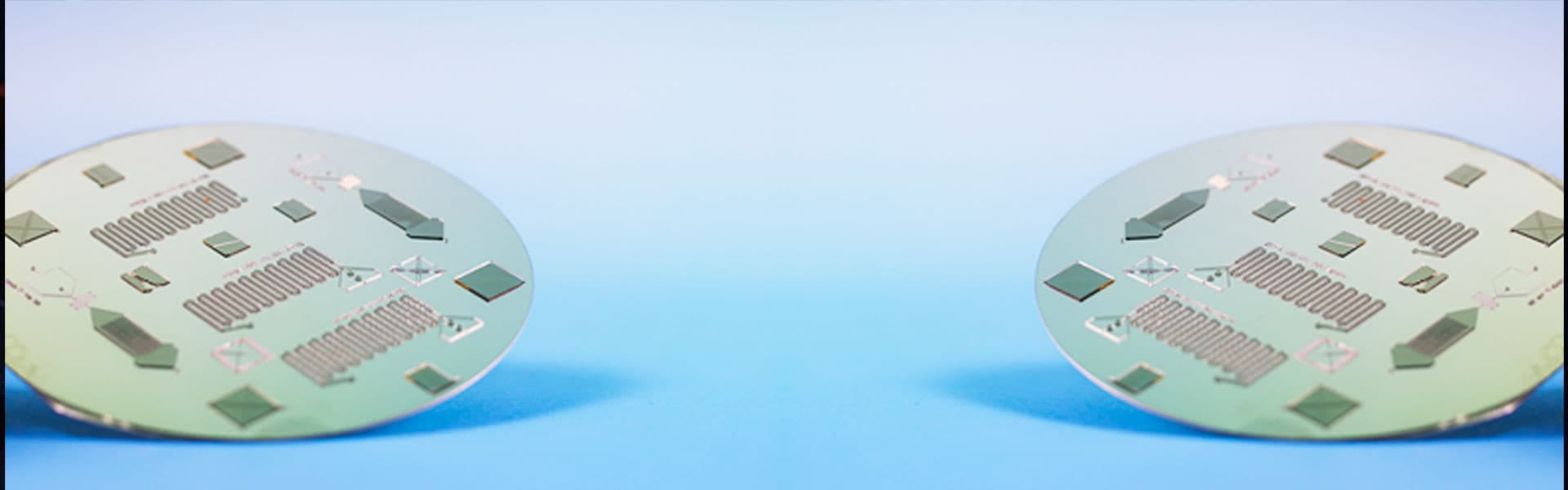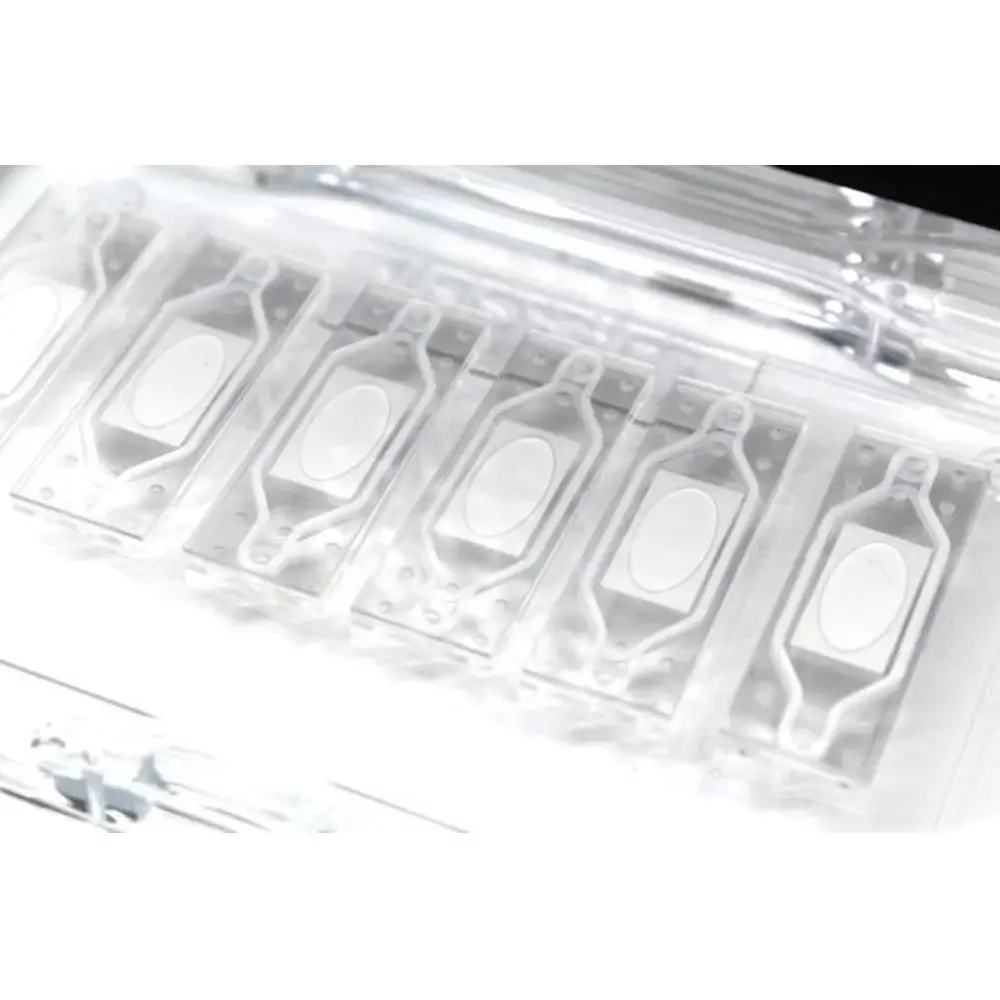

Les chercheurs se sont principalement orientés vers des polymères tels que le PDMS pour fabriquer leurs dispositifs microfluidiques. Cependant, c'est bien avec le verre et le silicium que les premiers dispositifs microfluidiques ont été créés, notamment pour la chromatographie en phase liquide et gazeuse. Ces matériaux présentent de nombreux avantages pour une large gamme d'applications.
We will compare 3 microfabrication processes that make it possible to transform these materials into microfluidic devices: surface micromachining, buried channel techniques and bulk micromachining.
Micromachinage de surface
The surface micromachining technique consists of the use of a sacrificial layer which is shaped to define the desired fluid channels, then a structural layer is deposited and finally the sacrificial layer is etched. It should be noted that although surface micromachining offers greater potential for the fabrication of multilayer devices compared to mass micromachining, it nevertheless involves more process steps per layer. A number of promising surface micromachined microfluidic devices have been reported [James CD et al. 2006 J Micromech Microeng]. Surface micromachining is particularly interesting for the fabrication of nano-channels. Indeed, the thickness of the sacrificial layer that corresponds to the final height of the channel can easily be controlled to the nearest nanometre. Bulk micromachining, on the other hand, cannot offer such channel height control due to spatial variations in etching speed.
Buried channel technology
In buried channel technology, the idea is to create a deep access trench by direct anisotropic deep reactive ion etching (DRIE) of silicon. The side walls are passivated by chemical vapour deposition (CVD), and a circular channel is then isotropically etched, with the bottom of the access trench centrally located [Paick SJ et al. Sens Actuators A]. Moreover, this technology is successful when very deep and narrow access features are used. This requires micron-scale lithography and a high aspect-ratio DRIE.
A variant of this technique is also widely used: DRIE’s isotropic method is used to etch bulk silicon under a perforated silicon nitride mask. Then, the CVD technique is used to seal the access holes in the mask [Dijksta M et al. 2007 J Micromech Microeng]. The downside of this method is the mechanical stability of the thin-film roof, which is a limitation in some applications.
Micromachinage en volume
L'approche de fabrication encore la plus largement utilisée aujourd'hui est sans aucun doute le micro-usinage de masse. Dans cette méthode, les canaux micro- et nanofluidiques sont formés en retirant l'excès de matière d'une tranche et en la liant ou en l'adhérant à une autre tranche pour encapsuler les canaux.
In the table below, you will find protocols allowing you to choose different microfabrication options according to your application using glass and/or silicon. To go further, this table also gives you information on the different processes involved in microfabrication such as bonding methods or fluid connection.
Étape | Sélection à effectuer | Voie A | Voie B |
1 | Matériaux impliqués dans le processus de microfabrication | – Verre/verre (choisir cette voie si l'application exige la transparence optique du dispositif) | – Verre/Silicium (une voie plus courante et bien établie) |
2 | Méthode de structuration : Microcanaux | –Gravure humide dans HF/HCl* -Gravure sèche (recommandée uniquement si des parois verticales ou des structures à rapport d'aspect élevé sont requises) | –Gravure sèche du silicium -For complex microfluidic devices requiring multiple channel layers, the silicon wafer can be patterned on both side and via holes etched through the wafer to connect them ; alternatively, the glass can be patterned (by wet etching) as well as the silicon |
2 | Méthode de structuration : Trous traversants pour ports fluidiques | – Gravure humide – Sablage – Perçage | – Gravure sèche – Forage laser – Sablage |
| 3 | Méthode de liaison : Sans connexion électrique et l'appareil fonctionne au-dessus de 200 °C | –Liaison par fusion -Liaison anodique avec une couche métallique ou a:Si | – Liaison anodique |
| 3 | Méthode de liaison : Sans connexion électrique et l'appareil fonctionne en dessous de 200 °C | –Liaison adhésive -Liaison anodique avec une couche métallique ou a :Si -Liaison par fusion | – Liaison anodique – Collage adhésif |
| 3 | Méthode de liaison : Avec connexion électrique et l'appareil fonctionne au-dessus de 200 °C | – Liaison anodique (l'épaisseur de la couche métallique peut être critique) -Liaison par couche intermédiaire | – Liaison anodique (l'épaisseur de la couche métallique peut être critique) |
| 3 | Méthode de liaison : Avec connexion électrique et l'appareil fonctionne en dessous de 200 °C | –Liaison adhésive -Liaison anodique (l'épaisseur de la couche métallique peut être critique) |
– Liaison adhésive – Liaison anodique (l'épaisseur de la couche métallique peut être critique) |
| 4 | Connexions fluidiques | – Permanent : push-fit tubing into polymer ports (optionally fix with glue or PDMS) – Permanently attached ferrule with removable capillary (e.g., Nanoport) – Temporary : push-fit capillary tubing into PDMS device (permanent if PDMS is plama-treated) – Mechanically clamped chip-holder |
Permanent : push-fit tubing into polymer ports (optionally fix with glue or PDMS) – Permanently attachted ferrule with removable capillary (e.g., Nanoport) – Temporary : push-fit capillary tubing into PDMS device (permanent if PDMS is plama-treated) – Mechanically clamped chip-holder |
* HF/HCl : Solution de fluorure d'hydrogène et de chlorure d'hydrogène
Tableau 1 : Sélection du procédé de fabrication selon les exigences de l'application (optiques, géométriques, électriques et thermiques). Les options de procédé préférées sont indiquées en gras. Extrait de Iliescu et al. 2012 Biomicrofluidics