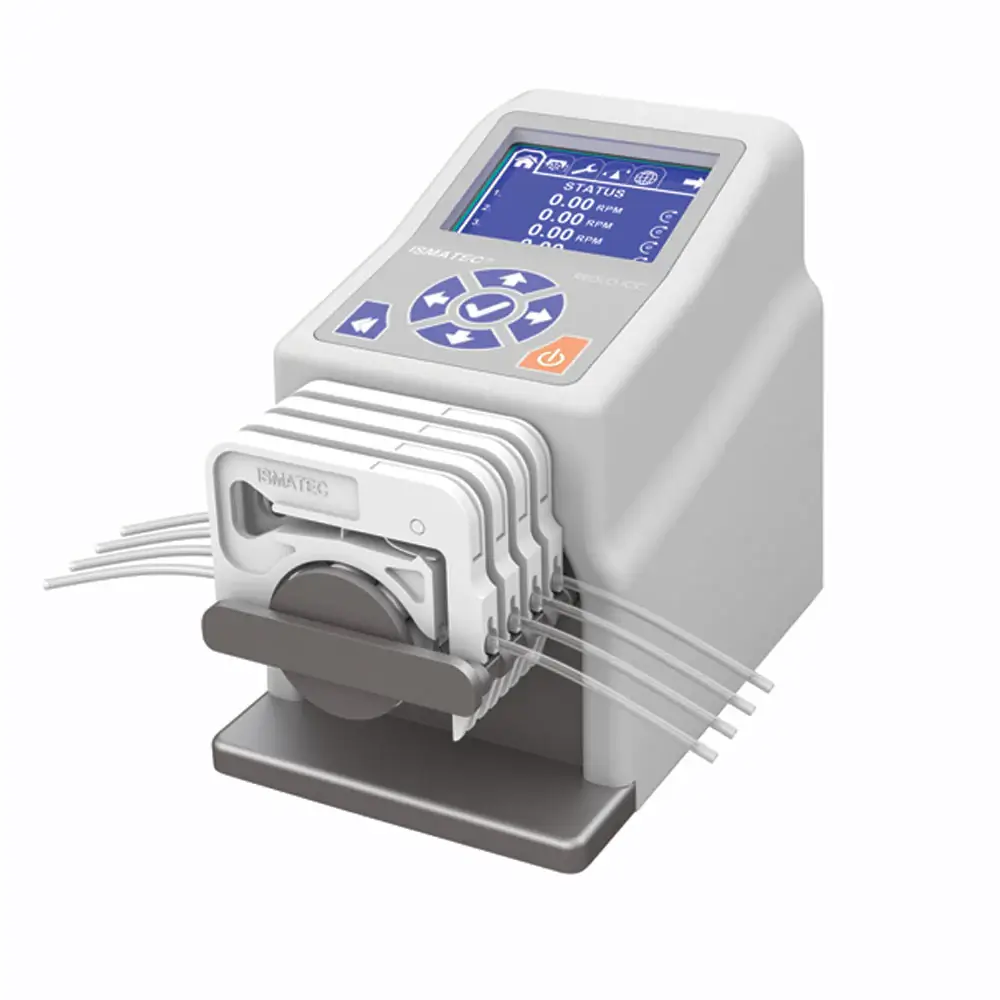

Les pompes péristaltiques sont des dispositifs utilisés pour le pompage de petits volumes de fluide dans les systèmes microfluidiques. Ce guide exhaustif couvrira les fondamentaux, y compris la construction, le principe de fonctionnement et les applications de ces pompes.
Que vous soyez chercheur ou étudiant, cet article vous fournira tout ce que vous devez savoir sur les pompes péristaltiques.
Que sont les pompes péristaltiques microfluidiques et comment fonctionnent-elles ?
Peristaltic pumps are a type of mechanical pump designed specifically to handle liquids in small volumes and with precise flow control. They work by forcing liquid through flexible tubing rather than valves, creating peristaltic action.
These peristaltic pumps reduce the risk of contamination, making them ideal for use in sensitive environments. The pump head applies pressure to the flexible tubing, squeezing and pushing any liquid within it through the length of the tubing and controlling its speed.
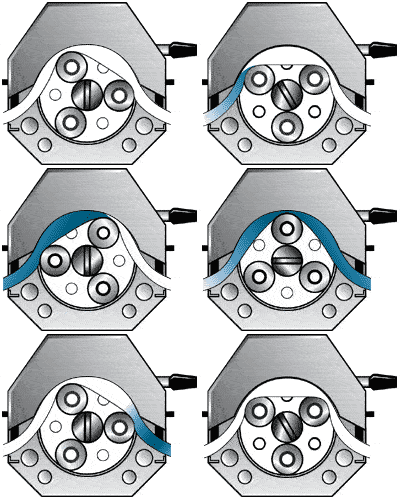
De plus, ces pompes péristaltiques ne comportent aucun joint et ont des coûts de maintenance minimaux, ce qui en fait une solution très recherchée pour les laboratoires et autres environnements contrôlés. En comprenant leurs composants et leur cycle de fonctionnement, vous pouvez déterminer comment utiliser efficacement les pompes péristaltiques dans vos applications microfluidiques.
What are the components of a peristaltic pump?
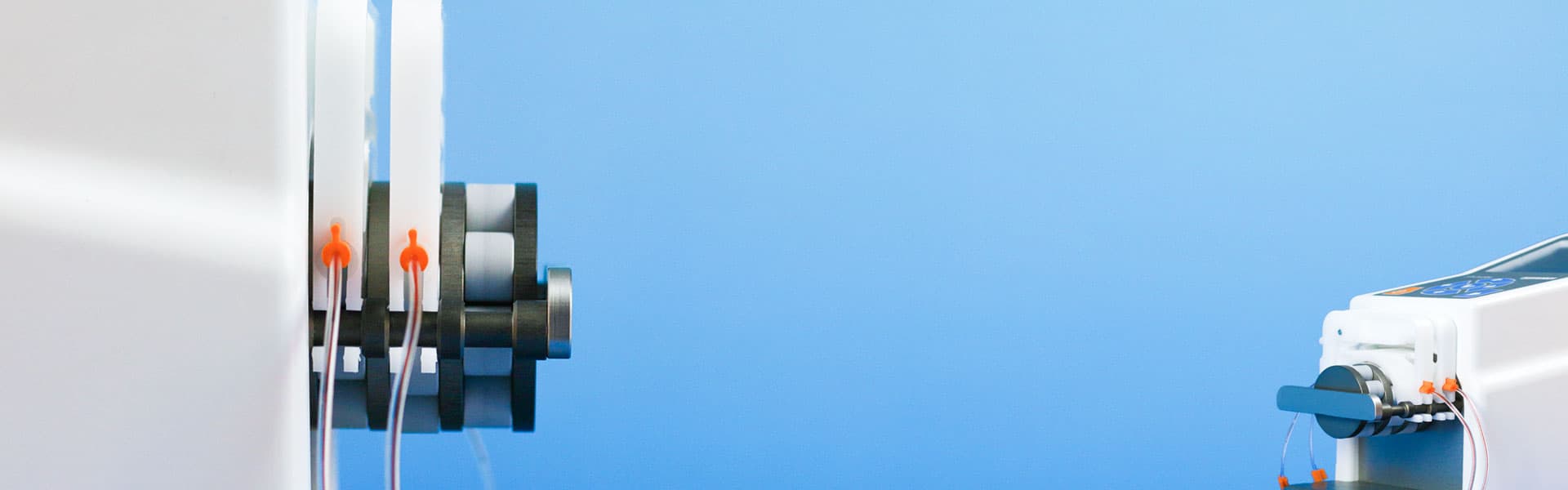
A peristaltic pump has three main parts: a pump driver, a pump head, and some special tubing:
Contrôleur de pompe
A pump driver contains the motor and controller of the peristaltic pump. One or several pump heads can be attached to it.
Tête de pompe
A pump head is the part of a peristaltic pump that is attached to the pump driver. It is usually constructed from metal or plastic and is designed to keep the pump rollers in place as they rotate. A broad range of pump heads exists, with 1 up to 12 rollers, one channel or multichannel capability, and different tubing compatibilities.
Tubing

Peristaltic pump tubing is a special tubing used inside of a peristaltic pump. Generally, a given pump head only accepts a restricted range of tubing sizes. Some pump heads only accept tubing with stoppers to hold it in position. Depending on the tubing you choose, you may get more or less pulsing in the fluid as it moves through the pump.
The benefits and disadvantages of using a peristaltic pump
✅Les pompes péristaltiques constituent la solution idéale pour de nombreuses situations industrielles et de laboratoire :
They contain a pump head that is easy to access and replace, meaning minimal downtime for maintenance tasks. This makes them one of the most cost-effective solutions available.
Les pompes péristaltiques sont d'une fiabilité remarquable, avec de très faibles taux de défaillance grâce à leur construction simple, ce qui en fait un choix idéal pour de nombreuses applications où la fiabilité est essentielle.
Open reservoirs make them ideal for recirculation.
❗When it comes to using a peristaltic pump, there are several cons that should be taken into account:
First, the tubing must be replaced regularly in order to ensure proper operation, as it will eventually wear out from regular use.
Les pompes péristaltiques ne peuvent pas atteindre de très faibles débits (inférieurs à 1 µL/min).
When using a peristaltic pump, it is important to consider the pulsatility of the flow rate caused by the rollers.
💡Pulsatile flows can be desirable in certain applications, such as sample collection, or organ-on-chip. However, they can also cause problems such as inaccuracy and flow fluctuation, especially for very low-flow applications.
Dans l'ensemble, les pompes péristaltiques microfluidiques sont des dispositifs très utiles et fiables, capables d'assurer un contrôle précis du débit dans différents types d'applications. Elles nécessitent un entretien minimal, ce qui en fait un choix idéal pour les laboratoires et autres environnements contrôlés. Grâce à ce guide, vous avez désormais une meilleure compréhension des principes fondamentaux de ces pompes, ce qui vous permettra de prendre une décision éclairée lorsque vous envisagerez des pompes péristaltiques pour vos applications.
Les différents types de pompes péristaltiques
The discussion about difference between hose pumps and peristaltic pumps is often a topic of debate, yet there are very few actual differences between these two types of pumps. In the most basic sense, peristaltic pumps use a peristaltic action to move fluid, while hose pumps use the same mechanism to squeeze a reinforced hose.
The term "hose pump" is mostly used to describe peristaltic pumps that are designed to move large volumes of liquid or slurry at high pressure, making them well-suited for many applications such as pumping abrasive and corrosive media. These are typically industrial peristaltic pumps.
There are many types of peristaltic pumps and they all have unique components, so we will describe those used to handle small volumes.
Depending on the application, peristaltic pumps might come with various features like a pump head and tubing design tailored to deliver specific amounts of flow, as well as accessories capable of interfacing with the control system.
Some peristaltic pumps even feature manual controllers, meaning all functions can be adjusted without connecting to a computer. Ultimately, knowing which peristaltic pump type suits your needs will help ensure efficient operation and durability.
Single-roller peristaltic pump:
A single-roller pump is a type of peristaltic pump with a simple design and construction that makes it both reliable and cost-efficient. The pump head has just one roller that presses against the flexible tubing, squeezing and pushing liquid through it while controlling the speed or flow rate.
❗Nous ne recommandons pas son utilisation pour les applications microfluidiques❗
Multi-roller peristaltic pump:
Multi-roller peristaltic pumps are a type of pump that is designed for more precise and efficient flow control. This type of pump consists of two or more rollers that press against the flexible tubing, squeezing it as they rotate. The shape, speed and number of rollers can all be adjusted to improve efficiency and flow rate accuracy.
Il convient de noter que plus le nombre de galets est élevé, moins la pulsatilité est importante !
Le type le plus polyvalent pour s'adapter à vos applications microfluidiques 😉
Independent channel peristaltic pump:
Independent channel peristaltic pumps are an advanced type of pump that offers a unique advantage over traditional models: they are capable of controlling multiple channels of fluid simultaneously.
Cette configuration peut vous faire économiser une quantité significative d'espace sur la paillasse de laboratoire. Non seulement cela est utile dans les laboratoires où l'espace est limité, mais cela permet également un fonctionnement plus efficace.
How to choose the right peristaltic pump for your needs?
Choosing the right peristaltic pump for your needs doesn’t have to be complicated. Start by determining the required flow rate and volumes, then consider the materials that will come into contact with the pumped fluid.
The pump head is one of the most important features to consider when selecting a peristaltic pump – you’ll want to make sure that it’s compatible with the other components in your system. Furthermore, ensuring compatibility between the pump tube material and your fluid is essential; various types of peristaltic pumps are designed for different liquids, so research thoroughly before getting started.
Enfin et surtout, votre budget sera une condition importante. De nombreuses marques proposent des fonctionnalités qui ne correspondent pas nécessairement à votre projet, ce qui peut se refléter dans le prix final.
Heureusement, depuis un certain temps, le nombre de modèles n'a fait qu'augmenter. Dans la plupart des cas, vous trouverez un modèle qui correspondra à vos exigences.
Nous proposons une large gamme de pompes, n'hésitez donc pas à y jeter un œil 😉
💡 Tips for using a peristaltic pump
Using a peristaltic pump correctly can make all the difference when it comes to pumping small volumes of liquid. Firstly, always ensure that the peristaltic pump is securely connected to the required power source and that the tubing is inserted properly into the pump head.
Secondly, consider choosing a peristaltic pump that has adjustable settings as this can allow for more flexible use, allowing you to customize settings such as flow rate and rotation speed depending on your specific project requirements.
Finally, remember to regularly check for signs of wear and tear in both the tubing and the peristaltic pump itself to guarantee efficient performance whenever you need it, so that your peristaltic pumps will remain reliable and accurate for years to come!
🧠 Ce qu'il faut retenir
Les pompes péristaltiques sont un type de pompe volumétrique idéal pour le pompage de petits volumes de fluide dans les systèmes. Ces pompes offrent de nombreux avantages, notamment d'être auto-amorçantes, adaptables à différentes pressions système et portables.
The right pump for your needs will depend on the application and desired flow rate.
When using a peristaltic pump, be sure to keep the following tips in mind:
- Use clean tubing free of debris or damage.
- Assurez un alignement correct entre toutes les parties de la pompe.
- Inspectez régulièrement la pompe afin de détecter d'éventuelles fuites ou autres anomalies.
With this information in hand, you should be well on your way to choosing and using the perfect peristaltic pump for your needs! 😁