Définition de l'hydrophobie
L'hydrophobie est la propriété physique d'une molécule ou d'une substance qui la pousse à repousser l'eau. C'est un phénomène fascinant aux applications diverses, allant de la conception de vêtements hydrofuges à la création de dispositifs microfluidiques.
Comprendre l'hydrophobie
The term ‘hydrophobic’ comes from the Greek words ‘hydro’ (water) and ‘phobos’ (fear), describing substances that resist mixing with water.
Water molecules are polar, meaning they have distinct positive and negative ends, which allows them to form hydrogen bonds with other polar molecules, including other water molecules. In contrast, hydrophobic molecules are typically non-polar and lack such distinct ends, preventing them from forming hydrogen bonds with water. Consequently, hydrophobic substances are poorly soluble in water and tend to aggregate with other hydrophobic molecules to minimize their exposure to water, often leading to phase separation.
Ce comportement est crucial dans la structure et la fonction des membranes biologiques, le repliement des protéines et l'interaction des substances chimiques dans les environnements aqueux, faisant de l'hydrophobie un concept fondamental en chimie, en biologie et en microfluidique.
L'effet Lotus
A well-known example of natural hydrophobicity is the ‘lotus effect’. The leaves of the lotus plant are extremely hydrophobic, causing water to bead up and roll off, taking dirt and contaminants with it. This self-cleaning property has inspired the development of hydrophobic coatings and materials.
La feuille de lotus atteint ce niveau élevé d'hydrophobie grâce à sa structure de surface. De minuscules protubérances cireuses à la surface de la feuille empêchent l'eau de s'étaler, ce qui fait que les gouttelettes se posent sur ces protubérances et roulent facilement.
Mesure de l'hydrophobie
Hydrophobicity is not a binary property; it exists on a spectrum. Some materials are more hydrophobic than others, and this can be quantified using the contact angle. The contact angle is the angle formed at the interface between a liquid/vapor and a solid surface. The higher the contact angle, the more hydrophobic the surface.
For instance, a perfectly hydrophilic (water-attracting) surface has a contact angle of 0 degrees, meaning water spreads out completely. In contrast, a highly hydrophobic surface may have a contact angle of 120 degrees or more, causing water to bead up and roll off.
L'hydrophobie en microfluidique
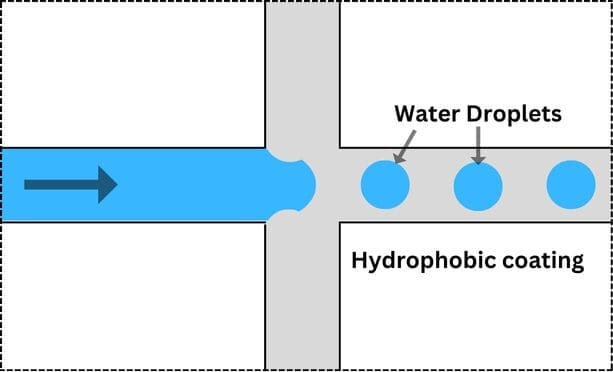
One primary use of hydrophobicity in microfluidics is in the design of microchannels. By making channel walls hydrophobic, scientists can control the movement of water-based solutions, directing fluid flow, separating different fluids, or even creating droplets of one fluid within another.
Techniques de modification de surface
To create hydrophobic surfaces for microfluidics, various modification techniques are employed. One common method is chemical modification, where hydrophobic molecules are bonded to the surface. Techniques like silanization, where a silane molecule with a hydrophobic end is attached to the surface, are often used.
La modification physique est une autre approche, consistant à altérer la structure de la surface pour accroître l'hydrophobie. Cela implique la création de micro ou nanostructures à la surface, à l'instar des protubérances de la feuille de lotus, afin d'augmenter l'angle de contact et d'améliorer l'hydrophobie.
Microfluidique en gouttelettes
A particularly exciting application of hydrophobicity in microfluidics is droplet microfluidics. This involves creating, manipulating, and studying droplets within a microfluidic device. By combining hydrophobic and hydrophilic regions, scientists can form droplets of a water-based solution within an oil-based one, or vice versa.
Ces gouttelettes servent de réacteurs miniatures, permettant des réactions chimiques ou biologiques à micro-échelle. Cela a de nombreuses applications, de la découverte de médicaments à la science des matériaux, où un contrôle précis de la taille et de la composition des gouttelettes est essentiel.
Applications pratiques de l'hydrophobicité en microfluidique
L'hydrophobie présente de nombreuses applications pratiques, notamment en microfluidique. Du diagnostic médical à la surveillance environnementale, la capacité à manipuler les fluides à l'échelle microscopique transforme de nombreux domaines de la science et de la technologie.
Tests au point de service
One key application of hydrophobic surfaces is in lab-on-a-chip devices, which integrate multiple laboratory functions onto a single chip, making testing faster, cheaper, and more efficient. These devices are particularly promising for point-of-care testing, where diagnostic tests are conducted at or near the patient care site. By using hydrophobic surfaces to control fluid flow, lab-on-a-chip devices can perform complex processes like DNA sequencing or immunoassays on a chip no larger than a credit card.
For instance, in a microfluidic device designed for blood glucose testing, a hydrophobic surface can separate blood cells from plasma, directing the plasma into a separate channel for analysis while discarding the cells. This ability to conduct quick, minimally equipped tests is especially beneficial in remote or resource-limited settings.
Surveillance environnementale
Microfluidic devices are also valuable in environmental monitoring, such as water quality testing or pollutant detection. These devices can react with specific substances, changing color or producing a signal when the substance is present. Hydrophobic surfaces help confine these reactions to specific areas, improving sensitivity and accuracy.
For instance, a microfluidic device detecting heavy metals in water might use hydrophobic surfaces to create water droplets within an oil-based solution. Each droplet acts as a miniature reactor, changing color if heavy metals are present, enabling rapid, on-site water quality testing.
Conclusion
Hydrophobicity is a fascinating property with wide-ranging applications, particularly in microfluidics. From controlling fluid flow in microchannels to creating miniature droplet reactors, manipulating hydrophobicity is revolutionizing fluid control on a microscale.