In this review, we explore two of the most used designs for droplet generation: T-junction and flow focusing. First, we discuss how it is possible to predict droplet size in microfluidics. Then, we introduce the results we have obtained for two chips with two common fluorinated oils, based on the use of a controller pressure system and microfluidic devices offered at Darwin microfluidics.
Matériau
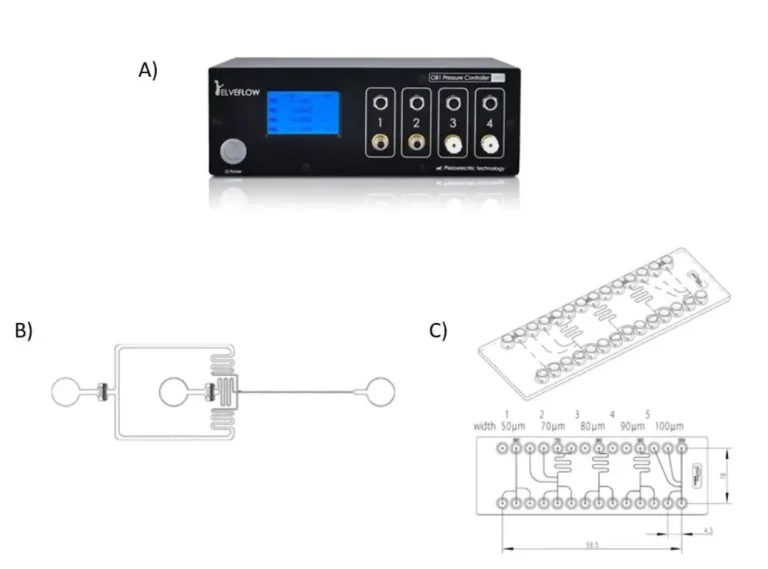
To perform our characterisation, we chose to use a pressure controller and two types of chips: a PDMS chip with a flow focusing geometry and a polycarbonate chip integrating different T-junctions designs (see figure 1).
Ces expériences nous ont permis d'évaluer la taille des gouttelettes en fonction des différentes géométries des systèmes de génération de gouttelettes, mais aussi en fonction du type d'huile utilisée (FluoDrop 40 et FluoDrop 7500 (avec 2% de FluoSurf) qui sont les huiles fluorées les plus couramment utilisées en microfluidique).
Comment prédire la taille de vos gouttelettes ?
The required step in all droplet-based devices is droplet formation. A droplet generator must deliver an application-specific performance that includes a prescribed droplet size and generation frequency while producing monodisperse droplets. The desired performance is usually reached through several cost- and time-inefficient design iterations.
To facilitate this stage of droplet generation, several studies have been carried out to predict the size of the droplets according to the geometry of the droplet generator and the viscosity of the continuous phase used.
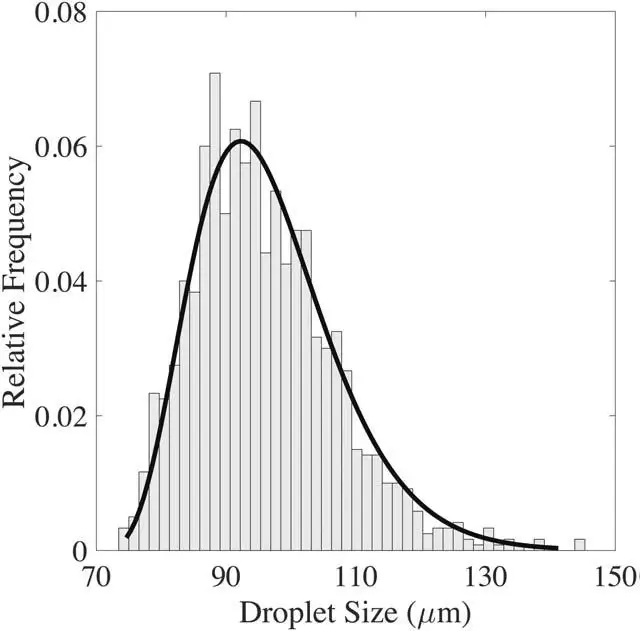
For example, Prileszky and coworkers demonstrate that the size of droplets produced in a T-junction is gamma-distributed (see figure 2), providing additional insight into the physics of the breakup process and the properties of emulsions generated in microfluidics. They show that the size of the droplets produced in a T-junction is distributed by gamma radiation, which allows a better understanding of the physics of the rupture process and the properties of the emulsions generated in microfluidics. Knowledge of the underlying probability distribution allows the control of droplet size for droplets made from viscous materials. Understanding how dispersed phase viscosity affects droplet size is essential to create droplets with the correct geometry and properties [Prileszky et al. 2016 AIChE Journal].
The gamma distribution seems to be the best-fitting model, even outperforming the more commonly used log-normal distribution, demonstrated by the large disparity between the Anderson-Darling statistics (this test measures the distance between a hypothesized distribution and the empirical model over the entire cumulative distribution function (cdf) of the hypothesized distribution) and associated p-values from representative probability plots.
The development of a probabilistic description of a physical process leads to the correlation of the measurements with the physical parameters. Without understanding the shape of the distribution of a random variable, systematic noise in experimental data directly translates into systematic errors in a proposed correlation. However, filtering out the noise by comparing an experimental distribution to a theoretical distribution makes it possible to better estimate the mean of the real distribution, by minimising the propagation of the error through regression analyses. Consequently, identifying the gamma distribution as representative of the variability in the size of droplets formed in a T-junction allows a more accurate correlation of droplet size with viscosity and flow rate of the dispersed phase [Prileszky et al. 2016 AIChE Journal].
Another technique for predicting drop size is numerical simulation via the COMSOL software. In this example, the process of droplet formation in a microfluidic flow-focusing device is investigated. Several findings were made: It was shown that the accuracy of the numerical solution increases with the water flow rate. Indeed, the average error decreased from 14.6 to 6.96 % by increasing the water flow rate from 0.3 to 0.6 μL/min. Then, the variation of the droplet radius as a function of the flow ratio and the number of capillaries was studied. It was shown that these two parameters were the main parameters affecting droplet size, rather than water and oil flow. Finally, it was shown that capillary number is more dominant in determining the droplet radius in comparison to flow ratio [Lashkaripour et al. 2015 JAMECH].
Caractérisation de la taille des gouttelettes pour deux puces standard (focalisation de flux et jonction en T)
Pour réaliser cette caractérisation, nous avons décidé d'évaluer la taille des gouttelettes générées par focalisation de flux et jonction en T avec 2 huiles fluorées largement utilisées en microfluidique. Dans le tableau suivant, vous trouverez les résultats obtenus.
| Droplet generator geometry | Taille des gouttelettes (µm) avec l'huile FluoDrop 40* | Taille des gouttelettes (µm) avec l'huile FluoDrop 7500* |
| Focalisation de flux (DG-DM1-45) | 20 → 79 | 21 → 93 |
| Jonction en T (CS-10000176) modèle 1 | 98 → 312 | 60 → 494 |
| Jonction en T (CS-10000176) modèle 2 | 18 → 70,002 | 12 → 70 |
| Jonction en T (CS-10000176) modèle 3 | 11 → 79 | 22 → 78 |
| Jonction en T (CS-10000176) modèle 4 | 94 → 484 | 96 → 387 |
| Jonction en T (CS-10000176) modèle 5 | 270 → 876 | 345 → 700 |
* La viscosité du HFE est de 0,77 cSt et la viscosité du FC40 est de 2,2 cSt
Selon la publication de Nekouei et Vanapalli (2017), l'interprétation de ces résultats montre que plus la viscosité de la phase continue est élevée, plus la taille des gouttelettes générées est petite.