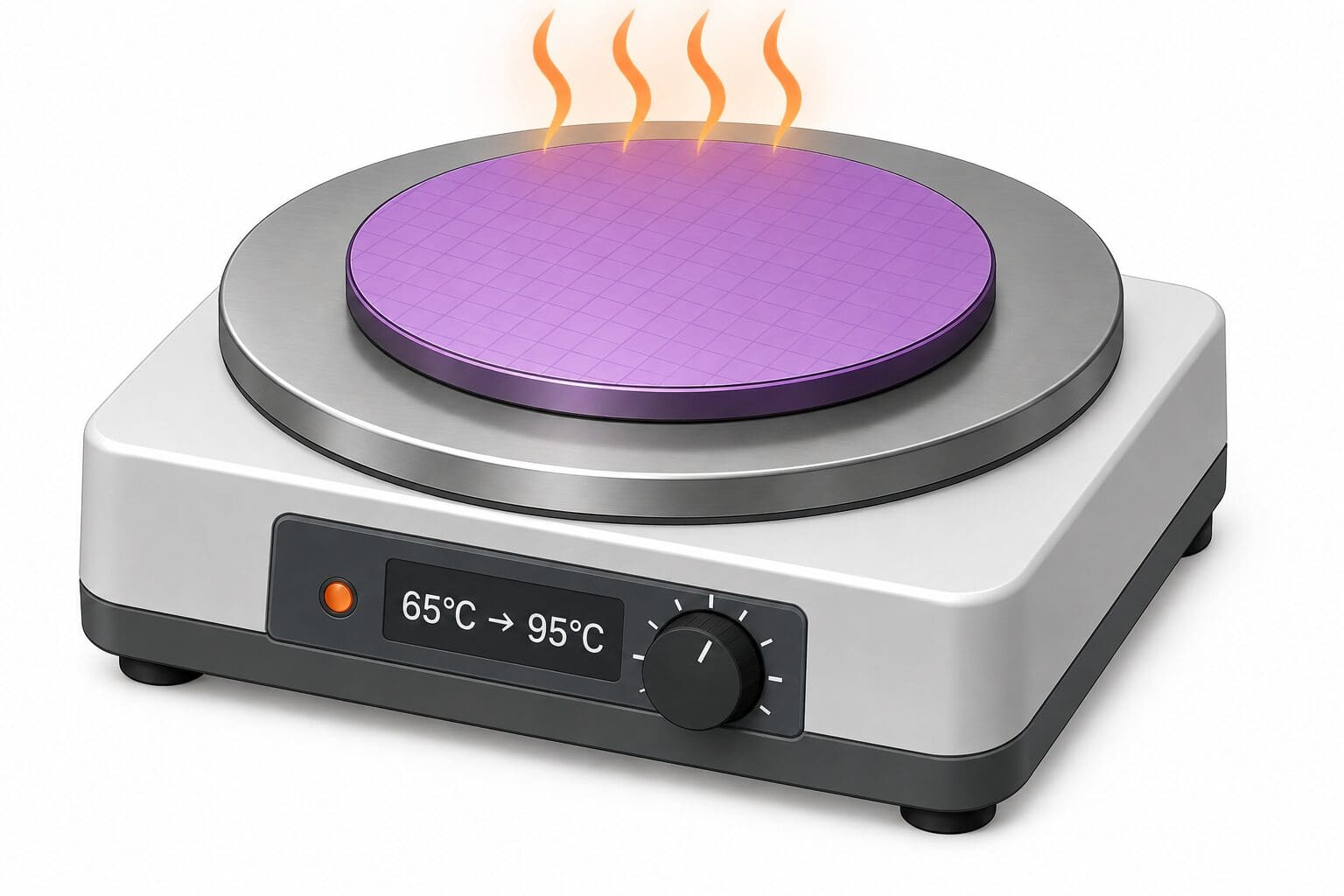

Baking is one of the most important parts of the SU-8 photolithography process. SU-8 undergoes several baking stages during fabrication, including the soft bake, post-exposure bake (PEB), and optional hard bake, each serving a specific purpose.
Proper control of the baking conditions is essential for achieving consistent results. Temperature uniformity, bake time, and heating and cooling rates can have a significant effect on the final pattern. Poorly controlled baking can result in residual solvent, internal stress, cracking, delamination, or distorted features.
This guide explains the main SU-8 baking steps, their typical temperature ranges, and the most common baking-related defects, with practical recommendations for achieving more consistent results.
The Role of Baking in SU-8 Photolithography
SU-8 baking plays an essential role in controlling the properties of the photoresist throughout the photolithography process. Proper thermal treatment helps remove residual solvent, stabilize the resist film, promote crosslinking, and improve the mechanical and chemical stability of the final structures.
SU-8 undergoes three main baking stages during fabrication, each performed at a specific point in the photolithography workflow:
- Soft bake: performed after spin coating to remove most of the residual solvent and stabilize the resist film before UV exposure.
- Post-exposure bake (PEB): performed after UV exposure to activate and accelerate the chemical crosslinking reaction in the exposed regions.
- Hard bake: an optional treatment after development that can further improve the mechanical and chemical stability of the patterned SU-8.
The conditions used for each stage are not interchangeable, as each baking stage affects the resist differently. The temperature, duration, and heating and cooling profiles must be carefully controlled according to the SU-8 formulation, film thickness, substrate, and intended application.
SU-8 Soft Bake: Solvent Removal and Film Stabilization
The soft bake is the first thermal treatment performed after SU-8 spin coating. At this stage, the freshly coated film still contains a significant amount of solvent. The purpose of the bake is to evaporate most of this solvent while leaving the resist in a stable condition for subsequent UV exposure.
As the wafer is heated, the solvent gradually evaporates from the SU-8 film, causing the resist to become more concentrated and the film to stabilize. The rate at which solvent is removed depends on factors such as the SU-8 formulation and film thickness, with thicker layers generally requiring longer thermal treatment.
SU-8 Soft Bake Temperature Profile
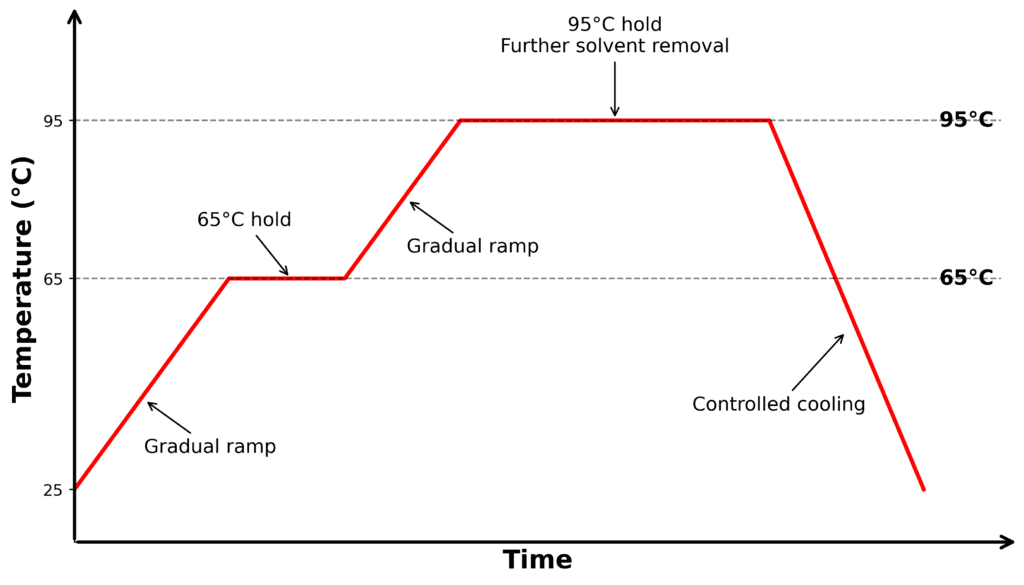
A commonly used SU-8 soft bake profile consists of two temperature stages:
- Ramp from room temperature to approximately 65°C
- Hold at 65°C for several minutes
- Increase gradually to approximately 95°C
- Hold at 95°C for a period determined by the resist thickness
- Cool gradually back to room temperature
A gradual transition between the two temperatures allows the solvent to leave the film progressively and helps prevent excessive thermal stress within the resist. A typical starting ramp may be around 2°C/min, although the appropriate profile depends on the specific SU-8 formulation and process.
The initial 65°C stage provides a relatively gentle environment for solvent evaporation, while the subsequent 95°C stage removes additional solvent and stabilizes the film. Thicker SU-8 layers generally require longer bake times at 95°C.
Soft Bake Time and Resist Thickness
The required soft bake time increases with the SU-8 film thickness because thicker resist layers contain more solvent and require more time for solvent removal.
There is no single soft bake time that is appropriate for every SU-8 layer. The formulation, viscosity, deposited thickness, substrate, and baking equipment all influence the actual time required. The goal is to remove sufficient solvent while avoiding excessive heating that could introduce stress or affect the resist properties.
Why Cooling After Soft Bake Matters?
Once the soft bake is complete, the wafer should be allowed to cool gradually to room temperature before UV exposure. This allows the SU-8 film and substrate to thermally equilibrate and reduces stress caused by rapid temperature changes.
Controlled cooling is important, particularly for thicker SU-8 layers, because differences in thermal expansion between the resist and substrate can contribute to internal stress. Avoiding rapid cooling therefore helps reduce the risk of cracking, delamination, or pattern deformation during subsequent processing.
Hot Plate vs. Convection Oven
Both hot plates and convection ovens can be used for SU-8 baking, but they provide different heating conditions and levels of process control.
Hot Plate
A hot plate heats the wafer directly through contact with its surface, allowing precise control of the wafer temperature and heating profile. Heat is transferred through the substrate, providing predictable and uniform heating across the wafer.
Convection Oven
A convection oven heats the wafer through circulating hot air, transferring heat gradually from the surrounding air to the substrate and SU-8 film. This allows multiple wafers to be processed simultaneously and can be useful for batch fabrication.
However, the actual wafer temperature may take longer to reach the oven’s set temperature, and heating uniformity can depend on factors such as airflow, wafer position, and oven design.
Hot Plate or Convection Oven for SU-8 Baking?
The choice depends on the number of wafers, resist thickness, required temperature control, and process reproducibility. For most SU-8 photolithography workflows, a programmable hot plate is the preferred option because it provides more direct heating of the wafer and makes it easier to reproduce the required temperature profile.
A convection oven can still be appropriate for batch processing when its temperature uniformity and process conditions are well characterized.
💡 Soft Bake Tip: Keep the wafer centered on a clean, level hot plate. The center of a large heating surface is generally more uniform than its edges, while dust or particles beneath the wafer can interfere with heat transfer.
SU-8 Post-Exposure Bake (PEB): Completing Crosslinking
The post-exposure bake (PEB) is the second major thermal treatment in the SU-8 photolithography process. It takes place immediately after UV exposure and serves a fundamentally different purpose from the soft bake.
During UV exposure, the photoactive components in SU-8 generate the chemical catalyst required for crosslinking. The subsequent PEB supplies the thermal energy needed to accelerate this reaction, allowing the exposed regions of the resist to form a strongly crosslinked polymer network with improved mechanical stability and chemical resistance.
Typical SU-8 PEB Temperature
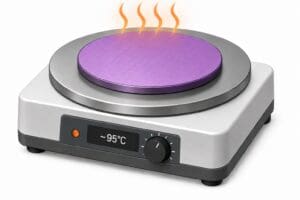
The PEB temperature is commonly around 95°C, although the optimum conditions depend on the specific SU-8 formulation and process.
A PEB profile can therefore resemble the thermal profile used during the soft bake, involving gradual heating of the wafer, with a short hold around 65°C before increasing the temperature to approximately 95°C, where the wafer is held for a specified time determined by the exposure and resist formulation.
Some processes use lower PEB temperatures with longer bake times to reduce thermal stress. For this reason, the manufacturer’s recommended process conditions should always take priority over a generic temperature profile.
Why PEB Temperature Matters?
The PEB temperature determines how effectively the exposed SU-8 photoresist crosslinks after UV exposure. The degree of crosslinking achieved during PEB directly affects the properties of the final SU-8 structures.
If the PEB is insufficient, the exposed regions may remain incompletely crosslinked and become more susceptible to attack during development. This can result in weak structures, poor pattern definition, or incomplete removal of the unexposed resist.
On the other hand, unnecessarily aggressive thermal treatment can increase internal stress, particularly in thick SU-8 films, which may cause cracking, deformation, or other pattern defects.
PEB Cooling
After the PEB, the wafer should be allowed to cool gradually to room temperature before development. Controlled cooling helps reduce thermal stress within the SU-8 film, particularly in thicker layers.
Rapid cooling can increase the risk of cracking, delamination, or pattern deformation due to differences in thermal expansion between the SU-8 and substrate.
💡 PEB Tip: PEB conditions should be adjusted to the SU-8 formulation and resist thickness, since both influence the kinetics and extent of crosslinking. Rather than using a fixed bake time, start with the manufacturer’s recommended conditions and optimize them for your specific process.
SU-8 Hard Bake: When Is It Necessary?
A hard bake is an optional thermal treatment performed after development to further strengthen the patterned SU-8 structures. Unlike the soft bake and PEB, which are essential parts of the standard lithography process, the hard bake is mainly used when additional mechanical or chemical stability is required.
The elevated temperature promotes further curing of the SU-8 and can improve the hardness, chemical resistance, and long-term stability of the structures. It can be particularly useful for SU-8 master molds that will undergo repeated PDMS casting.
Typical Hard Bake Conditions
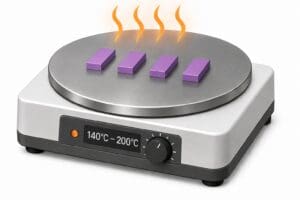
Hard baking is generally performed at a higher temperature than the soft bake or PEB. Typical hard bake conditions for SU-8 are around 140–200°C for 20–30 minutes. The exact temperature and duration depend on factors such as resist thickness, formulation, and the intended application.
The hard bake should not be treated as a universal final step. If the mechanical or chemical stability provided by the existing process is already sufficient, additional thermal treatment may not be necessary.
Benefits and Risks of Hard Baking
Hard baking can further improve the mechanical strength, chemical resistance, and thermal stability of patterned SU-8. This can be beneficial when the structures must withstand repeated processing or long-term use.
However, excessive hard baking can increase internal stress within the SU-8, particularly in thick films, leading to cracking, deformation, or delamination. The hard bake should therefore be optimized for the specific resist thickness and application.
💡 Hard Bake Tip: Use hard baking only when the application requires the additional mechanical or chemical stability. If it is needed, use the lowest temperature and shortest duration that provide the required performance.
SU-8 Baking Parameters: Temperature and Time
SU-8 baking conditions depend on several factors, including the resist formulation, film thickness, substrate material, heating equipment, temperature ramp, required mechanical properties, and final application. Therefore, there is no single temperature and bake time that applies to every SU-8 process.
The tool below provides the recommended soft bake and PEB conditions for the selected SU-8 formulation, making it easier to identify appropriate starting parameters for your process.
Select your SU-8 formulation below to view the corresponding baking temperatures and times.
COMING SOON
🚨 The values provided above are general starting points and should not be considered universal process recipes. Always verify the recommended conditions against the manufacturer’s technical documentation and validate them for your specific process. For critical applications, conduct appropriate process testing or seek expert advice.
Why Film Thickness Matters?
Film thickness is one of the most important variables when selecting bake conditions. A thin SU-8 layer can release solvent more readily than a thick layer, while thick films require more time for heat and solvent transport throughout the resist.
The same principle applies to thermal stress. Thick SU-8 structures contain more material and can develop larger stress gradients during heating, cooling, and crosslinking.
For this reason, bake conditions developed for a thin film should not automatically be applied to a much thicker SU-8 layer.
Temperature Ramps Matter Too
The rate at which the wafer reaches the target temperature can also affect the final result. Gradual heating ramps and controlled cooling allow the resist to respond more uniformly to temperature changes.
As a general guideline, some SU-8 processes use heating rates of around 2–10°C/min, but the optimal values depend on the process and equipment.
Common SU-8 Baking Defects and How to Avoid Them
Many SU-8 defects can be traced back to inadequate control of temperature, bake time, or heating and cooling rates. These defects, their possible causes, and recommended solutions are summarized in the table below.
| Defect | Possible Cause | How to Avoid It |
|---|---|---|
| Cracking | • Rapid temperature changes • Aggressive PEB / hard bake • Thick SU-8 films | • Slow heating/cooling ramps • Optimized bake temperature and duration • Minimal high-temperature treatment |
| Residual Solvent | • Insufficient soft bake | • Longer soft bake • Optimized temperature profile |
| Skin Formation | • Rapid surface solvent evaporation | • Gradual, staged heating |
| Poor Adhesion | • Poor substrate preparation • Insufficient baking • Excessive baking | • Proper wafer cleaning and dehydration • Optimized soft bake |
| Incomplete Crosslinking | • Insufficient PEB temperature • Insufficient PEB duration | • Recommended PEB conditions • Target wafer temperature reached |
| Delamination | • Excessive thermal stress • Poor adhesion • Thick structures | • Proper substrate preparation • Slow temperature changes • Optimized bake profile |
| Pattern Deformation | • Excessive thermal treatment | • Moderate bake temperature • Controlled bake duration • Conditions matched to resist thickness |
Key Factors for Successful SU-8 Baking
A successful SU-8 baking depends on controlling the entire thermal history of the wafer, rather than following a single temperature or bake time. The following points summarize practical rules that can significantly improve baking consistency:
- Keep the hot plate clean and level. Dust or particles beneath the wafer can affect heat transfer, while an uneven surface can compromise the uniformity of the resist film.
- Center the wafer on the hot plate. This helps minimize the effect of temperature variations between the center and edge of the heating surface.
- Use controlled temperature ramps. Avoid sudden changes in temperature, particularly with thick SU-8 layers.
- Match bake time to resist thickness. Thicker films generally require longer thermal treatment to remove solvent and achieve uniform crosslinking.
- Allow sufficient cooling time. Do not force rapid cooling after soft bake or PEB.
- Avoid unnecessarily high temperatures. Higher temperature does not automatically mean better curing and can increase internal stress or alter the resist chemistry.
- Follow the formulation-specific process recommendations. SU-8 formulations can differ, so manufacturer-provided bake conditions should take precedence over generic process values.
- Keep the thermal history consistent. Reproducible heating, holding, and cooling conditions are essential for obtaining repeatable SU-8 structures.
💡 Conclusion
Baking conditions have a direct influence on the quality and consistency of SU-8 microstructures. Careful control of the wafer’s thermal history throughout the process is therefore essential for consistent and high-quality results.
Stay tuned for more insights on SU-8 photoresists, soft lithography, microfabrication, PDMS microfluidics, and other techniques driving innovation in microfluidic devices 🔬!
📧 If you have any questions or feedback, please feel free to contact us at contact@darwin-microfluidics.com.
❓ FAQ: SU-8 Baking
What is the purpose of the SU-8 soft bake?
The soft bake removes residual solvent from the SU-8 film and stabilizes the resist before UV exposure.
What temperature should SU-8 be soft baked at?
SU-8 is commonly soft baked using a two-stage profile around 65°C and 95°C, with the exact conditions depending on the resist thickness and formulation.
How long should SU-8 be soft baked?
The required time depends mainly on the SU-8 thickness and formulation. Thicker layers generally require longer baking to remove the remaining solvent.
What is the difference between soft bake and PEB?
Soft bake removes solvent after coating, while PEB uses heat after UV exposure to complete the crosslinking reaction in the exposed SU-8.
Is a hard bake necessary for SU-8?
No. Hard baking is an optional treatment used when additional mechanical, chemical, or thermal stability is required for the final application.
Why does SU-8 crack during baking?
Cracking is mainly associated with excessive internal thermal stress caused by rapid heating or cooling, excessive thermal treatment, thick resist layers, or differences in thermal expansion between SU-8 and the substrate.
Can SU-8 be baked in an oven?
Yes, but hot plates generally provide more direct and controllable heating of the wafer. For repeatable SU-8 processing, a programmable hot plate is often preferred.
Why is a slow cooling rate important for SU-8?
Gradual cooling reduces thermal stress generated by differences in thermal contraction between the SU-8 layer and its substrate, helping reduce cracking and delamination.
How should SU-8 baking conditions be selected?
Baking conditions should be selected according to the SU-8 formulation, resist thickness, substrate, and process requirements, with the manufacturer’s recommendations used as the primary reference.

🔗 References
- Feng, R., & Farris, R. J. (2003). Influence of processing conditions on the thermal and mechanical properties of SU8 negative photoresist coatings. Journal of Micromechanics and Microengineering, 13(1), 80. https://doi.org/10.1088/0960-1317/13/1/312
- Anhoj, T. A., Jorgensen, A. M., Zauner, D. A., & Hübner, J. (2006). The effect of soft bake temperature on the polymerization of SU-8 photoresist. Journal of Micromechanics and Microengineering, 16(9), 1819. https://doi.org/10.1088/0960-1317/16/9/009
- Keller, S., Blagoi, G., Lillemose, M., Haefliger, D., & Boisen, A. (2008). Processing of thin SU-8 films. Journal of micromechanics and microengineering, 18(12), 125020. https://doi.org/10.1088/0960-1317/18/12/125020
- SU-8 2-25 Datasheet from MicroChem
- SU-8 50-100 Datasheet from MicroChem
- SU-8 2000-2015 Datasheet from MicroChem
- SU-8 2025-2075 Datasheet from MicroChem
- SU-8 2100 and 2150 Datasheet from MicroChem
- SU-8 3000 Datasheet from MicroChem