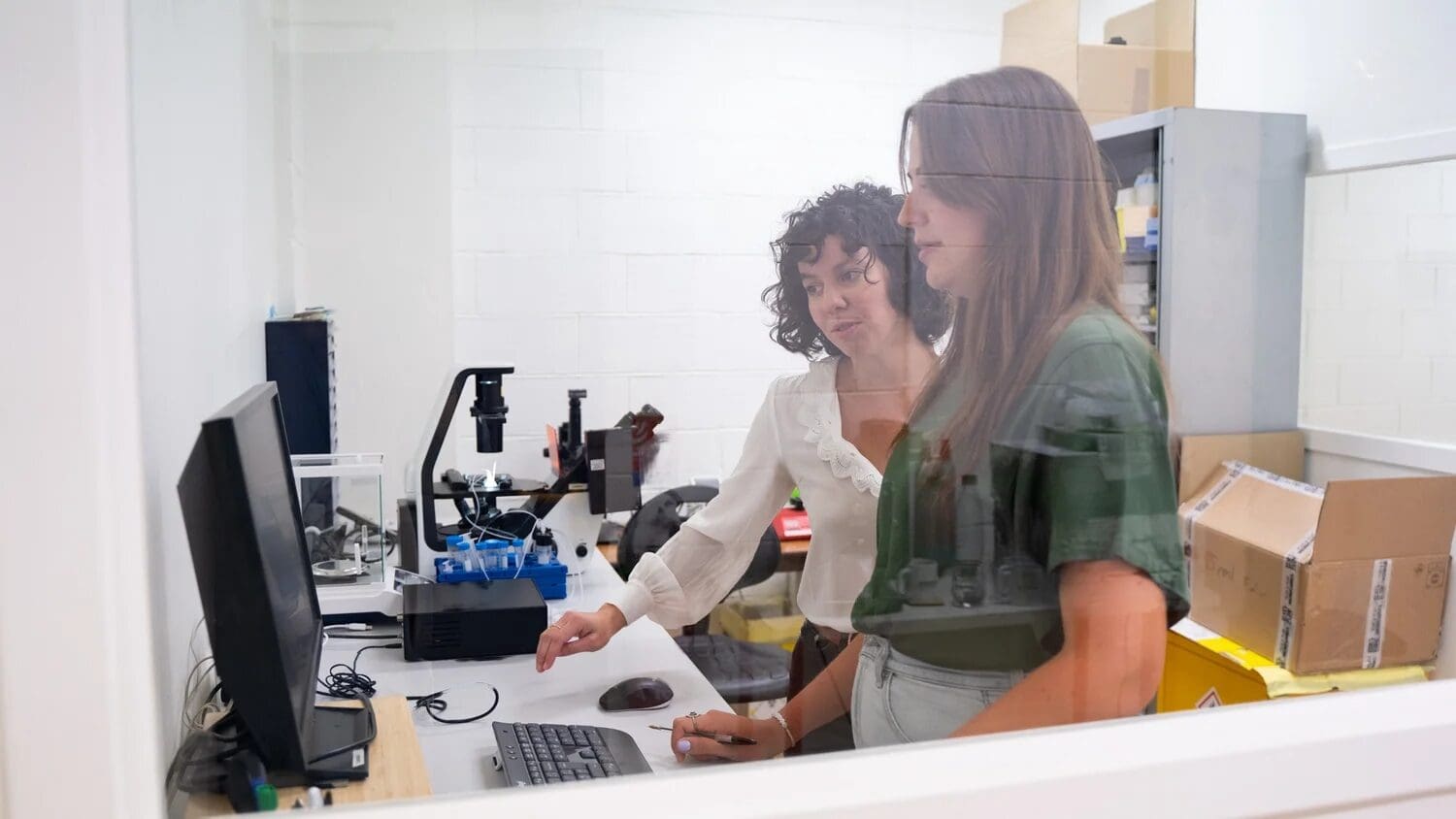

Small devices, microchannels, tiny droplets — and yet, big discoveries. For many years, PDMS has been at the heart of microfluidic device development and fabrication. Poured, cured, peeled, punched, and bonded, it has quietly become one of the backbones of microfluidics, enabling rapid prototyping and fast design iterations in research labs around the world.
Not because it is perfect. Not because it is the most chemically resistant or mechanically robust material available. But because it offers something microfluidics fundamentally needs: balance. Balance between performance and simplicity. Between precision and accessibility. Between advanced microfabrication and practical laboratory work.
To understand why PDMS has become such a staple in microfluidics, this article explores its material properties, practical advantages, and its role in the development and fabrication of modern microfluidic devices.
What is PDMS?
Polydimethylsiloxane (PDMS) is a silicone-based organic polymer from the siloxane family, composed of repeating silicon–oxygen (Si–O) units with methyl groups attached to the silicon atoms. This hybrid inorganic–organic molecular structure gives PDMS a unique combination of flexibility, chemical stability, and optical transparency, making it particularly suited for microfluidic applications and microfabrication.
In practical terms, PDMS is a versatile elastomer: in its uncured state, it behaves as a viscous liquid that can be poured, molded, or spun onto a surface. Once mixed with a cross-linking agent and cured through heat or time, it forms a soft, elastic, and durable material capable of replicating micro-scale structures with high precision.
Beyond microfluidics, PDMS is widely used in cosmetics, food processing, lubricants, and industrial coatings due to its inertness and stability. Its breakthrough in scientific research, however, came with the rise of soft lithography, which allowed researchers to rapidly prototype microfluidic chips and elastomeric molds with complex geometries. This compatibility established PDMS as a core material for microfabrication in biomedical research, chemical analysis, and cell-based assays, and its use continues to expand across the field.

Properties of PDMS Relevant to Microfluidics
Early microfluidic systems were fabricated primarily in silicon or glass, borrowing techniques from the semiconductor industry. While these materials offered precision, they required expensive cleanroom processes and complex fabrication steps. PDMS entered the field of microfluidics with the rise of soft lithography, offering a simpler and more accessible way to fabricate microscale channels. What began as a rapid prototyping material quickly became a standard in many research laboratories, significantly reducing cost, fabrication time, and infrastructure requirements.
Today, even with the growth of thermoplastics and glass-based microfluidic devices, PDMS remains widely used. Its continued presence in the field is not accidental — it is directly linked to a combination of material properties that align remarkably well with the practical and technical demands of microfluidics.
Understanding these properties is essential to understanding why PDMS is still so effective in microfluidic device development and microfabrication.
Optical Transparency
PDMS is highly transparent across a wide optical range, from near-ultraviolet to near-infrared, which makes it ideal for microfluidic systems. This optical clarity, combined with low autofluorescence, allows direct observation and characterization of fluid flow, droplet formation, particle tracking, fluid–substrate interactions, and cell adhesion directly within microchannels using microscopy or fluorescence imaging.
Elasticity and Mechanical Compliance
Unlike glass or silicon, PDMS is an elastomer, capable of bending, stretching, and deforming under pressure. This mechanical flexibility is more than a material property — it becomes a functional advantage in microfluidic design. Its elasticity enables tight, leak-free connections with tubing without additional fittings, simplifying device assembly.
In biomechanics and cell mechanotransduction studies, the softness of PDMS even allows the measurement of very small forces exerted by cells, a capability few other microfabrication materials can provide.
Gas Permeability
One of PDMS’s key advantages in microfluidics is its permeability to gases like oxygen and carbon dioxide. This property is especially important for cell culture devices, where confined cells still need gas exchange to survive. It also helps release trapped air bubbles from dead-end channels, improving experimental stability.
Surface Chemistry and Bonding
PDMS is naturally hydrophobic, but its surface can be temporarily modified with plasma treatment. This introduces silanol groups, making the surface hydrophilic and enabling strong covalent bonding to glass, other PDMS layers, or certain treated materials. This capability is essential in microfabrication, allowing sealed microfluidic devices without adhesives or clamps and supporting hybrid systems where glass supports metal electrodes or thin-film coatings while PDMS forms the microchannel network.
High-Resolution Molding and Rapid Prototyping
PDMS starts as a liquid prepolymer that, once mixed with a curing agent, remains workable for hours at room temperature, making casting straightforward. It is typically poured over microstructured master molds—often fabricated from SU-8 photoresist on silicon wafers—and then cured to form an elastomeric replica. This process allows PDMS to reproduce features with micron-scale accuracy, making it ideal for soft lithography. Compared to costly silicon processing, this approach enables researchers to prototype microfluidic chips quickly and inexpensively.
Biocompatibility and Cost
PDMS is generally biocompatible and inexpensive compared to materials like silicon or glass, making it ideal for rapid prototyping of microfluidic devices and cell-based assays. Its inertness and compatibility with biological systems allow researchers to culture cells and run experiments reliably, while keeping fabrication simple and cost-effective.
Common Uses of PDMS in Microfluidics
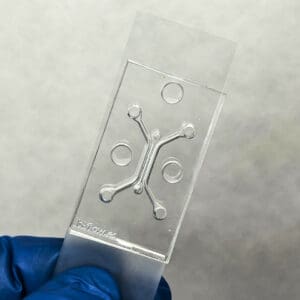
Thanks to its unique combination of transparency, elasticity, gas permeability, and ease of fabrication, PDMS is used across a wide range of microfluidic applications. It is particularly popular for lab-on-a-chip devices, microfluidic drug-delivery, cell culture platforms, and droplet-based microfluidics, where observation, control, and rapid prototyping are essential.
PDMS also enables biomechanics studies, allowing researchers to measure cellular forces and interactions within flexible microchannels. Its compatibility with soft lithography makes it ideal for creating complex microchannel networks, integrated valves, and multilayer devices. Even hybrid systems benefit from PDMS, where it forms the microchannel structure while other materials like glass or metals provide functional surfaces for electrodes, sensors, or coatings.
A Reference Material: Sylgard® 184
In many microfluidics laboratories, the most commonly used PDMS formulation for device fabrication is the Sylgard® 184 Silicone Elastomer Kit, widely trusted for prototyping and soft lithography application.
This two-component PDMS system consists of a base polymer and a curing agent, typically mixed at a 10:1 ratio by weight. After mixing and degassing to remove trapped air bubbles, the liquid PDMS is poured over a master mold and thermally cured to produce an elastomeric replica.
The mechanical properties of Sylgard® 184 — including Young’s modulus, elongation at break, hardness, and tensile strength — can be adjusted by modifying the curing temperature, curing time, or mixing ratio. This tunability is particularly useful in microfluidic fabrication, where the desired channel rigidity or flexibility can vary depending on the application.
| Property | SYLGARD™ 184 Silicone Elastomer |
|---|---|
| Chemical Resistance | Fair |
| Color | Transparent |
| Cure Time at 25°C | 48h |
| Curing Temperature | 25°C to 150°C |
| Density (Cured) | 1.03 g/cm³ |
| Dielectric Strength | 19 kV/mm |
| Hardness (Shore A) | 43 |
| Heat Cure Time at 100°C | 35 min at 100°C |
| 20 min at 125°C | 6.7 MPa |
| 10 min at 150°C | 0.27 W/m·K |
| Refractive Index | 1.4118 at 589 nm |
| 1.4225 at 632.8 nm | 3.5 Pa.s |
| 1.4028 at 1321 nm | 48h |
| 1.3997 at 1554 nm | 35 min at 100°C 20 min at 125°C 10 min at 150°C |
| Service Temperature (Continuous) | -45°C to 200°C |
| Tensile Strength | 6.7 MPa |
| Thermal Conductivity | 0.27 W/m·K |
| Viscosity (Base) | 5.1 Pa.s |
| Viscosity (Mixed) | 3.5 Pa.s |
Limitations and Challenges of PDMS
While PDMS offers many advantages for microfluidic device fabrication, it also presents several limitations that researchers must consider depending on the application. Knowing these limitations makes it easier to decide when PDMS is the best choice for a microfluidic device and when materials like glass or thermoplastics might be a better fit.
Absorption of Small Molecules
PDMS can adsorb small hydrophobic molecules from solutions, which can alter concentrations and affect quantitative biological or chemical assays.
Limited Scalability for Industrial Use
While ideal for rapid prototyping and research, PDMS is less suited for large-scale manufacturing. Long curing times, manual processing, and mechanical limitations make it challenging to scale for industrial production.
Unstable Surface Treatments
Plasma or chemical treatments temporarily modify PDMS surfaces to improve hydrophilicity or bonding. However, these modifications tend to revert over time and the hydrophobic surface of PDMS gradually recovers after treatment.
Chemical Compatibility
PDMS swells or degrades when exposed to certain organic solvents, acids, or bases. This reduced chemical compatibility limits its use and requires careful selection of chemical reagents that come into contact with the device.
Bonding Limitations and Fabrication Time
Although PDMS bonds well to glass or other PDMS layers, bonding can be hindered by large metal areas or complex geometries. Additionally, multi-layer device fabrication can be time-consuming.
Reproducibility Concerns
Mechanical properties of PDMS can vary depending on curing temperature, time, and mixing ratios, potentially affecting experimental consistency between batches.

How PDMS Compares to Alternative Microfluidic Materials?
Several materials are used to fabricate microfluidic devices, including silicon, glass, thermoplastics, and Flexdym. Each offers specific advantages depending on the microfluidic device requirements, fabrication method, production scale.
Compared with silicon, PDMS is easier and less expensive to process. Silicon microfabrication relies on advanced semiconductor techniques, such as photolithography to define patterns on the wafer and etching to create micro-scale structures, and requires cleanroom facilities. In contrast, PDMS devices can be produced with soft lithography using standard lab equipment.
Compared with glass, PDMS provides flexibility, gas permeability, and easier fabrication, useful for biological experiments and rapid prototyping. Glass, in contrast, provides excellent chemical resistance, rigidity, and optical stability for high-precision or chemically demanding applications.
Thermoplastics such as PMMA or COC are ideal for large-scale manufacturing through injection molding and provide good chemical resistance, but design iterations are slower and require costly tooling. PDMS, on the other hand, allows rapid prototyping and flexible microchannel designs, making it better suited for iterative research.
Compared with Flexdym, PDMS provides greater flexibility, gas permeability, and compatibility with established soft lithography techniques. However, Flexdym shows minimal small-molecule absorption, better surface stability, easier bonding, higher scalability, and higher reproducibility.
Despite the strengths of other materials, PDMS continues to be widely used in research and prototyping due to its flexibility, compatibility with soft lithography, and suitability for early-stage microfluidic device development.
💡 Conclusion
PDMS continues to play a central role in microfabrication thanks to its flexibility, optical transparency, and compatibility with soft lithography. While other materials may be preferred for specific applications, PDMS remains the go-to choice for research, rapid prototyping, and early-stage device development, offering the perfect balance between performance, simplicity, and practical usability in the lab.
Stay tuned for more insights on PDMS, microfabrication, soft lithography, SU-8 photolithography, and other techniques driving innovation in microfluidic devices 🔬!
📧 If you have any questions or feedback, please feel free to contact us at contact@darwin-microfluidics.com.
❓ FAQ: PDMS in Microfluidics
Q1: What is PDMS?
PDMS (Polydimethylsiloxane) is a silicone-based polymer widely used in microfluidics for its flexibility, optical transparency, and chemical stability.
Q2: Why is PDMS popular in microfluidic device fabrication?
Its compatibility with soft lithography, gas permeability, biocompatibility, and ease of molding make PDMS ideal for lab-scale microfluidic devices.
Q3: What are the main properties of PDMS for microfluidics?
Key properties include optical transparency, elasticity, gas permeability, surface bonding via plasma treatment, and high-resolution molding.
Q4: Is PDMS biocompatible?
Yes, PDMS is generally biocompatible, allowing cell culture and biological experiments, although care is needed with hydrophobic molecules that may adsorb onto the surface.
Q5: Can PDMS be used for industrial-scale production?
No. PDMS is best for research and prototyping, not large-scale manufacturing.
Q6: What are the limitations of PDMS in microfluidics?
PDMS can absorb small molecules, has limited chemical resistance, unstable surface treatments, and reproducibility issues depending on curing conditions.
Q7: What is Sylgard® 184?
Sylgard® 184 is the most commonly used PDMS formulation in microfluidics, consisting of a base polymer and curing agent, allowing tunable mechanical properties for prototyping.
🔗 References
- Toepke, M. W., & Beebe, D. J. (2006). PDMS absorption of small molecules and consequences in microfluidic applications. Lab on a Chip, 6, 1484.
- Friend, J., & Yeo, L. (2010). Fabrication of microfluidic devices using polydimethylsiloxane. Biomicrofluidics, 4(2), 026502.
- Raj, M. K., & Chakraborty, S. (2020). PDMS microfluidics: A mini review. Journal of Applied Polymer Science, 137, 48958.
- Elveflow. Polydimethylsiloxane (PDMS) in Microfluidics: Properties and Emerging Smart Functionalities.
https://elveflow.com/microfluidic-reviews/the-poly-di-methyl-siloxane-pdms-and-microfluidics/ - LinkedIn HiComp. Why PDMS is the preferred material for microfluidic device fabrication.
https://www.linkedin.com/pulse/why-pdms-preferred-material-microfluidic-device-fabrication-ihjsc/ - Dow. Sylgard 184 Silicone Elastomer Kit.
https://www.dow.com/en-us/pdp.sylgard-184-silicone-elastomer-kit.01064291z.html?productCatalogFlag=1#properties - Micronit. PDMS for Microfluidics: Limitations and Alternatives.
https://micronit.com/expertise/manufacturing-expertise/pdms-for-microfluidics