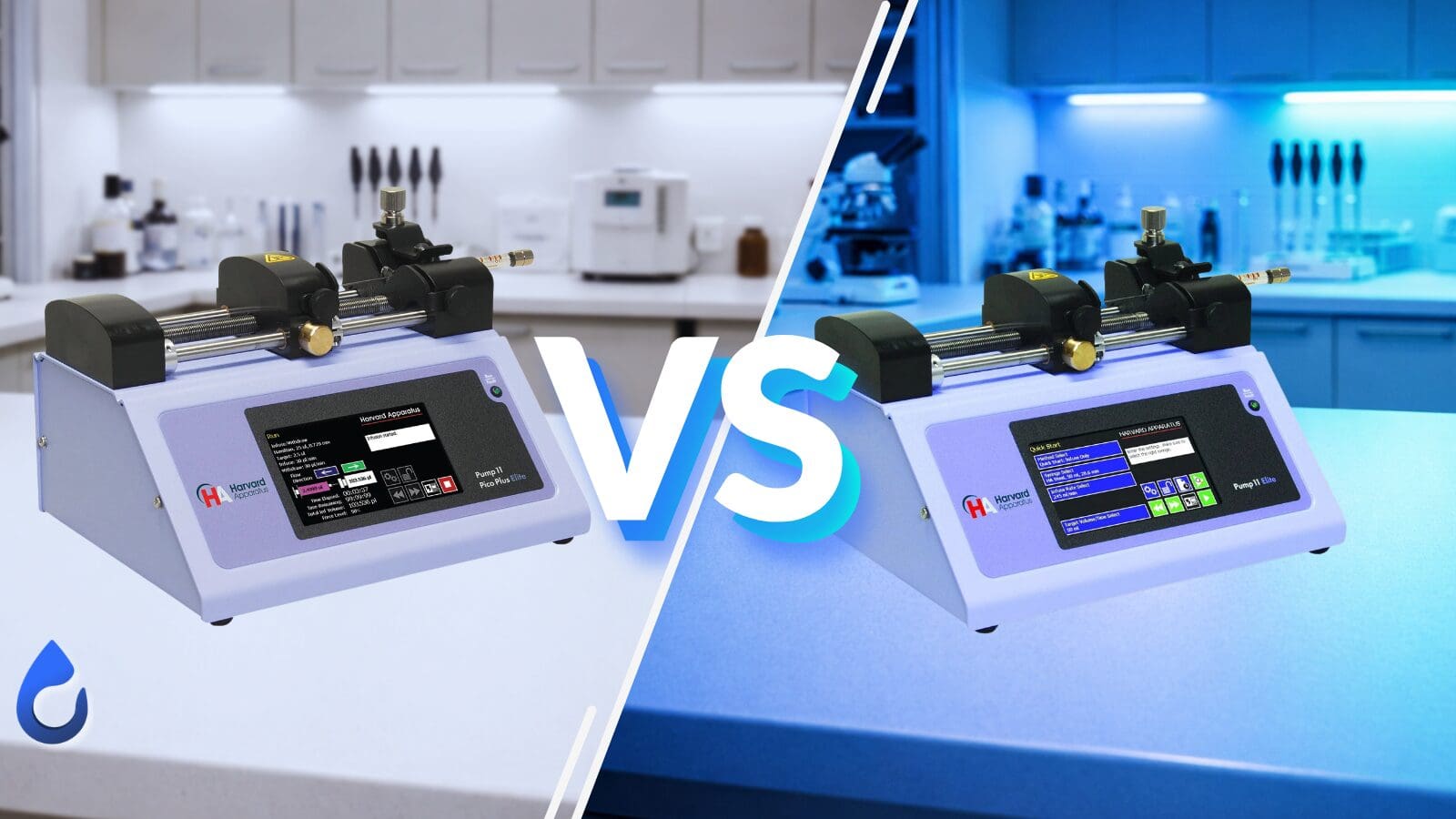

11 Pico Plus Elite vs 11 Elite Programmable Syringe Pump: Quick Verdict
The Pico Plus Elite wins for microfluidic researchers who need picoliter-level precision. The 11 Elite Programmable wins for labs seeking versatility and budget flexibility.
If your experiments demand flow rates starting at 0.54 pl/min with ±0.35% accuracy, the Pico Plus Elite is your only real option between these two. This pump was engineered specifically for microfluidic applications where ultra-small volumes determine experimental success or failure. The finer step resolution of 0.031 μm/μstep eliminates pulsation at the lowest flow rates, which matters enormously when you’re working with droplet generation or single-cell analysis.
The 11 Elite Programmable makes more sense for general-purpose microfluidic work. It handles a broader flow range up to 88.28 ml/min in single-syringe configuration, costs significantly less at entry-level pricing, and offers the same touchscreen interface and programming capabilities. The ±0.5% accuracy satisfies most standard applications. Labs running cell culture perfusion, drug delivery studies, or routine microfluidic experiments will find the 11 Elite more than adequate. The price difference between these pumps can fund other equipment needs.
Harvard Apparatus 11 Pico Plus Elite vs 11 Elite at a Glance
| Feature | Pico Plus Elite | 11 Elite Programmable |
|---|---|---|
| Price Range | $4,299 – $4,430 | $2,691 – $4,430 |
| Flow Rate (Single) | 0.54 pl/min – 39.77 ml/min | 1.26 pl/min – 88.28 ml/min |
| Flow Rate (Dual) | 0.54 pl/min – 11.70 ml/min | 1.26 pl/min – 26.02 ml/min |
| Accuracy | ±0.35% | ±0.5% |
| Reproducibility | ±0.05% | ±0.05% |
| Step Resolution | 0.031 μm/μstep | 0.069 μm/μstep |
| Microsteps/Revolution | 20,480 | 15,360 |
| Best For | Microfluidics, ultra-low flow | General lab use, higher throughput |
| Warranty | 2 years | 2 years |
The table reveals the fundamental trade-off. The Pico Plus Elite delivers roughly twice the step resolution and 30% better accuracy, but at a higher minimum price point. The 11 Elite offers greater maximum flow rates and pricing flexibility through its infusion-only option. Both pumps share identical dimensions, weight, and connectivity options. The choice comes down to whether your application requires picoliter precision or whether standard microfluidic accuracy suffices.
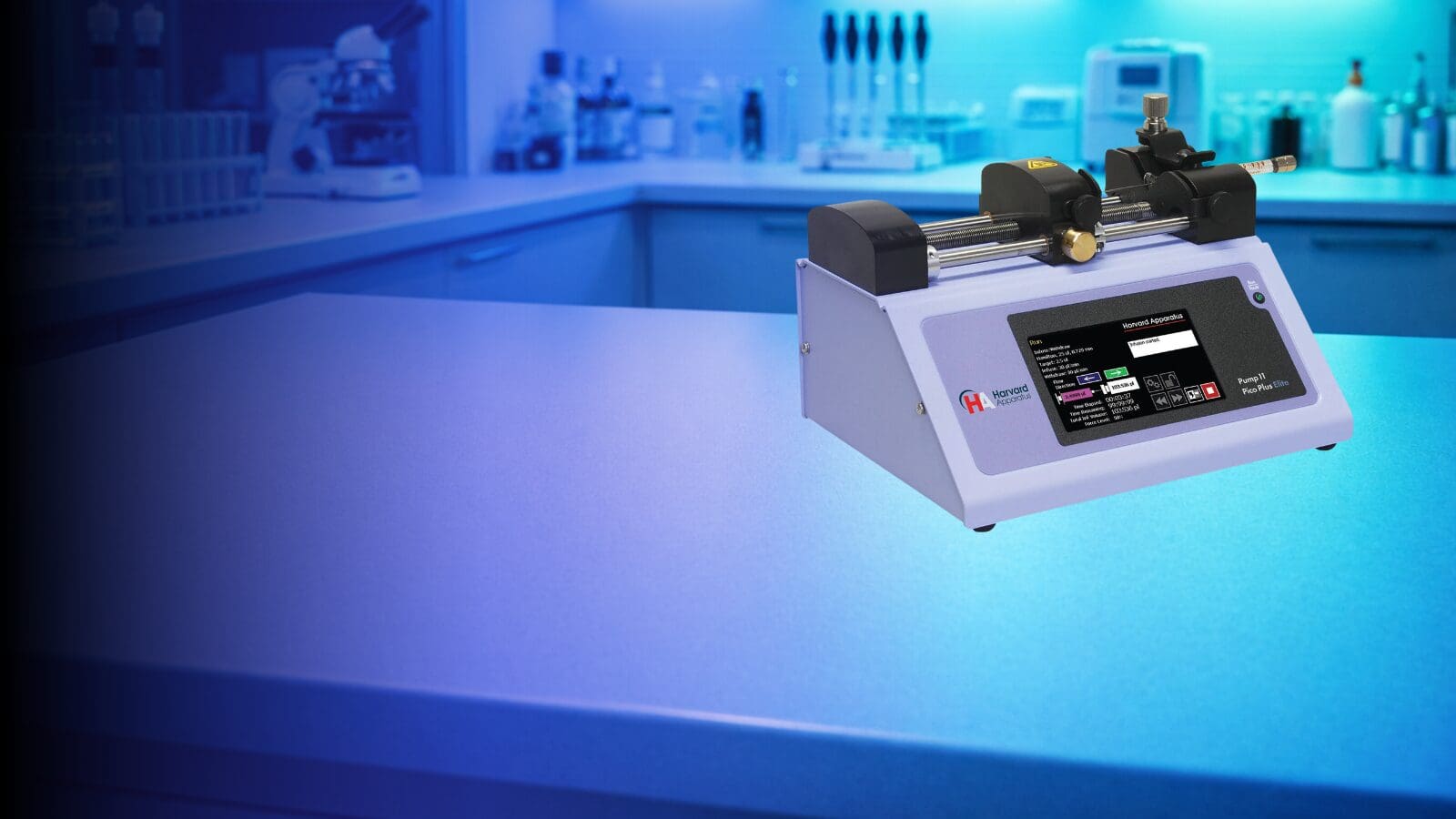
Description of the Harvard Apparatus 11 Pico Plus Elite
Harvard Apparatus, a division of Harvard Bioscience, has manufactured precision fluid handling equipment for over 100 years. The 11 Pico Plus Elite represents their flagship microfluidic syringe pump, designed specifically for applications requiring the lowest possible flow rates with exceptional accuracy.
This pump delivers flow rates from 0.54 picoliter per minute up to 39.77 ml/min in single-syringe configuration. The dual-syringe version handles 0.54 pl/min to 11.70 ml/min. That picoliter capability matters for researchers working in droplet microfluidics, organ-on-chip systems, and nanoparticle synthesis where volume precision directly impacts experimental outcomes.
The Pico Plus Elite targets pharmaceutical researchers, academic microfluidics labs, and biotech companies developing precision drug delivery systems. It solves the problem of flow pulsation at ultra-low rates through 20,480 microsteps per lead screw revolution and advanced microstepping techniques. The 4.3-inch color touchscreen allows standalone operation without computer control, though USB, RS-485, and TTL I/O connections support automated workflows.
Single and dual-channel configurations accommodate syringes from 0.5 μl to 50/60 ml (single) or 0.5 μl to 10 ml (dual). Both glass and plastic syringes work with the adjustable syringe rack. The pump can be positioned vertically to reduce bench footprint by 55%.
Pricing starts at $4,299.75 for the single-syringe version and reaches $4,429.62 for dual-syringe configurations.
Description of the Harvard Apparatus 11 Elite
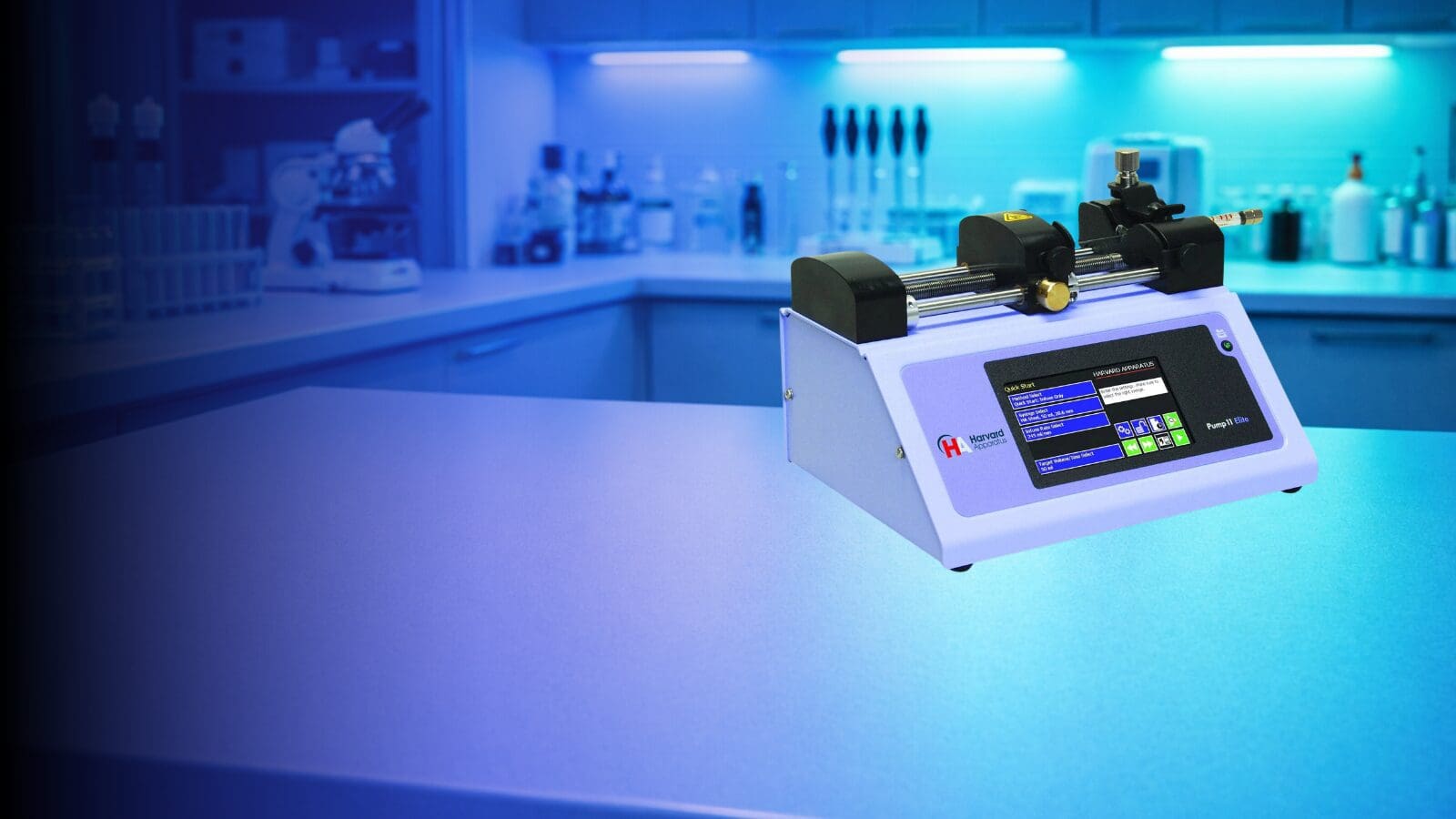
The 11 Elite Programmable serves as Harvard Apparatus’s versatile workhorse for general microfluidic applications. Where the Pico Plus Elite specializes in ultra-low flow precision, the 11 Elite balances capability with accessibility.
Flow rates span 1.28 pl/min to 88.28 ml/min for single-syringe operation and 1.26 pl/min to 26.02 ml/min for dual-syringe setups. The higher maximum flow rate makes this pump suitable for applications requiring faster fluid delivery alongside precision work. Accuracy sits at ±0.5% with ±0.05% reproducibility.
Harvard Apparatus offers the 11 Elite in two versions. The infusion-only model handles basic constant-rate delivery with volume or time targets. The infusion/withdrawal programmable version adds bidirectional operation, ramp profiles, gradient generation, and autofill capabilities. This version flexibility explains the wide price range.
Target users include teaching laboratories, research groups with diverse application needs, and facilities where budget constraints matter. The pump handles cell culture perfusion, chromatography sample loading, and standard microfluidic device testing without the premium cost of ultra-precision models.
The same 4.3-inch touchscreen, connectivity options, and space-saving vertical orientation carry over from the Elite series design. Syringe compatibility matches the Pico Plus Elite specifications.
Pricing ranges from $2,691.00 for entry-level infusion-only configurations to $4,429.62 for fully-equipped dual-syringe programmable versions.
Feature-by-Feature Comparison
Flow Rate Range and Minimum Flow Capability
The Pico Plus Elite reaches down to 0.54 pl/min, while the 11 Elite bottoms out at 1.26 pl/min. That 0.72 picoliter difference sounds trivial until you’re generating 50-micron droplets or dosing single cells. At the upper end, the 11 Elite delivers 88.28 ml/min versus 39.77 ml/min for the Pico Plus Elite.
Winner: Application-dependent. Choose Pico Plus Elite for ultra-low flow; choose 11 Elite for higher throughput needs.
Accuracy and Reproducibility
The Pico Plus Elite achieves ±0.35% accuracy compared to ±0.5% for the 11 Elite. Both share ±0.05% reproducibility. The accuracy difference becomes meaningful in quantitative experiments where flow rate directly correlates with concentration or reaction kinetics.
Winner: Pico Plus Elite. The 30% improvement in accuracy justifies the premium for precision-critical work.
Step Resolution and Pulsation Control
With 0.031 μm/μstep resolution and 20,480 microsteps per revolution, the Pico Plus Elite produces smoother flow at low rates than the 11 Elite’s 0.069 μm/μstep and 15,360 microsteps. Finer stepping translates to reduced pulsation, which matters for shear-sensitive samples and consistent droplet formation.
Winner: Pico Plus Elite. The doubled step resolution eliminates pulsation artifacts in sensitive applications.
Programming Capabilities
Both pumps offer identical programming features in their infusion/withdrawal versions. Four pump operation profiles (constant rate, ramp, gradient, autofill) support up to 50-step user-defined methods. Methods can be stored, duplicated, and transferred between pumps. The touchscreen interface handles all programming without computer connection.
Winner: Tie. Identical programming architecture across both models.
Connectivity Options
USB Type B, RS-485 for daisy-chaining up to 99 pumps, 15-pin D-Sub for TTL I/O, footswitch input, and optional RS-232 ports appear on both models. External device triggering and computer control work identically.
Winner: Tie. Same connectivity specifications.
Syringe Compatibility
Both pumps accept glass or plastic syringes from 0.5 μl to 50/60 ml (single) or 0.5 μl to 10 ml (dual). The adjustable syringe rack accommodates standard syringe formats without additional adapters.
Winner: Tie. Identical syringe compatibility.
Pricing: 11 Pico Plus Elite vs 11 Elite Programmable Syringe Pump
The 11 Elite Programmable offers significant cost advantages for labs that don’t require picoliter precision. The infusion-only single-syringe version starts at $2,691, representing a $1,600+ savings over the entry-level Pico Plus Elite.
For dual-channel programmable configurations, both pumps converge at $4,429.62. At this price point, the Pico Plus Elite delivers better value through superior accuracy and step resolution. The 11 Elite’s advantage lies entirely in its lower-tier options.
Total cost of ownership considerations favor both pumps equally. The 2-year warranty, identical power requirements, and shared consumables (syringes, tubing) mean ongoing costs don’t differentiate the models. Neither requires proprietary software licenses or subscription fees.
For academic labs with limited budgets, the 11 Elite infusion-only version provides capable microfluidic pumping at an accessible price. Core facilities serving multiple research groups benefit from the 11 Elite’s versatility and lower replacement cost. Pharmaceutical development labs and precision microfluidics researchers should budget for the Pico Plus Elite from the start rather than upgrading later.
The Verdict: 11 Pico Plus Elite or 11 Elite the Final Choice
Choose the Pico Plus Elite if you:
- Work with flow rates below 1 pl/min regularly
- Perform droplet microfluidics requiring consistent size distribution
- Run organ-on-chip or microphysiological system experiments
- Need ±0.35% accuracy for quantitative dosing studies
- Develop nanoparticle synthesis protocols where flow precision affects particle size
- Can justify the higher upfront cost through improved experimental reproducibility
Choose the 11 Elite Programmable if you:
- Require maximum flow rates above 40 ml/min
- Run diverse applications with varying precision requirements
- Operate a teaching lab where students need reliable, forgiving equipment
- Need budget flexibility through infusion-only options
- Perform cell culture perfusion or standard microfluidic device testing
- Want dual-channel capability at a lowest price point
The decision ultimately depends on your minimum flow requirements and accuracy tolerance. Labs that occasionally need picoliter flows but primarily work at higher rates face a harder choice. In those cases, consider whether the 11 Elite’s limitations would force experimental compromises or simply represent acceptable trade-offs.
Frequently Asked Questions
What is the main difference between the Pico Plus Elite and 11 Elite Programmable?
The Pico Plus Elite offers finer step resolution (0.031 vs 0.069 μm/μstep) and better accuracy (±0.35% vs ±0.5%). These specifications enable smoother flow at ultra-low rates down to 0.54 pl/min. The 11 Elite provides higher maximum flow rates and lower entry pricing.
Can both pumps operate without a computer?
Yes. Both feature 4.3-inch color touchscreens that allow complete method programming, storage, and execution without computer connection. USB and RS-485 connectivity support computer control when needed.
How many pumps can be daisy-chained together?
Up to 99 pumps can be linked through the RS-485 interface on either model. Each pump requires a unique address assignment for proper communication.
What syringes work with these pumps?
Both accept glass or plastic syringes from 0.5 μl to 50/60 ml (single-syringe rack) or 0.5 μl to 10 ml (dual-syringe rack). Standard luer-lock syringes from major manufacturers are compatible.
Is the 11 Elite available in infusion-only configuration?
Yes. The 11 Elite offers both infusion-only and infusion/withdrawal programmable versions. The Pico Plus Elite is only available as an infusion/withdrawal programmable model.
What warranty coverage do these pumps include?
Both pumps carry a 2-year warranty from Harvard Apparatus. Both hold CE, ETL, WEEE, RoHS, and CB Scheme certifications.
Can these pumps be mounted vertically?
Yes. Both can be positioned on their side to reduce bench footprint by 55%. The display tilts to remain readable in vertical orientation