Microfluidic-based hydrodynamic trap facilitates trapping using the sole action of fluid flow and provides a viable alternative to existing confinement and manipulation techniques based on electric, optical, magnetic or acoustic force fields for example. In this review, we describe various methods and techniques utilized in microfluidic spheroid and single-cell trapping.
Single-cell trapping processes
L'une des méthodes les plus robustes pour analyser des populations de cellules uniques avec un débit relativement élevé est celle des microwell arrays.
Cependant, un problème récurrent est que les cultures en micropuits sont statiques. Cela limite leur capacité à manipuler activement les cellules piégées, par exemple pour changer le milieu ou pour contrôler l'exposition des cellules aux stimuli mitogènes. D'autre part, les vannes microfluidiques, les pinces optiques, la diélectrophorèse (DEP) et les ondes acoustiques, qui peuvent être facilement intégrées aux dispositifs microfluidiques, permettent des approches plus puissantes pour piéger et manipuler des cellules individuelles.
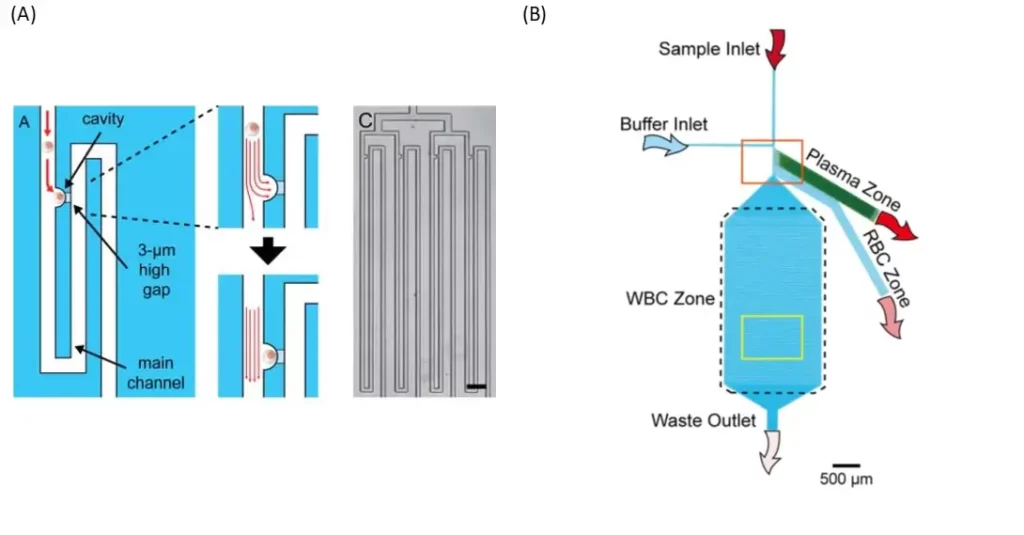
In this review, we have chosen to rely on the study of Koben et al. in 2018, in which they were able to evaluate the trapping force according to different chip designs. In their study, Koben et al. present a microfluidic device capable of trapping a single cell via a network of traps whose main channel length can be 1, 2 or 4 mm with respectively 64 traps in parallel and 3 to 10 traps in series. Each chip then has two inlets, one for medium infusion and one for cell loading.
In practice, the chip was first primed with complete cell culture medium at a flow rate of 25 ml/min and the cells were injected through the spare inlet. After closing the cell inlet with a stopper, the chip was placed on an inverted microscope, infused at a flow rate of 20 nl/min and the ratio between successful and unsuccessful traps was quantified. In order to analyse a sufficiently large number of trapping events for statistical analysis, the already trapped cells were removed from the traps by reversing the direction of flow for about 1.5 to 2 s and restarting the infusion.
An other smart device was designed to allow the loading of a whole blood sample (fig. 1 B). It consists of a whole blood inlet, a buffer inlet and a bifurcation region, which leads to three blood component collection areas: a plasma area, a red blood cell (RBC) area and a white blood cell (WBC) area. The separation mechanism for red and white blood cells is based on the bifurcation law and the cross-flow (saline) method. The bifurcation region contains six bead-filled side channels, four narrowed side channels and one main channel for plasma extraction, red blood cell extraction and white blood cell trapping, respectively. In order to achieve a uniform flow profile in the bifurcation region, all side channels have been inclined at 60 degrees to the main channel.
Typically, RBCs have a diameter of 6.2-8.2 μm and a thickness of 2-2.5 μm and WBCs have a diameter of 7-18 μm. Due to the density of 10-μm balls in the side channel, the effective pore size is 1.55 μm. Therefore, all blood cells would pass through and only plasma can circulate in the plasma area and be collected.
Processus de piégeage de sphéroïdes
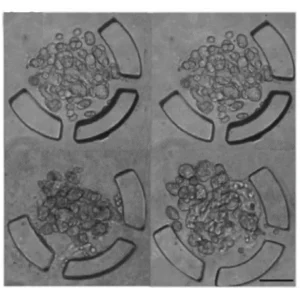
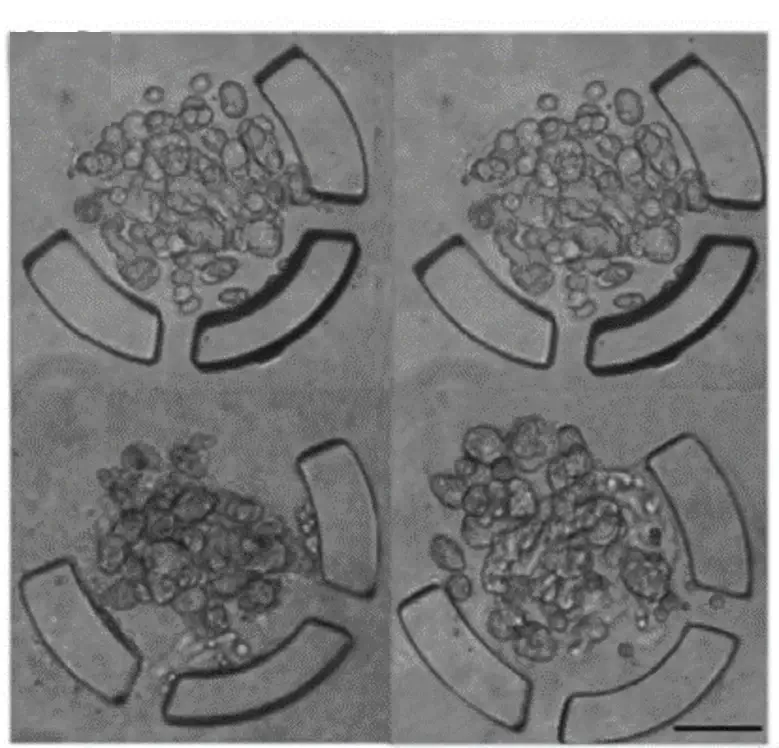
Microstructures en forme de U
Les microstructures en forme de U fonctionnent soit temporairement, par actionnement pneumatique, soit en permanence à l'intérieur du dispositif. Beaucoup de ces microstructures en forme de U sont généralement intégrées. Le diamètre des sphéroïdes dépend de la taille de la microstructure, tandis que la position relative des microstructures est essentielle pour un piégeage cellulaire efficace.
In addition, it is possible to modulate the time of spheroid formation using the flow rate. However, high flow rates cause the cells to escape from the trap. On the other hand, in order to keep the spheroids inside the microstructures, the flow must be maintained, thus maintaining the necessary stagnation pressure.
Puces microfluidiques à base de micropuits pour la formation de sphéroïdes (µSFC)
In general, a microwell-based µSFC needs a specified number of microwells and a microchannel network to deliver the culture medium. Microchannels should be designed in a way that can prevent undesirable spheroid escape from the microwells. Experimentally, it has been indicated that increasing the channel width or decreasing its height can limit spheroid escape.
In order to equalize flow rates across several microchannels, flow resistance must be the same through all of them. Therefore, if channels have the same width and height, their lengths must also be equal to satisfy this requirement. Sinuous channels, often used in concentration gradient generators (CGGs) as mixing channels, are appropriate to adjust channel length precisely within a smallarea of the chip. Such channels can thus be applied for flow control purposes rather than including valves within microfluidic chips. Desired flow rates must also take into account the number of cells existing in the culture environment and their corresponding requirements for oxygen, nutrients and other factors.
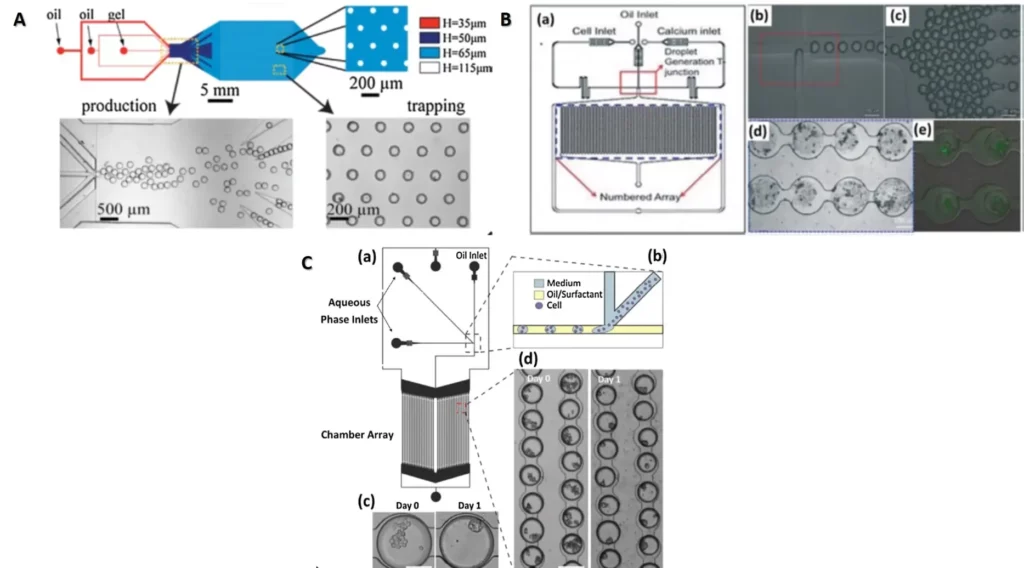
Il existe de nombreux dispositifs qui peuvent être utilisés pour piéger des cellules organisées appelées sphéroïdes ou organoïdes. La figure 3 présente certains de ces dispositifs.