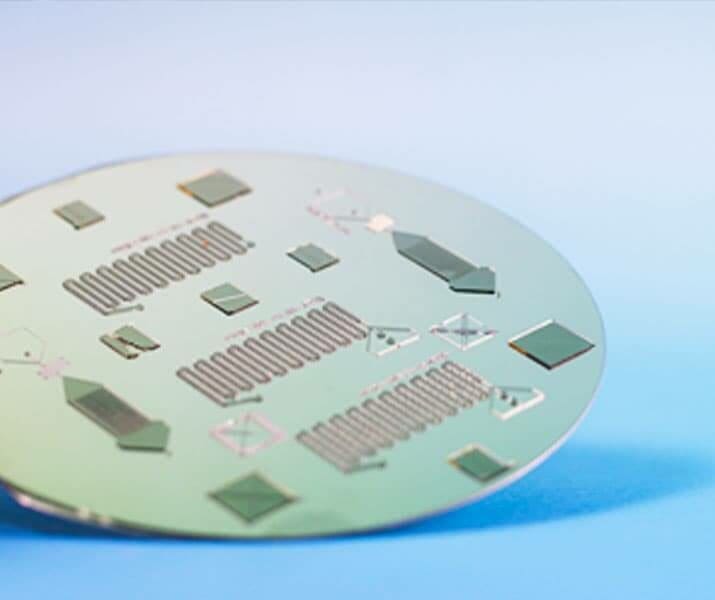
Il n'y a pas de microfluidique sans microfabrication. Puisque la microfluidique repose sur le contrôle des fluides à travers des dispositifs tels que les puces ADN, les Lab-on-Chips et les Organ-on-Chips à l'échelle submillimétrique, la microfabrication est essentielle pour la création de motifs géométriquement définis.
Il existe de nombreuses techniques de microfabrication issues de l'industrie microélectronique pour la microfabrication de semi-conducteurs, de circuits et de systèmes micro-électromécaniques (MEMS). En microfluidique, le micropatterning représente les techniques spécifiques impliquées dans la fabrication de la plupart des dispositifs [1].
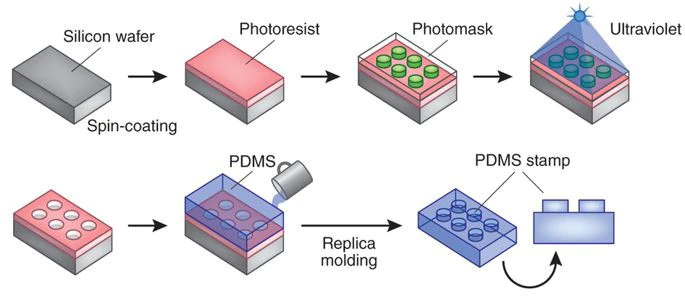
L'ensemble du processus de microfabrication d'un micropatterning courant est représenté à la figure 1.
Il consiste en la combinaison de deux techniques de lithographie, la photolithographie et la soft-lithographie, pour la fabrication d'un dispositif en polydiméthylsiloxane (PDMS).
Qu'est-ce que la photolithographie ?
Photolithography, known also as optical lithography, is the key process for microstructure scaffold fabrication. Through the photolithography is possible to create a geometrically defined pattern in a layer of an energy-definable polymer called photoresist. The most widely used photolithography technique employs the UV light to transfer a specific pattern from a photomask to the UV light-sensitive photoresist laid on a rigid substrate.
Usually, with the most common clean-room facility, photolithography is used to prepare molds with negative relief patterns of SU-8 photoresist on a silicon (Si) wafer. The SU-8 is an acid-catalyzed negative photoresist often used for the microfabrication of structures with high aspect/ratio [3].
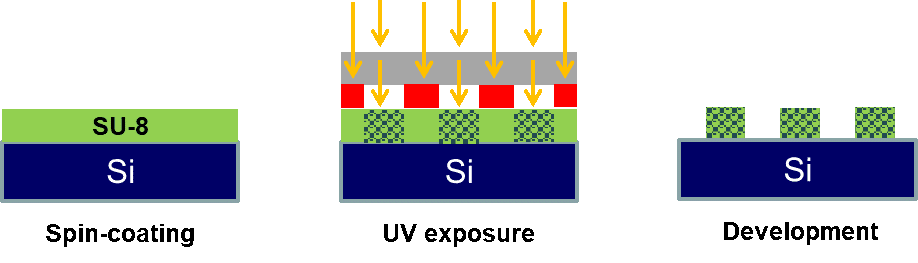
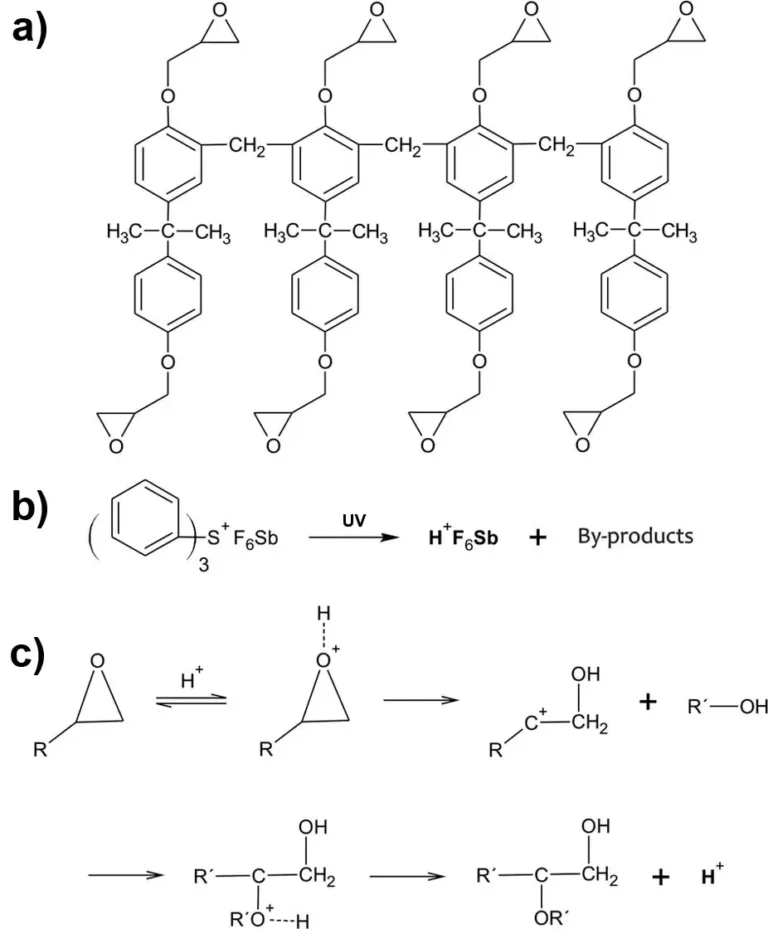
As schematized in figure 2, a uniform film of SU-8 is spin-coated on a Si wafer, then a photomask with a microscale pattern is overlaid and this assembly is exposed to the UV light to transfer the pattern. The photoresist contains indeed highly branched epoxy groups (Fig. 3a) and the UV activates the photolytic reaction by producing the photoacid initiator (Fig. 3b) able to protonate the SU-8 epoxides and start the polymerization (Fig. 3c).
The desired pattern is finally developed by dissolving the uncross-linked photoresist: the precise control of the process allows to achieve the desired micro- and nanoarchitecture in term of dimension, depth and shape. The obtained SU-8 mold presents the inverse pattern of the final device structure and will be used in the following step of soft-lithography.
Qu'est-ce que la soft-lithography ?
La soft-lithographie, également appelée moulage par réplique, utilise des polymères élastomères pour créer des moules complémentaires à un gabarit portant le motif négatif. Cette méthode de structuration présente plusieurs avantages tels que des coûts réduits, un débit élevé, une mise en œuvre facile et une bonne résolution de motif [1].
Once the microfabrication is done by photolithography, the master mold can be used several times to produce the polymer stamps and PDMS, in particular, is the most common elastomer widely employed to create microfluidic devices which find application in different research fields from biology to chemistry and physic.
Figure 4 shows how the PDMS is used in the replica molding to fabricate chips from a SU-8 patterned mold (previously created by photolithography). In particular, a mixture of PDMS base and curing agent is generally poured on the mold and degassed. The PDMS stamp is separated from the mold only after the process of polymerization through a crosslinking at 60 °C for at least 2 h. Finally, in order to obtain the final microfluidic device, the PDMS stamp can be assembled for example with a glass support through a covalent bonding by using the oxygen plasma treatment.
Références
[1] Onur, S. et al. 3 – Micro- and nanopatterning of biomaterial surfaces. Fundamental Biomaterials: Metals, Woodhead Publishing, 2018: p. 67-78.
[2] Bhatia, S.N. et D.E. Ingber, Microfluidic organs-on-chips. Nature Biotechnology, 2014. 32: p. 760.
[3] Pinto, C.V., et al., Optimized SU-8 Processing for Low-Cost Microstructures Fabrication without Cleanroom Facilities. Micromachines, 2014. 5(3).
[4] Lima, R.S., et al., Liaison adhésive sacrificielle : une méthode puissante pour la fabrication de micropuces en verre. Scientific Reports, 2015. 5: p. 13276.