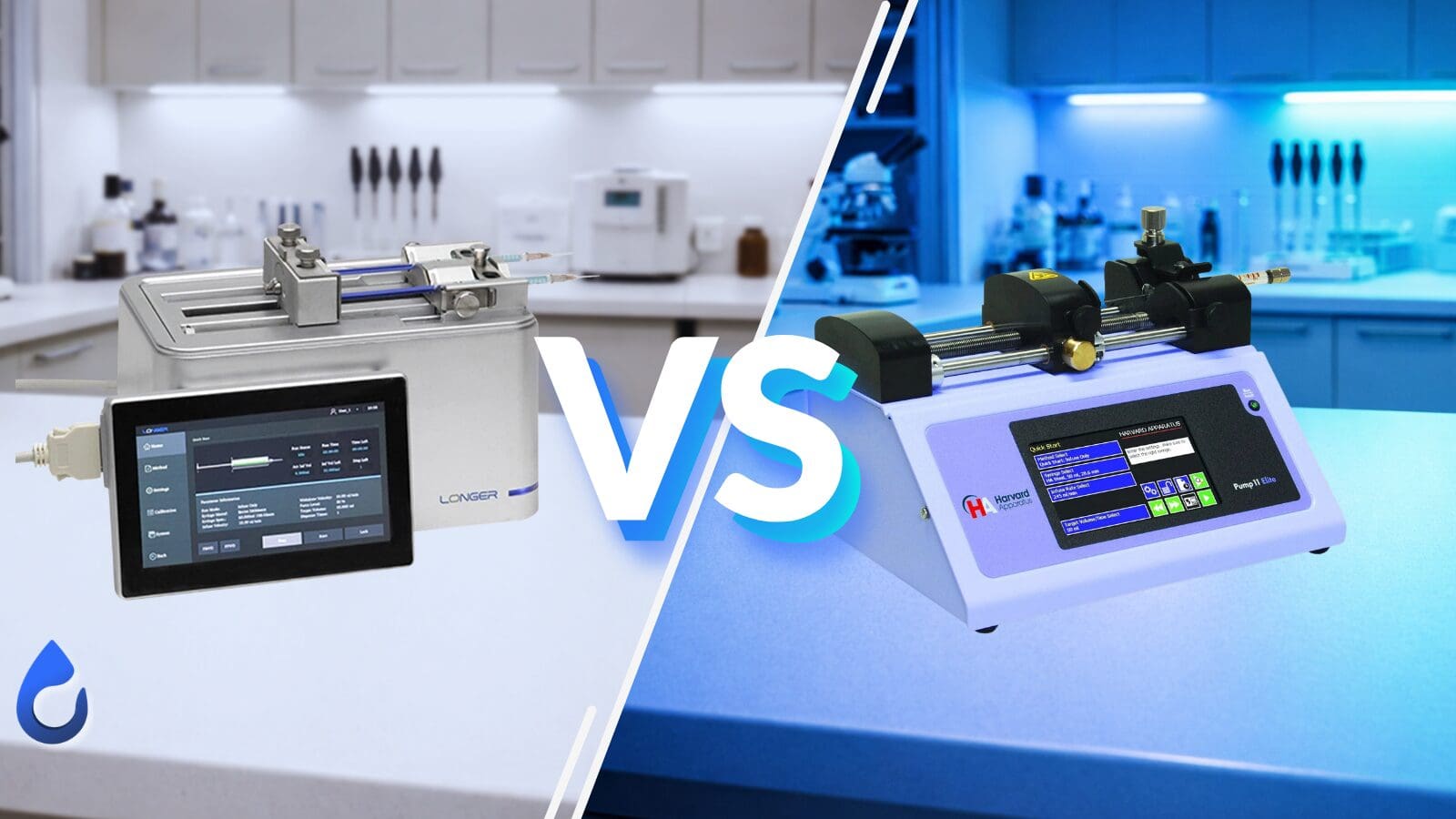
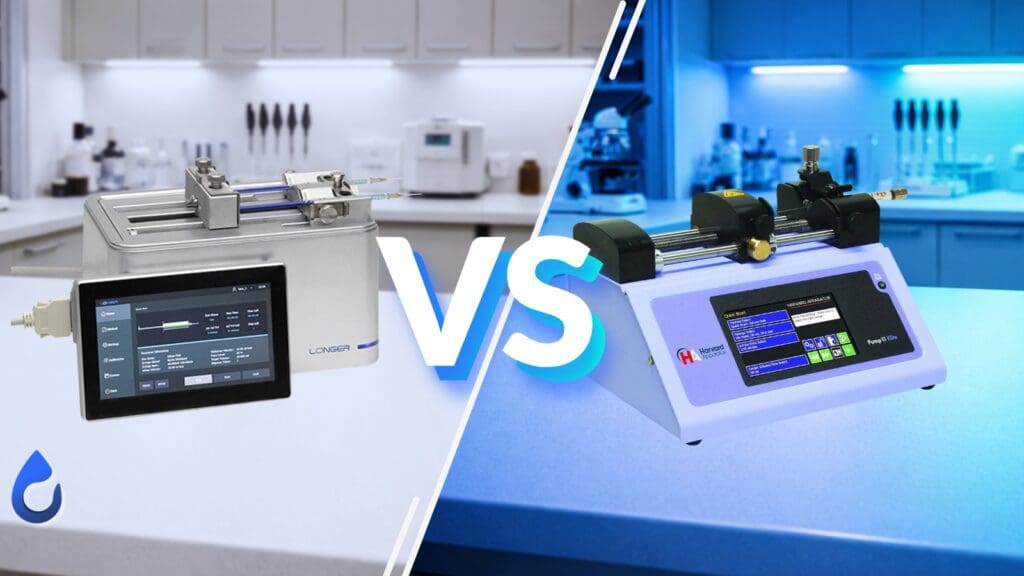
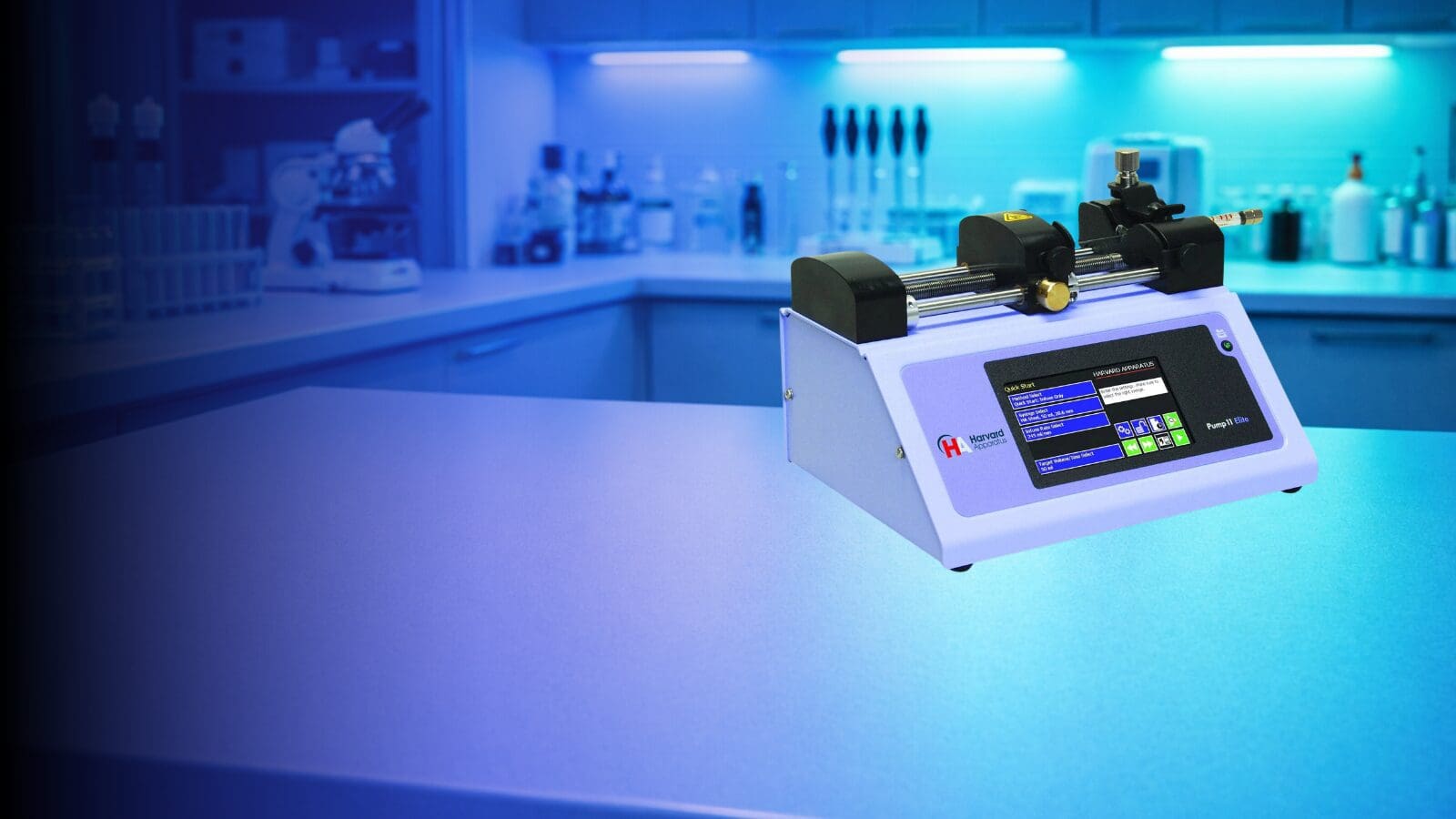
dLSP 500 vs 11 Elite: Quick Verdict
The dLSP 500 wins for labs requiring maximum precision, regulatory compliance, and modern connectivity options. Its Pro version delivers ±0.35% linear travel accuracy and meets 21CFR Part 11 requirements, making it the clear choice for pharmaceutical research and GLP/GMP environments. The Harvard Apparatus 11 Elite takes the crown for budget-conscious labs prioritizing proven reliability, extensive pump networking capabilities, and a compact footprint.
Choose the dLSP 500 if precision and regulatory compliance drive your purchasing decision. Choose the Harvard Apparatus 11 Elite if you need a versatile workhorse at a lower entry price with better scalability.
dLSP 500 vs 11 Elite at a Glance
| Feature | dLSP 500 Series | Harvard Apparatus 11 Elite |
|---|---|---|
| Price Range | $3,409 – $5,014 | $2,691 – $4,430 |
| Accuracy | ±0.35% (Pro) / ±0.5% (Standard) | ±0.5% |
| Reproducibility | ±0.05% | ±0.05% |
| Flow Rate Range | 0.3 pL/min – 120 mL/min | 1.26 pL/min – 88.4 mL/min |
| Display | 7" IPS HD LCD (1024×600) | 4.3" WQVGA TFT |
| Max Syringe Size (Dual) | 30 mL | 10 mL |
| Linear Force | 40 lbs (18 kg) | 35 lbs (16 kg) |
| Pump Networking | Up to 99 pumps | Up to 99 pumps |
| 21CFR Part 11 | Yes (Pro version) | No |
| Warranty | Standard | 2 years |
The comparison reveals two distinct philosophies. The dLSP 500 prioritizes precision engineering and regulatory readiness, while the Harvard Apparatus 11 Elite focuses on versatility and multi-pump laboratory setups. The dLSP 500’s larger display and superior accuracy specifications position it for demanding research applications, whereas the 11 Elite’s lower entry price and extensive networking make it ideal for teaching labs and facilities running multiple pump stations.
Description of the dLSP 500 Digital Syringe Pump
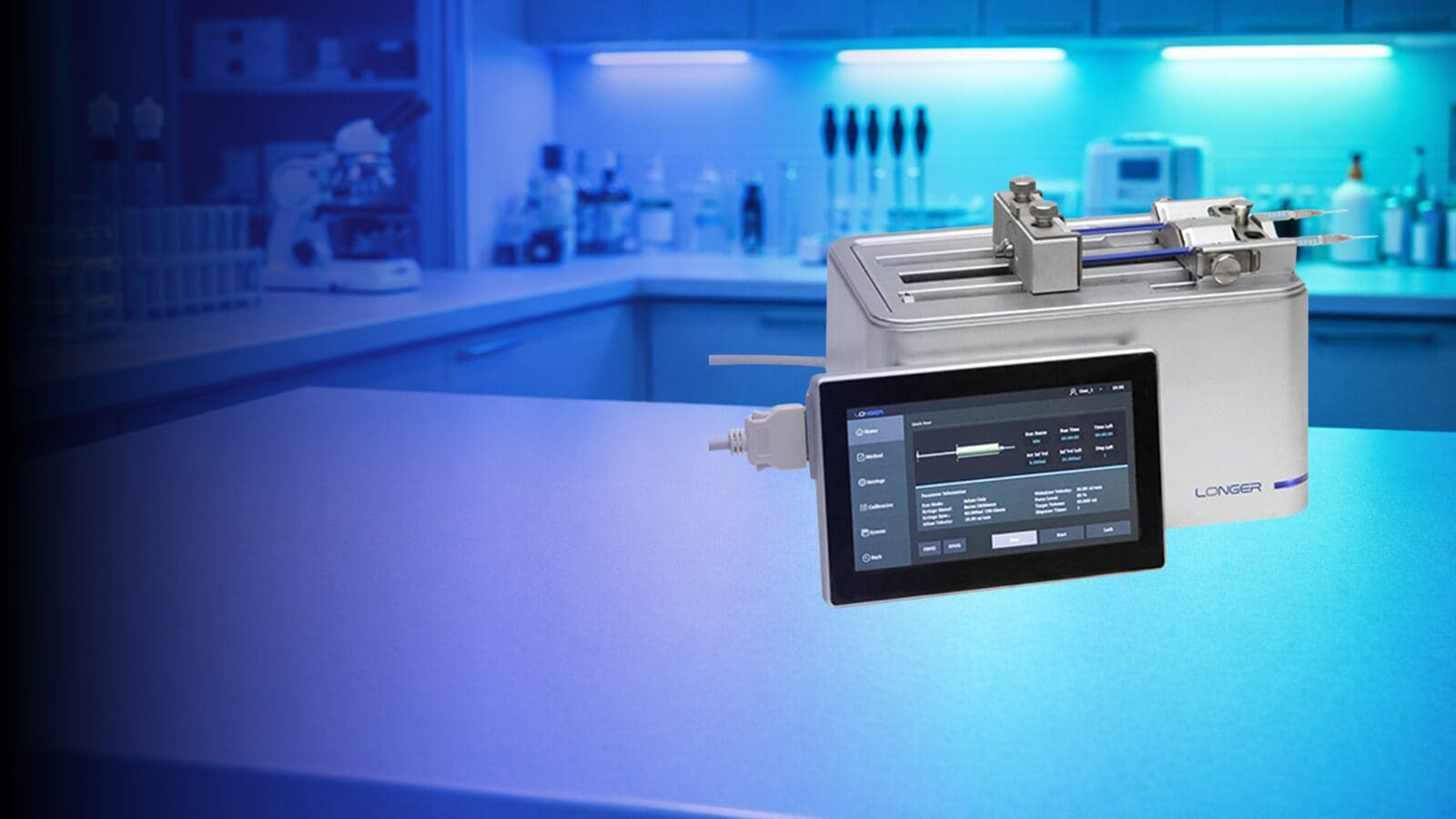
The dLSP 500 Series represents a high-precision syringe pump platform designed specifically for microfluidics applications. Available in four models (dLSP 510, 520, 510 Pro, and 520 Pro), this system delivers flow rates from picoliter to milliliter ranges with exceptional stability.
The standard models offer ±0.5% linear travel accuracy, while the Pro versions push this to ±0.35%. Both achieve ±0.05% reproducibility. The Pro models also include multi-step programmability with workflow blocks including constant, ramp, loop, delay, repeat, and various trigger options.
What sets the dLSP 500 apart is its connectivity. The system supports USB, RS485, Ethernet, Wi-Fi, and Bluetooth protocols. You can control it via the 7-inch touchscreen, dedicated PC software, or an Android app. For pharmaceutical and clinical research facilities, the Pro version’s 21CFR Part 11 compliance eliminates validation headaches.
The dual-channel dLSP 520 accommodates syringes from 0.5 µL to 30 mL, delivering maximum flow rates up to 74.7 mL/min. Single-channel models support syringes up to 60 mL with flow rates reaching 120 mL/min.
Pricing starts at $3,409.73 for the single-channel standard model and reaches $5,014.27 for the dual-channel Pro version.
What is Harvard Apparatus 11 Elite Programmable Syringe Pump?
Harvard Apparatus has been manufacturing laboratory equipment for decades, and the 11 Elite represents their flagship programmable syringe pump line. This microprocessor-controlled system delivers flow rates from 1.26 pL/min to 88.4 mL/min (single syringe) or up to 26.02 mL/min (dual syringe configuration).
The pump achieves ±0.5% accuracy and ±0.05% reproducibility through its 0.9° stepper motor with 1/16 microstepping. The 4.3-inch color touchscreen provides intuitive control without requiring a computer connection.
Harvard Apparatus offers two operational versions. The infusion-only model handles straightforward delivery applications, while the infusion/withdrawal programmable version supports ramp, gradient, and multi-step programming with up to 50 steps per method. Users can store two custom methods directly on the pump.
The 11 Elite’s standout feature is its networking capability. Using RS-485 connections, you can daisy-chain up to 99 pumps and control them from a single interface. The compact design also allows vertical operation, reducing bench footprint by 55% when space is limited.
The dual syringe rack accommodates syringes from 0.5 µL to 10 mL. A 2-year warranty and CE, ETL, and RoHS certifications provide peace of mind for institutional purchasing.
Pricing ranges from $2,691.00 for basic configurations to $4,429.62 for fully-equipped dual programmable models.
Feature-by-Feature Comparison
Accuracy and Precision
Accuracy determines whether your experiments produce publishable data. The dLSP 500 Pro models achieve ±0.35% linear travel accuracy, outperforming the Harvard Apparatus 11 Elite’s ±0.5% specification. Both systems match at ±0.05% reproducibility.
The difference matters most at ultra-low flow rates. The dLSP 500 Pro reaches minimum flows of 0.3 pL/min compared to the 11 Elite’s 1.26 pL/min. For nanoparticle synthesis, droplet microfluidics, or single-cell applications, that four-fold improvement in minimum flow rate translates to expanded experimental possibilities.
Winner: dLSP 500 Pro for its superior accuracy specification and lower minimum flow rates.
User Interface and Display
The dLSP 500 features a 7-inch IPS HD LCD display with 1024×600 resolution. This larger screen accommodates more information simultaneously and improves visibility from across the lab bench. The Harvard Apparatus 11 Elite uses a 4.3-inch WQVGA TFT touchscreen.
Both interfaces allow method programming without computer connection. The 11 Elite’s interface has been refined over multiple product generations, and users report quick learning curves. The dLSP 500’s larger display reduces eye strain during extended monitoring sessions.
Winner: dLSP 500 for display size and resolution, though the 11 Elite’s proven interface remains highly functional.
Connectivity Options
The dLSP 500 supports USB, RS485, Ethernet, Wi-Fi, and Bluetooth. This broader connectivity enables easier integration with automated systems, remote monitoring, and optional PC software control. It also supports daisy-chaining of up to 99 pumps, matching the Harvard unit for large synchronized setups.
The Harvard Apparatus 11 Elite offers USB, RS-485, footswitch input, and digital I/O through a 15-pin D-sub connector. Its RS-485 implementation also allows daisy-chaining up to 99 pumps, giving it strong networking capability for multi-pump laboratory workflows.
Winner: The dLSP 500 goes further with Ethernet, Wi-Fi, and Bluetooth, giving it a more versatile connectivity package.
Syringe Compatibility
The dLSP 520 dual-channel model accommodates syringes from 0.5 µL to 30 mL. The Harvard Apparatus 11 Elite dual configuration is limited to 10 mL maximum syringe size.
For single-channel operation, the dLSP 510 handles syringes up to 60 mL, while the 11 Elite single syringe rack accepts 50/60 mL syringes. Both systems work with glass and plastic syringes.
Winner: dLSP 500 for dual-channel applications requiring larger syringe volumes.
Linear Force
The dLSP 500 generates 40 lbs (18 kg) of linear force at 100% selection. The Harvard Apparatus 11 Elite produces 35 lbs (16 kg). This 14% force advantage helps the dLSP 500 maintain consistent flow when pushing viscous fluids or overcoming back pressure from microfluidic chips.
Winner: dLSP 500 for applications involving viscous fluids or high-resistance systems.
Regulatory Compliance
The dLSP 500 Pro versions meet 21CFR Part 11 requirements for electronic records and signatures. This compliance is mandatory for pharmaceutical development, clinical research, and GLP/GMP manufacturing environments. The Harvard Apparatus 11 Elite does not offer this certification.
For academic research without regulatory oversight, this difference is irrelevant. For industry applications, it can determine whether a pump is even eligible for consideration.
Winner: dLSP 500 Pro for regulated environments; tie for academic research.
Physical Footprint
The Harvard Apparatus 11 Elite measures 22.6 x 17.78 x 15 cm and weighs 2.1 kg. Its vertical operation capability reduces bench footprint by 55%. The dLSP 500 drive unit measures 260 x 185 x 180 mm and weighs 3.49 kg, plus a separate 0.37 kg controller.
Winner: Harvard Apparatus 11 Elite for space-constrained laboratories.
Pricing: dLSP vs 11 Elite
The Harvard Apparatus 11 Elite enters at $2,691 for basic configurations, roughly $700 less than the dLSP 500’s starting price of $3,409.73. This gap narrows when comparing fully-equipped dual programmable models: $4,429.62 for the 11 Elite versus $5,014.27 for the dLSP 520 Pro.
For academic teaching labs running standard microfluidics experiments, the 11 Elite provides excellent value. The $700-$900 savings per unit adds up quickly when equipping multiple stations. The 2-year warranty reduces long-term ownership risk.
Core research facilities and pharmaceutical labs face different calculations. The dLSP 500 Pro’s 21CFR Part 11 compliance eliminates the cost of validation workarounds or third-party documentation systems. The improved accuracy specification (±0.35% vs ±0.5%) may reduce experimental variability enough to decrease required replicate counts.
Budget-conscious labs should also consider total equipped cost. The dLSP 500 includes PC software as an optional add-on, while the 11 Elite’s basic connectivity covers most needs without extras. Factor in any required communication modules or accessories when comparing quotes.
The Verdict: dLSP 500 Digital Syringe Pump or Harvard Apparatus 11 Elite Programmable Syringe Pump?
Choose the dLSP 500 if you:
- Work in pharmaceutical development or clinical research requiring 21CFR Part 11 compliance
- Need maximum accuracy (±0.35%) for ultra-low flow rate applications
- Require dual-channel operation with syringes larger than 10 mL
- Value wireless connectivity and remote monitoring via Android app
- Push viscous fluids or work with high-resistance microfluidic systems
- Prefer a larger display for extended monitoring sessions
Choose the Harvard Apparatus 11 Elite if you:
- Operate on a tighter budget and need reliable performance at lower cost
- Plan to network multiple pumps in a single laboratory
- Work in space-constrained environments where vertical operation helps
- Run a teaching lab requiring multiple identical pump stations
- Need a proven platform backed by decades of Harvard Apparatus support
- Prioritize a compact, lightweight unit for portable applications
Both pumps deliver professional-grade performance for microfluidics research. The decision ultimately hinges on whether you need the dLSP 500’s superior precision and regulatory compliance or the 11 Elite’s networking flexibility and lower entry cost.

Frequently Asked Questions
Which pump offers better accuracy for ultra-low flow rates?
The dLSP 500 Pro achieves ±0.35% linear travel accuracy and minimum flow rates of 0.3 pL/min. The Harvard Apparatus 11 Elite offers ±0.5% accuracy with minimum flows of 1.26 pL/min. For picoliter-range applications, the dLSP 500 Pro provides measurably better performance.
Can I control multiple pumps from one computer?
The Harvard Apparatus 11 Elite supports daisy-chaining up to 99 pumps via RS-485. The dLSP 500 offers various connectivity protocols with an equivalent multi-pump networking capability.
Which pump works better for pharmaceutical research?
The dLSP 500 Pro meets 21CFR Part 11 requirements for electronic records and signatures. The Harvard Apparatus 11 Elite does not offer this compliance certification, making the dLSP 500 Pro the clear choice for regulated environments.
What syringe sizes can each pump accommodate?
The dLSP 520 dual-channel model accepts syringes from 0.5 µL to 30 mL. The Harvard Apparatus 11 Elite dual configuration is limited to 10 mL maximum. Single-channel versions of both pumps accommodate larger syringes up to 50-60 mL.
How do the warranties compare?
The Harvard Apparatus 11 Elite includes a 2-year warranty. Warranty terms for the dLSP 500 should be confirmed with the supplier at time of purchase.
Can both pumps operate without a computer?
Yes. Both systems feature touchscreen interfaces that allow complete pump control, method programming, and operation monitoring without computer connection.
Which pump takes up less bench space?
The Harvard Apparatus 11 Elite is more compact and can operate vertically, reducing footprint by 55%. The dLSP 500 requires more bench space with its separate drive unit and controller.