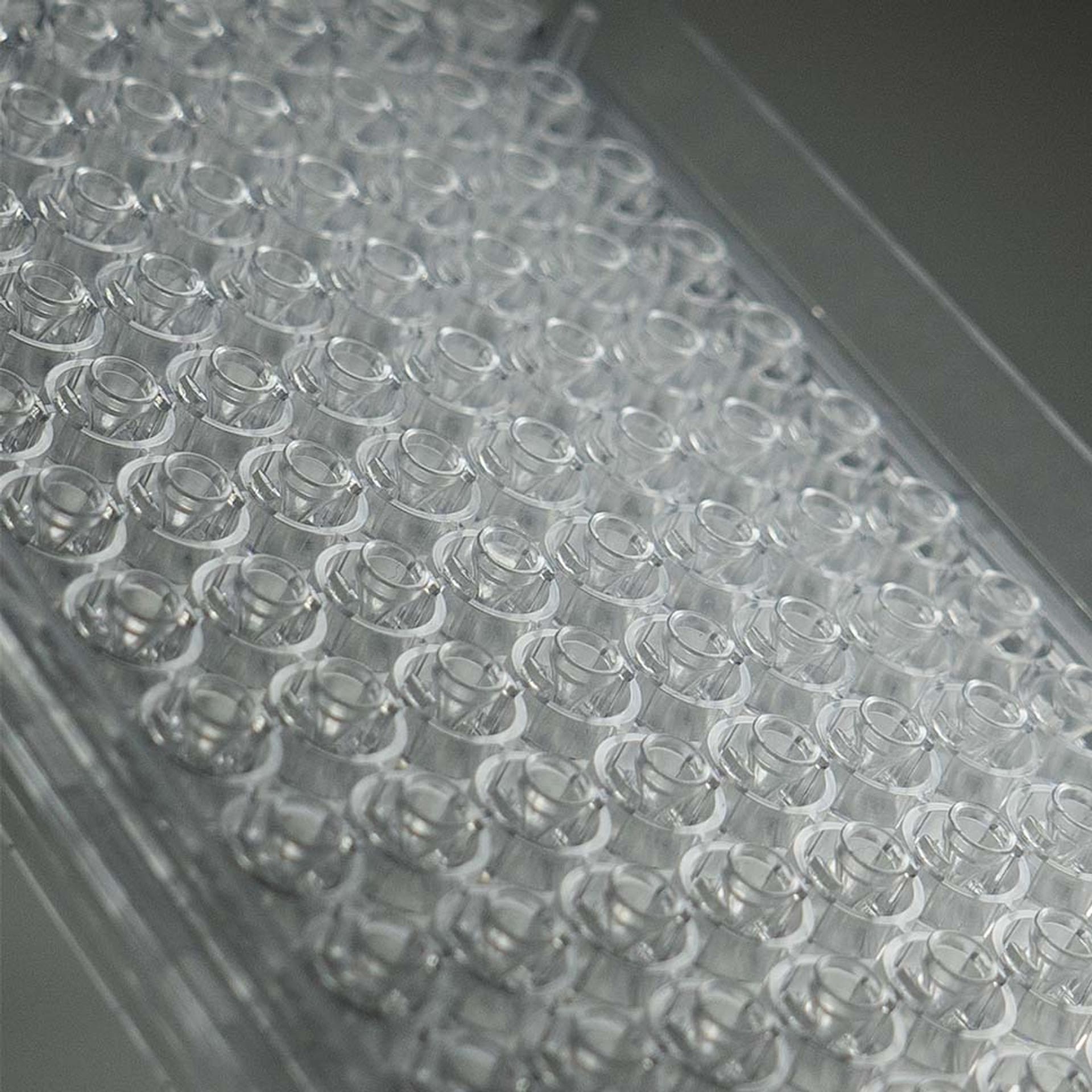

Bei der Auswahl Chips (z. B. Lab-on-a-Chip, organe sur puce) oder Mikroplatten (z. B. Sphäroide oder Hanging-Drop-Mikroplatten) für mikrofluidische Anwendungen ist die Gewährleistung der chemischen Beständigkeit entscheidend für die Aufrechterhaltung der Systemintegrität und -leistung. PS (Polystyrol) ist aufgrund seiner optischen Transparenz, seines geringen Gewichts und seiner Bruchsicherheit eine beliebte Wahl. Es wird häufig in medizinischen, pharmazeutischen und lebensmittelverarbeitenden Anwendungen eingesetzt, da es eine hervorragende Beständigkeit gegenüber Wasser, Alkoholen und einer Vielzahl von Chemikalien aufweist.
Wie alle Materialien hat jedoch auch PS seine Grenzen, und nicht jede Chemikalie ist damit verträglich. Daher ist es unerlässlich, die Beständigkeit zu kennen, um eine Zersetzung zu verhindern und die Sicherheit zu gewährleisten. In diesem Leitfaden stellen wir eine umfassende Tabelle zur chemischen Beständigkeit von PS-Chips und -Mikroplatten vor. Diese Tabelle basiert auf den von Reichelt Chemietechnik bereitgestellten Daten zur chemischen Beständigkeit (bei 20 °C) und soll Ingenieuren, Technikern und Forschern dabei helfen, schnell zu ermitteln, ob PS-Chips oder -Mikroplatten für ihre spezifischen Anwendungen geeignet sind, um eine zuverlässige und langlebige Leistung in verschiedenen chemischen Umgebungen zu gewährleisten.
Nutzen Sie diese Tabelle, um fundierte Entscheidungen zu treffen und die Effizienz und Sicherheit Ihres Systems zu gewährleisten.
💡 Die Legende zur Chemikalienbeständigkeit lautet wie folgt:
- resistent = keine bis geringe Wirkung
- geringer Widerstand = mäßige Wirkung
🚨 Die in diesen Tabellen angegebenen Widerstandswerte dienen lediglich als allgemeine Orientierungshilfe und sind möglicherweise nicht vollständig oder genau. Sie berücksichtigen weder eine mögliche Verunreinigung noch Veränderungen der Flüssigkeitseigenschaften aufgrund von Wechselwirkungen zwischen Material und Flüssigkeit ( tube ). Wir übernehmen keine Gewähr für die Eignung eines Materials für bestimmte Zwecke oder für die Auswirkungen von Wechselwirkungen zwischen Material und Flüssigkeit ( tube ) auf die Flüssigkeitsqualität. Bei kritischen Anwendungen sollten Sie spezifische Tests durchführen oder fachkundigen Rat einholen.
PS-Chips und Mikrotiterplatten: Tabelle zur chemischen Beständigkeit
| Stoff/Medium | Chemikalienbeständigkeit |
|---|---|
| A | |
| Acetamid | resistent |
| Essigsäure, 10 % | resistent |
| Essigsäure, 5 % | resistent |
| Essigsäure, 50 % | begrenzter Widerstand |
| Acetylsalicylsäure | resistent |
| Adipinsäure | resistent |
| Adipinsäure, wässrig | resistent |
| Alanin | resistent |
| Allylalkohol | resistent |
| Allylalkohol (2-Propen-1-ol) | resistent |
| Mandelöl | begrenzter Widerstand |
| Aluminiumchlorid | resistent |
| Aluminiumhydroxid | begrenzter Widerstand |
| Aluminiumnitrat | resistent |
| Aluminiumoxid | resistent |
| Aluminiumkaliumsulfat, verdünnt | resistent |
| Aluminiumkaliumsulfat, gesättigt | resistent |
| Aluminiumsulfat | resistent |
| Aminosäuren | resistent |
| Ammoniumacetat | resistent |
| Ammoniumcarbonat, 50 % | resistent |
| Ammoniumchlorid, wässrig | resistent |
| Ammoniumdihydrogenphosphat | resistent |
| Ammoniumfluorid (Fluorammon) | resistent |
| Ammoniumglykolat | resistent |
| Ammoniumheptamolybdat | resistent |
| Ammoniumhydroxid | resistent |
| Ammoniumhydroxid, 30 % | begrenzter Widerstand |
| Ammoniumhydroxid, 5 % | resistent |
| Ammonium-Eisen(II)-sulfat | resistent |
| Ammoniumnitrat, 10 % | resistent |
| Ammoniumnitrat, gesättigt | resistent |
| Ammoniumoxalat | resistent |
| Ammoniumsulfat (Düngemittel) | resistent |
| Ammoniumsulfat, 10 % | resistent |
| Ammoniumsulfat, gesättigt | resistent |
| Ammoniumthiocyanat | resistent |
| Amylalkohol (Pentanol, Pentylalkohol) | begrenzter Widerstand |
| Frostschutzmittel (auf Glykolbasis) | resistent |
| Apfelsaft | resistent |
| Königswasser | begrenzter Widerstand |
| Arsensäure | resistent |
| Arsensäure, wässrig | resistent |
| B | |
| Bariumbromid | resistent |
| Bariumcarbonat | resistent |
| Bariumchlorid | resistent |
| Bariumchlorid, gesättigt | resistent |
| Batteriesäure | resistent |
| Rindertalg | resistent |
| Bier | resistent |
| Benzoesäure, gesättigt | resistent |
| Bleichpulver | resistent |
| Blauer Vitriol (Kupfersulfat) | resistent |
| Knochenöl | resistent |
| Borsäure, 10 % | resistent |
| Bremsflüssigkeit, ATE blau (auf Glykolbasis) | begrenzter Widerstand |
| Butanol (Butylalkohol) | resistent |
| Butanol (Butylalkohol), sekundär | resistent |
| Butanol (Butylalkohol), tertiär | resistent |
| Butanol-1 (Butylalkohol) | begrenzter Widerstand |
| Butter | resistent |
| Butylalkohol (Butanol) | resistent |
| Butylalkohol (Butanol), sekundär | resistent |
| Butylalkohol (Butanol), tertiär | resistent |
| C | |
| Cadmiumbromid | resistent |
| Kalziumbromid | resistent |
| Kalziumkarbonat (Kreide) | resistent |
| Kalziumchlorid | resistent |
| Kalziumchlorid, wässrig | resistent |
| Kalziumhydroxid (Kalkmilch) | resistent |
| Kalziumhydroxid (Kalkmilch), wässrig | resistent |
| Kalziumhydroxid (Kalkmilch), konzentriert | resistent |
| Calciumhypochlorit | resistent |
| Kalziumhypochlorit, wässrig | resistent |
| Kalziumhypochlorit, gesättigt | resistent |
| Kalziumnitrat, 50 % | resistent |
| Kalziumoxid | resistent |
| Kalziumphosphat | resistent |
| Kalziumphosphat, wässrig | resistent |
| Kalziumsulfat (Gips) | resistent |
| Kampfer | resistent |
| Kampferöl | resistent |
| Kampferöl (Kampfer) | resistent |
| Carbazol | resistent |
| Kohlendioxid | resistent |
| Rizinusöl | resistent |
| Ätzkali (Kaliumhydroxid, Kalilauge) | begrenzter Widerstand |
| Ätznatron (Natriumhydroxid, Natronlauge), 50 % | resistent |
| Kreide (Kalziumkarbonat) | resistent |
| Chloressigsäure (Ethylchloracetat) | resistent |
| Chloressigsäureethylester (Ethylchloracetat) | resistent |
| Chromsäure, 10 % | resistent |
| Chromsäure, 20 % | resistent |
| Chromsäure, 50 % | begrenzter Widerstand |
| Chromoschwefelsäure | begrenzter Widerstand |
| Zimt | begrenzter Widerstand |
| Zitronensäure, 10 % | resistent |
| Zitronensäure, 50 % | resistent |
| Zitronensäure, gesättigt | resistent |
| Kohlegas, ohne Benzol | resistent |
| Kakao | resistent |
| Kokosöl (gehärtet) | resistent |
| Lebertran | resistent |
| Kochsalz (Natriumchlorid) | resistent |
| Kupfersulfat (Blauer Vitriol) | resistent |
| Kupfer(II)-nitrat, gesättigt | resistent |
| Maiskeimöl | resistent |
| Rohöl | begrenzter Widerstand |
| Curry | begrenzter Widerstand |
| Cyclohexanol (Hexalin, Anol) | begrenzter Widerstand |
| D | |
| Decanol | begrenzter Widerstand |
| Dextrin | resistent |
| Dichloressigsäure | begrenzter Widerstand |
| Dieselkraftstoff | begrenzter Widerstand |
| Diethanolamin (DEA) | resistent |
| Diethylamin | begrenzter Widerstand |
| Diethylenglykol | begrenzter Widerstand |
| Dihydroxysuccin-Säure (Weinsäure) | resistent |
| Dimethylsulfoxid (DMSO) | resistent |
| Dipropylenglykol | resistent |
| Dodecanol (Laurylalkohol) | resistent |
| E | |
| Bittersalz (Magnesiumsulfat) | resistent |
| Ethanol (Ethylalkohol, Spiritus), 100 % | begrenzter Widerstand |
| Ethanol (Ethylalkohol, Spirituosen), 40 % | resistent |
| Ethanol (Ethylalkohol, Spiritus), 50 % | resistent |
| Ethanol (Ethylalkohol, Spiritus), 96 % | begrenzter Widerstand |
| Ethanol, 50 % | resistent |
| Ethanol, 96 % | begrenzter Widerstand |
| Ethylalkohol (Ethanol, Spiritus) | begrenzter Widerstand |
| Ethylchloracetat (Ethylester der Chloressigsäure) | resistent |
| Ethylcyanoacetat | resistent |
| Ethyllactat | begrenzter Widerstand |
| Ethylenglykol (Glykol, 1,2-Ethandiol) | resistent |
| Ethylhexanol (Isooctylalkohol, 2-Ethyl-1-hexanol) | begrenzter Widerstand |
| F | |
| Eisen(III)-chlorid (Eisen(III)-chlorid) | resistent |
| Eisenchlorid (Eisen(II)-chlorid) | resistent |
| Spirituosen (Ethylalkohol, Schnaps) | begrenzter Widerstand |
| Leinsamenöl (Linseedöl) | resistent |
| Fluorammon (Ammoniumfluorid) | resistent |
| Fluorsäure (Flusssäure), 4 % | resistent |
| Fluorsäure (Flusssäure), 40 % | resistent |
| Fluoride | resistent |
| Formaldehyd (Formalin, Methanal), 10 % | begrenzter Widerstand |
| Formamid | resistent |
| Ameisensäure, 3 % | resistent |
| Ameisensäure, 50 % | begrenzter Widerstand |
| Ameisensäure, 98–100 % | begrenzter Widerstand |
| Fruktose | resistent |
| Fruchtsäfte | resistent |
| Heizöl, auf Mineralölbasis | begrenzter Widerstand |
| G | |
| Gelatine | resistent |
| Glukose (Traubenzucker) | resistent |
| Glycerin (Glycerol) | resistent |
| Glykol (Ethylenglykol) | resistent |
| Traubenzucker (Glukose) | resistent |
| Gips (Calciumsulfat) | resistent |
| H | |
| Hexalin (Cyclohexanol) | begrenzter Widerstand |
| Hexamethylentetramin | resistent |
| Hexan | begrenzter Widerstand |
| Hexantriol | resistent |
| Bromwasserstoffsäure | begrenzter Widerstand |
| Salzsäure (Muriatsäure), 1–5 % | resistent |
| Salzsäure (Muriatsäure), 10 % | resistent |
| Salzsäure (Muriatsäure), 20 % | resistent |
| Salzsäure (Muriatsäure), 35 % | begrenzter Widerstand |
| Salzsäure (Muriatsäure), 37 % | begrenzter Widerstand |
| Salzsäure (Muriatsäure), konzentriert | begrenzter Widerstand |
| Salzsäure (Salzgeist) | begrenzter Widerstand |
| Blausäure (Cyanwasserstoff) | resistent |
| Fluorkieselsäure (Kieselsäure) | resistent |
| Wasserstoff | resistent |
| Wasserstoffperoxid, 3 % | resistent |
| Wasserstoffperoxid, 30 % | resistent |
| Wasserstoffperoxid, 90 % | resistent |
| Schwefelwasserstoff | begrenzter Widerstand |
| Iodwasserstoffsäure | resistent |
| I | |
| Jodtinktur | begrenzter Widerstand |
| Jod-Kaliumjodid-Lösung | begrenzter Widerstand |
| Jodoform (Triiodmethan) | begrenzter Widerstand |
| Eisennitrat, gesättigt | resistent |
| Eisen(II)-chlorid, wässrig (Eisen(II)-chlorid) | resistent |
| Eisen(II)-sulfat | resistent |
| Eisen(II)-sulfat, gesättigt | resistent |
| Eisen(III)-chlorid (Eisenchlorid) | resistent |
| Isoamylalkohol | resistent |
| Isobutanol (Isobutylalkohol) | resistent |
| Isobutylalkohol (Isobutanol) | resistent |
| Isooctan | begrenzter Widerstand |
| Isooctylalkohol (Ethylhexanol) | begrenzter Widerstand |
| Isopropanol (2-Propanol) | begrenzter Widerstand |
| J | |
| Marmelade | resistent |
| Javelwasser (Natriumhypochlorit, Bleichlösung) | resistent |
| L | |
| Milchsäure | resistent |
| Milchsäure, 3 % | resistent |
| Milchsäure, 80 % | resistent |
| Laktose | resistent |
| Lanolin (Wollfett) | resistent |
| Laurel | resistent |
| Laurylalkohol (Dodecanol) | resistent |
| Bleistearat | resistent |
| Bleisulfat | resistent |
| Blei(II)-acetat, wässrig | resistent |
| Blei(II)-nitrat | resistent |
| Zitronensaft | resistent |
| Leinöl (Flachsöl) | resistent |
| Lysol | begrenzter Widerstand |
| M | |
| Magnesiumbromid | resistent |
| Magnesiumcarbonat | resistent |
| Magnesiumchlorid, wässrig | resistent |
| Magnesiumhydroxid | resistent |
| Magnesiumnitrat | resistent |
| Magnesiumsulfat (Bittersalz) | resistent |
| Margarine | resistent |
| Quecksilber | resistent |
| Quecksilber(II)-chlorid | resistent |
| Quecksilberchlorid | resistent |
| Quecksilbernitrat | resistent |
| Methanol (Methylalkohol, Holzalkohol) | begrenzter Widerstand |
| Methylalkohol (Methanol, Holzalkohol) | begrenzter Widerstand |
| Milch | resistent |
| Kalkmilch (Kalziumhydroxid) | resistent |
| Mineralöle | resistent |
| Senf | resistent |
| N | |
| Naphtha | begrenzter Widerstand |
| Naphthalin (in Alkohol) | begrenzter Widerstand |
| Naphthalin (Steinöl) | begrenzter Widerstand |
| Nickelnitrat | resistent |
| Nickelsulfat, gesättigt | resistent |
| Nikotin | resistent |
| Salpetersäure, 1–10 % | resistent |
| O | |
| Öle und Fette, pflanzlich | begrenzter Widerstand |
| Ölsäure | resistent |
| Olivenöl | resistent |
| Orangensaft | resistent |
| Oxalsäure (Ethandisäure) | resistent |
| Sauerstoff | resistent |
| Ozon | begrenzter Widerstand |
| P | |
| Palmkernöl | resistent |
| Palmitinsäure | resistent |
| Paraffin (Alkan) | resistent |
| Erdnussöl | resistent |
| Pektin | resistent |
| Pektin, wässrig | resistent |
| Pentan | begrenzter Widerstand |
| Pentanol (Pentylalkohol, Amylalkohol) | begrenzter Widerstand |
| Pentylalkohol (Pentanol, Amylalkohol) | begrenzter Widerstand |
| Peressigsäure | resistent |
| Perchlorsäure, 70 % | resistent |
| Phosphorsäure, 1–5 % | resistent |
| Phosphorsäure, 30 % | resistent |
| Phosphorsäure, 85 % | resistent |
| Phthalsäure (Benzol-o-dicarbonsäure) | resistent |
| Ananassaft | resistent |
| Kaliumbromat, gesättigt | resistent |
| Kaliumbromid | resistent |
| Kaliumcarbonat | resistent |
| Kaliumcarbonat (Kaliumkarbonat) | resistent |
| Kaliumchlorat, wässrig | resistent |
| Kaliumchlorat, gesättigt | resistent |
| Kaliumchlorid (Sylvine) | resistent |
| Kaliumchromat, gelb, gesättigt | resistent |
| Kaliumdichromat, gesättigt | resistent |
| Kaliumferricyanid | resistent |
| Kaliumhydrogensulfat | resistent |
| Kaliumhydroxid (Ätzkali, Kalilauge) | begrenzter Widerstand |
| Kaliumhydroxid (Ätzkali, Kalilauge), 1 % | resistent |
| Kaliumhydroxid (Ätzkali, Kalilauge), 30 % | resistent |
| Kaliumhydroxid (Ätzkali, Kalilauge), 50 % | resistent |
| Kaliumhypochlorit | begrenzter Widerstand |
| Kaliumiodid, gesättigt | resistent |
| Kaliumnitrat (Salpeter), 50 % | resistent |
| Kaliumpermanganat | resistent |
| Kaliumpersulfat | resistent |
| Kaliumsulfid | resistent |
| Propandiol (Propylenglykol) | resistent |
| Propanol (Propylalkohol) | begrenzter Widerstand |
| Propionsäure (Methylessigsäure) | begrenzter Widerstand |
| Propylalkohol (Propanol) | begrenzter Widerstand |
| Propylenglykol (Propandiol) | resistent |
| Blausäure (Blausäure) | resistent |
| Pyrogallol (Pyrogallinsäure) | begrenzter Widerstand |
| R | |
| Resorcin (1,3-Dihydroxybenzol) | resistent |
| Resorcin, 5 % | resistent |
| S | |
| Salicylsäure (o-Hydroxybenzoesäure) | resistent |
| Salicylsäure, Pulver | resistent |
| Salicylsäure, gesättigt | resistent |
| Salzwasser (Meerwasser) | resistent |
| Meerwasser (Salzwasser) | resistent |
| Kieselsäure (Fluorkieselsäure) | resistent |
| Silikonfett | begrenzter Widerstand |
| Silikonöl | begrenzter Widerstand |
| Silberacetat | begrenzter Widerstand |
| Silbernitrat (Mondlauge) | begrenzter Widerstand |
| Soda (Natriumcarbonat) | resistent |
| Natriumacetat | resistent |
| Natriumbenzoat | resistent |
| Natriumbisulfat | resistent |
| Natriumborat, gesättigt | resistent |
| Natriumbromat | resistent |
| Natriumbromid | resistent |
| Natriumcarbonat (Soda) | resistent |
| Natriumchlorat | resistent |
| Natriumchlorid (Kochsalz) | resistent |
| Natriumchromat | resistent |
| Natriumdichromat | resistent |
| Natriumfluorid | resistent |
| Natriumhydroxid (Ätznatron, Natronlauge) | resistent |
| Natriumhydroxid (Ätznatron, Natronlauge), 1 % | resistent |
| Natriumhydroxid (Ätznatron, Natronlauge), 30 % | resistent |
| Natriumhydroxid (Ätznatron, Natronlauge), 45 % | resistent |
| Natriumhydroxid (Ätznatron, Natronlauge), 50 % | resistent |
| Natriumhydroxid (Ätznatron, Natronlauge), 60 % | resistent |
| Natriumhypochlorit (Bleichmittel, Javelwasser) | resistent |
| Natriumhypochlorit (Bleichlösung, Javelwasser), 12,5 % | resistent |
| Natriumhypochlorit (Bleichlösung, Javelwasser), 15 % | resistent |
| Natriumhypochlorit (Bleichmittel, Javelwasser), verdünnt | resistent |
| Natriumhypochlorit (Bleichlösung, Javelwasser), gesättigt | resistent |
| Natriumnitrat (chilenischer Salpeter), gesättigt | resistent |
| Natriumnitrit, gesättigt | resistent |
| Natriumperborat, gesättigt | resistent |
| Natriumphosphat, gesättigt | resistent |
| Natriumsilikat | resistent |
| Natriumsulfat (Glaubersalz), gesättigt | resistent |
| Natriumsulfid, gesättigt | resistent |
| Natriumsulfit | resistent |
| Spiritus (Ethylalkohol, Ethanol) | begrenzter Widerstand |
| Stauffer-Fett | resistent |
| Stearinsäure (Zinksalz) | resistent |
| Strychnin | resistent |
| Bernsteinsäure, gesättigt | resistent |
| Zuckerrübensaft | resistent |
| Zuckersirup | resistent |
| Schwefel | resistent |
| Schwefeldioxid, nass | begrenzter Widerstand |
| Schwefelsäure, 1–6 % | resistent |
| Schwefelsäure, 20 % | resistent |
| Schwefelsäure, 40 % | resistent |
| Schwefelsäure, 60 % | resistent |
| Schwefelsäure, 80 % | begrenzter Widerstand |
| T | |
| Gerbsäure (Tannin) | resistent |
| Tannin (Gerbsäure) | resistent |
| Teer | resistent |
| Weinsäure (Dihydroxybernsteinsäure) | resistent |
| Thymol | begrenzter Widerstand |
| Transformatoröl (auf Mineralölbasis) | resistent |
| Trichloressigsäure | begrenzter Widerstand |
| Triethanolamin (Triethylolamid) | resistent |
| Triethylenglykol | resistent |
| Triglykol | resistent |
| Tripropylenglykol (TPG) | resistent |
| U | |
| Undecylalkohol | resistent |
| Harnstoff | resistent |
| Urin | begrenzter Widerstand |
| V | |
| Vaseline | resistent |
| Vaselineöl | resistent |
| Essig | resistent |
| W | |
| Walnussöl | begrenzter Widerstand |
| Wasserglas (Kaliumsilikat) | resistent |
| Wasserglas (Natriumsilikat) | resistent |
| Wasser, destilliert | resistent |
| Wachse | resistent |
| Wein, Brandy | resistent |
| Holzalkohol (Methanol, Methylalkohol) | begrenzter Widerstand |
| Wollfett (Lanolin) | resistent |
| Z | |
| Zinkcarbonat | resistent |
| Zinkchlorid | resistent |
| Zinkchlorid, 10 % | resistent |
| Zinknitrat | resistent |
| Zinksalbe | resistent |
| Zinkoxid | resistent |
| Zinkphosphat | resistent |
| Zinksalz (Stearinsäure) | resistent |
| Zinkstearat | resistent |
| Zinksulfat | resistent |
| Zinksulfat, 10 % | resistent |