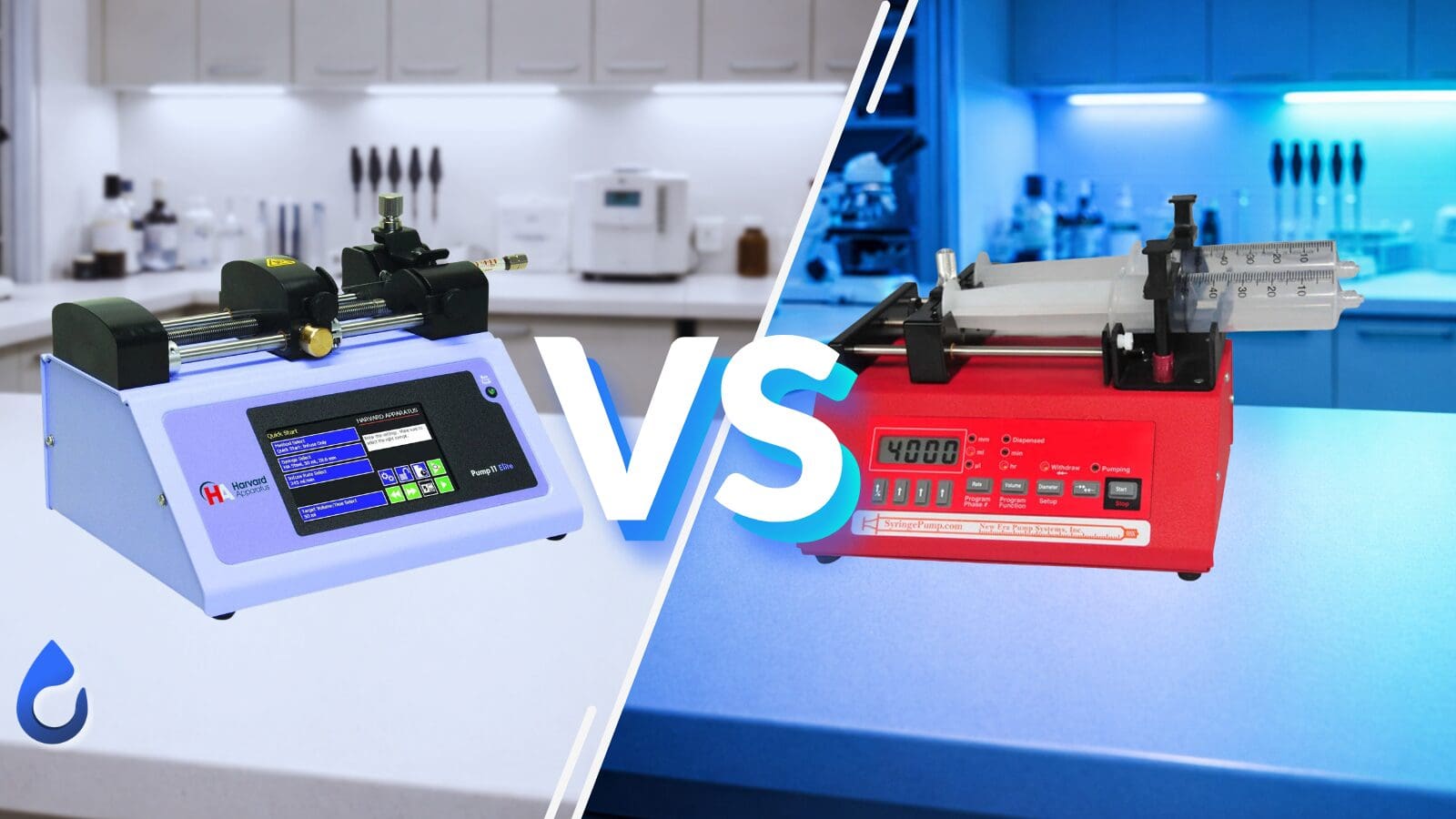
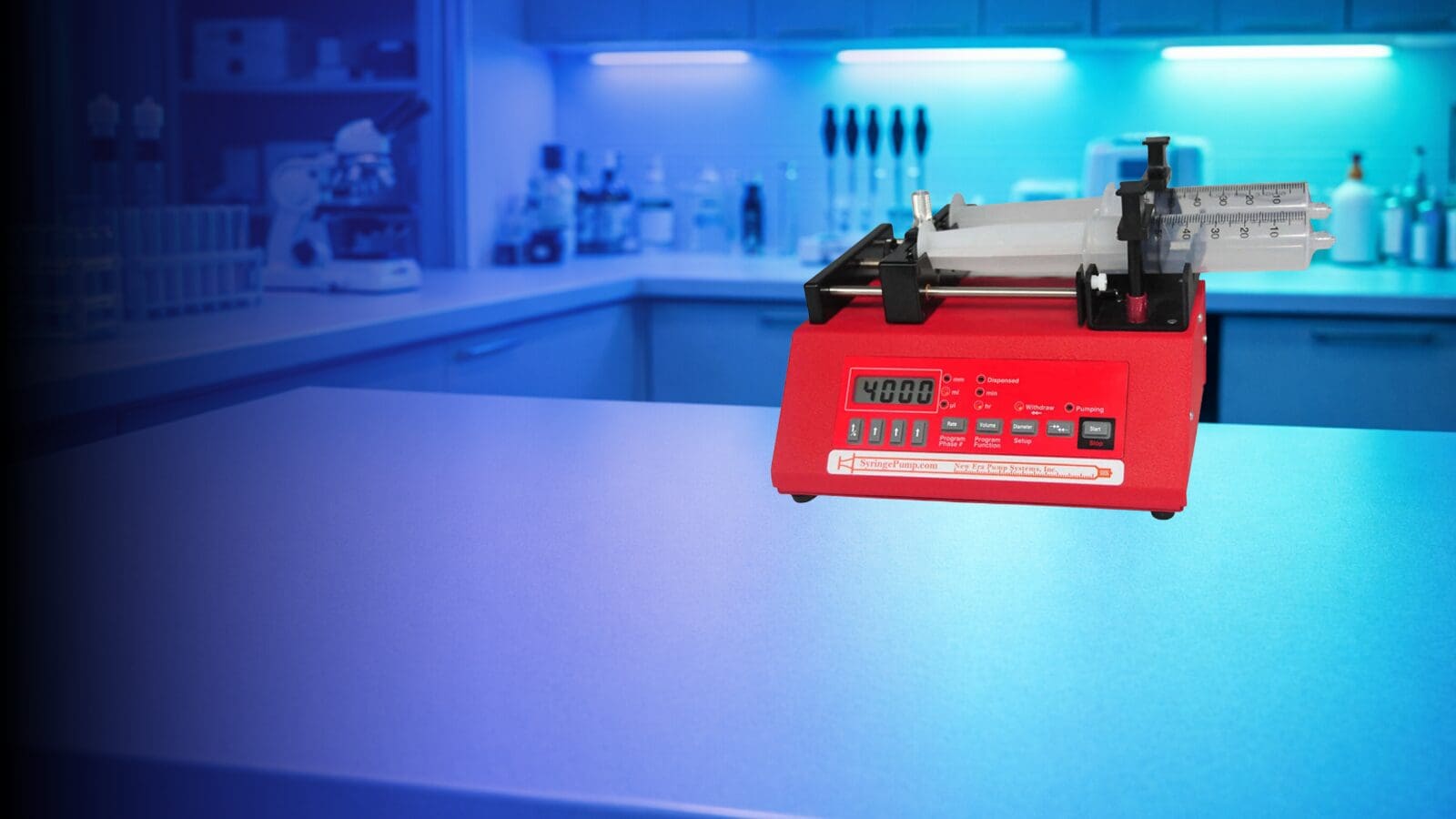
11 Elite vs NE-4002X SyringeTWO: Quick Verdict
The NE-4002X SyringeTWO wins for budget-conscious labs needing extreme low-flow capabilities and larger syringe compatibility. At $2,563.70 versus $2,691 to $4,429 for the Harvard Apparatus 11 Elite, you get lower minimum flow rates (0.12 pL/min versus 1.26 pL/min), support for syringes up to 60 mL in dual configuration, and significantly higher linear force for viscous fluids.
Choose the Harvard Apparatus 11 Elite if you prioritize standalone operation with a touchscreen interface, superior reproducibility (±0.05% versus ±0.2%), and broader regulatory certifications including ETL and CB Scheme compliance. The Elite also offers more flexible mounting options for tight lab spaces.
Choose the NE-4002X SyringeTWO if you need the absolute lowest flow rates, require higher pushing force for demanding applications, or want to maximize value while maintaining professional-grade accuracy.
11 Elite Programmable Syringe Pump vs NE-4002X SyringeTWO:Microfluidics Programmable Syringe Pump at a Glance
| Feature | Harvard Apparatus 11 Elite | NE-4002X SyringeTWO |
|---|---|---|
| Price | $2,691 – $4,429 | $2,563.70 |
| Min Flow Rate | 1.26 pL/min | 0.12 pL/min |
| Max Flow Rate (Dual) | 26.02 mL/min | 1,226 mL/min |
| Accuracy | ±0.5% | ±0.5% |
| Reproducibility | ±0.05% | ±0.2% |
| Max Syringe Size (Dual) | 10 mL | 60 mL (140 mL partial) |
| Linear Force | 35 lbs | 18-150 lbs |
| Interface | Color touchscreen | Keypad |
| Pump Networking | Up to 99 pumps (RS-485) | Up to 100 pumps (RS-232) |
| Warranty | 2 years | 2 years |
| Best For | General microfluidics, ease of use | Ultra-low flow, high force applications |
The Harvard Apparatus Model 11 Elite stands out for its touchscreen interface and more rigorous reproducibility specifications, which account for its higher price. The NE-4002X counters with a wider flow range, greater pumping power, and a more affordable price, making it particularly appealing to laboratories looking to expand their pump fleet.
Description of the Harvard Apparatus 11 Elite
Harvard Apparatus, a division of Harvard Bioscience, has manufactured precision laboratory instruments since 1901. The 11 Elite represents their flagship programmable syringe pump line, designed for researchers who need reliable microfluidic control without constant computer supervision.
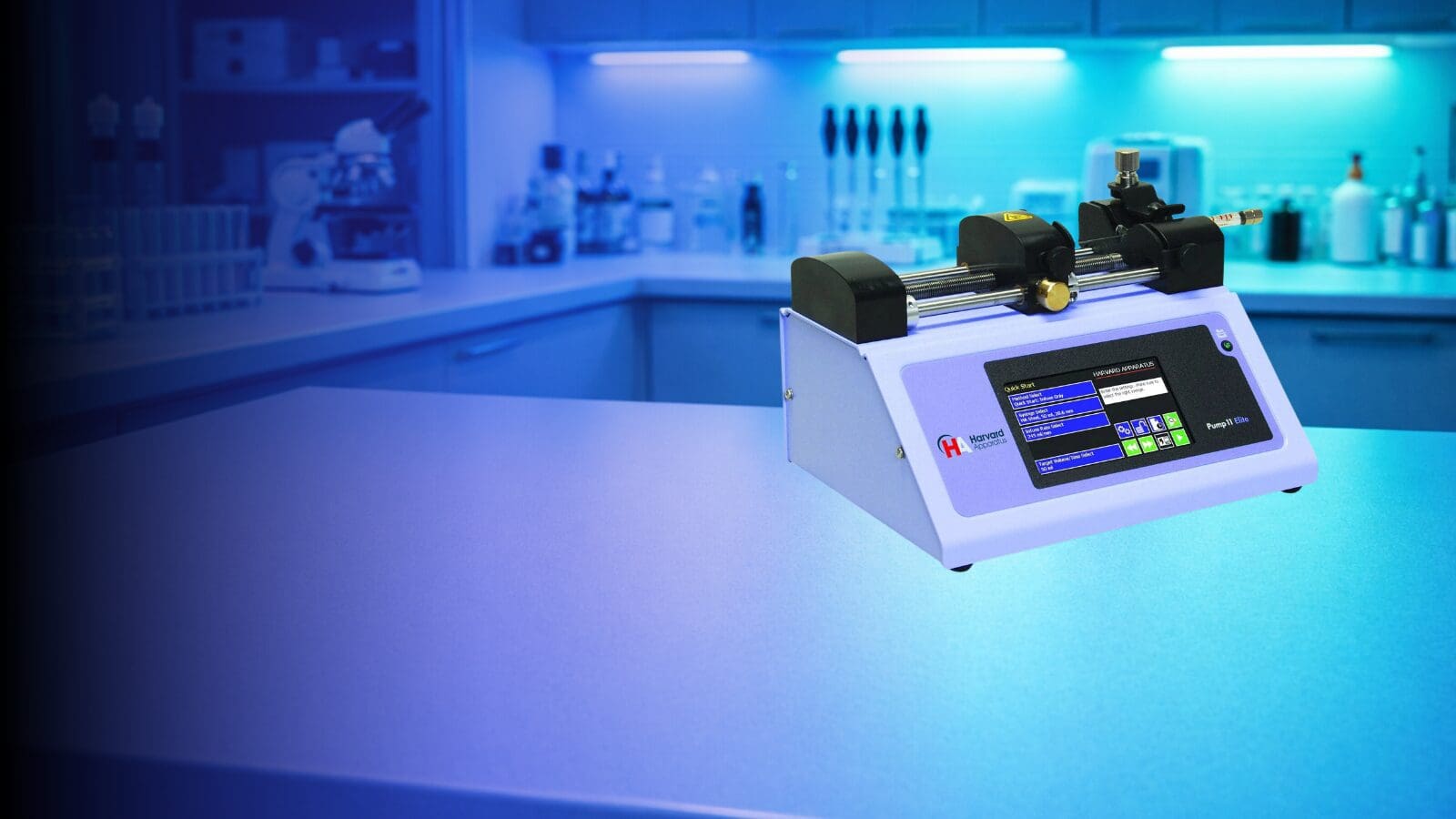
The pump delivers flow rates from 1.26 pL/min to 26.02 mL/min in dual syringe configuration, with ±0.5% accuracy and exceptional ±0.05% reproducibility. A 4.3-inch color touchscreen lets you create, save, and run multi-step pumping methods directly on the device. Four pre-programmed profiles handle constant rate, ramp, gradient, and autofill operations, while user-defined methods support up to 50 steps including time delays, repeating sequences, and TTL triggers.
The dual syringe rack accepts two glass or plastic syringes from 0.5 μL to 10 mL. Advanced micro-stepping techniques eliminate flow pulsation, critical for sensitive microfluidic experiments. The pump can be positioned vertically to reduce bench footprint by 55%, and the tilting display accommodates various mounting orientations.
Connectivity options include USB, RS-485 for daisy-chaining up to 99 pumps, footswitch input, and digital I/O. Certifications span CE, ETL, WEEE, RoHS, and CB Scheme, making it suitable for regulated environments. Pricing ranges from $2,691 for infusion-only models to $4,429 for fully programmable infusion/withdrawal versions with dual syringe capability.
Description of the SyringeTWO:Microfluidics
New Era Pump Systems manufactures the NE-4002X SyringeTWO, a dual-channel pump optimized specifically for microfluidic applications requiring extremely low flow rates. The company focuses on automation-ready instruments with extensive programming capabilities.
The SyringeTWO:Microfluidics achieves flow rates as low as 0.12 pL/min with a 0.5 μL syringe, roughly ten times lower than the Harvard Apparatus 11 Elite. Maximum flow reaches 1,226 mL/min with 60 mL syringes. The dual syringe rack accommodates syringes from 0.5 μL to 60 mL, or partially filled 140 mL syringes up to 120 mL capacity. Accuracy matches the Harvard at ±0.5%, though reproducibility sits at ±0.2%.
Linear force ranges from 18 lbs at maximum speed to 150 lbs at minimum speed, far exceeding the Elite’s 35 lb maximum. This makes the SyringeTWO better suited for viscous fluids or applications requiring high back-pressure.
Programming supports up to 340 phases with the X Upgrade’s smooth linear/gradient feature. The Pumping Program Generator spreadsheet enables one-click program uploads. RS-232 connectivity allows daisy-chaining up to 100 pumps, and TTL logic control interfaces with external equipment like footswitches, timers, and sensors.
The NE-4002X includes power failure recovery, stall detection, and keypad lockout for production environments. CE certification is standard. At $2,563.70, it undercuts even the basic Harvard Apparatus models.
Feature-by-Feature Comparison
Flow Rate Range
The NE-4002X reaches 0.12 pL/min with micro-syringes, compared to 1.26 pL/min for the Harvard Apparatus 11 Elite. At the high end, the SyringeTWO pushes 1,226 mL/min versus 26.02 mL/min for the Elite in dual configuration. The NE-4002X wins for applications demanding extreme flow rate flexibility.
Winner: NE-4002X SyringeTWO – Ten times lower minimum flow and dramatically higher maximum flow.
Reproducibility and Precision
Both pumps share ±0.5% accuracy, but the Harvard Apparatus 11 Elite achieves ±0.05% reproducibility versus ±0.2% for the NE-4002X. For experiments where run-to-run consistency matters more than absolute accuracy, this four-fold improvement justifies the Elite’s premium.
Winner: Harvard Apparatus 11 Elite – Superior reproducibility for demanding research protocols.
User Interface
The Harvard Apparatus 11 Elite features a 4.3-inch WQVGA color touchscreen with icon-based navigation. You can create and run complex methods without connecting to a computer. The NE-4002X uses a traditional keypad interface, requiring either manual button presses or computer connection for programming.
Screenshot of the 11 Elite interface
Winner: Harvard Apparatus 11 Elite – Standalone touchscreen operation reduces setup complexity.
Syringe Compatibility
The NE-4002X accepts dual syringes up to 60 mL (or 140 mL partially filled), while the Harvard Apparatus 11 Elite limits dual configuration to 10 mL syringes. For applications requiring larger reagent volumes per channel, the SyringeTWO offers significant advantages.
Winner: NE-4002X SyringeTWO – Six times larger syringe capacity in dual mode.
Linear Force
The NE-4002X delivers 150 lbs of force at minimum speed, compared to 35 lbs for the Harvard Apparatus 11 Elite. High-viscosity fluids, small-bore tubing, or systems with significant back-pressure benefit substantially from this additional pushing power.
Winner: NE-4002X SyringeTWO – Over four times the maximum force output.
Programming Depth
The Harvard Apparatus 11 Elite supports 50-step user-defined methods with four pre-programmed profiles. The NE-4002X handles up to 340 phases with smooth linear/gradient ramping and one-click spreadsheet uploads. Both offer TTL I/O, but the SyringeTWO provides more granular control for complex automated sequences.
Winner: NE-4002X SyringeTWO – Nearly seven times more programmable steps.
Regulatory Certifications
The Harvard Apparatus 11 Elite carries CE, ETL (UL, CSA), WEEE, RoHS, and CB Scheme certifications. The NE-4002X holds CE certification only. Labs operating under FDA regulations or requiring international certifications may find the Elite’s broader compliance portfolio necessary.
Winner: Harvard Apparatus 11 Elite – More comprehensive regulatory coverage.
Pricing: 11 Elite vs NE-4002X
The Harvard Apparatus 11 Elite pricing structure depends on configuration. Infusion-only single syringe models start around $2,691. Dual syringe infusion/withdrawal programmable versions reach $4,429. The price gap reflects the touchscreen interface, advanced programming features, and broader certifications.
The NE-4002X SyringeTWO sells at a flat $2,563.70, including infusion/withdrawal capability and the X Upgrade programming features. No tiered pricing or feature unlocks complicate the purchase decision.
For a fully-equipped dual-channel programmable pump comparison, the Harvard Apparatus 11 Elite costs roughly $1,866 more than the NE-4002X. That premium buys you the touchscreen interface, tighter reproducibility, and additional certifications.
Academic labs and startups stretching limited equipment budgets will find the NE-4002X delivers professional-grade performance at accessible pricing. Established research facilities or pharmaceutical labs requiring regulatory compliance and streamlined user training may justify the Harvard Apparatus premium.
When scaling to multiple pump networks, the cost difference compounds. Ten NE-4002X units cost $25,637 versus $44,296 for equivalent Harvard Apparatus 11 Elite programmable models, a savings of $18,659. Both pumps include 2-year warranties and local power supplies. Neither requires ongoing software subscriptions or licensing fees.
The Verdict: Harvard Apparatus 11 Elite or NE-4002X SyringeTWO?
Choose the Harvard Apparatus 11 Elite if you:
- Need standalone operation without constant computer connection
- Prioritize run-to-run reproducibility (±0.05%) over raw capability
- Require ETL, CB Scheme, or other certifications beyond CE
- Value intuitive touchscreen programming for multi-user labs
- Work primarily with syringes 10 mL or smaller
- Prefer established brand recognition in grant applications
Choose the NE-4002X SyringeTWO if you:
- Need flow rates below 1 pL/min for ultra-precise microfluidics
- Work with syringes larger than 10 mL in dual configuration
- Require high linear force for viscous fluids or back-pressure
- Plan to build large pump networks (20+ units)
- Need 340-phase programming for complex automated protocols
- Must maximize capability per dollar spent
The NE-4002X represents better raw value for most microfluidic applications. The Harvard Apparatus 11 Elite justifies its premium through user experience, reproducibility, and regulatory compliance. Neither pump is wrong; they serve different priorities.

Frequently Asked Questions
Which pump offers better accuracy for microfluidic droplet generation?
Both deliver ±0.5% accuracy, but the Harvard Apparatus 11 Elite’s ±0.05% reproducibility produces more consistent droplet sizes across runs. The NE-4002X’s ±0.2% reproducibility remains acceptable for most applications.
Can I use glass syringes with both pumps?
Yes. Both accept glass and plastic syringes. The NE-4002X requires an optional pusher block for 50 and 100 mL glass syringes in withdrawal mode.
How many pumps can I control from a single computer?
The Harvard Apparatus 11 Elite networks up to 99 pumps via RS-485. The NE-4002X connects up to 100 pumps through RS-232. Both support individual addressing and centralized control.
Do these pumps work without a computer?
The Harvard Apparatus 11 Elite operates fully standalone via its touchscreen. The NE-4002X functions standalone through its keypad but requires computer connection for complex program uploads.
What maintenance do these pumps require?
Both pumps require minimal maintenance: periodic cleaning, syringe replacement, and occasional lead screw lubrication. Neither specifies mandatory service intervals for light-duty laboratory use.
Which pump handles viscous fluids better?
The NE-4002X’s 150 lb maximum force significantly outperforms the Harvard Apparatus 11 Elite’s 35 lb limit. Choose the SyringeTWO for high-viscosity applications.
Are replacement parts readily available?
Both manufacturers maintain parts inventories and offer technical support. Harvard Apparatus benefits from longer market presence; New Era provides responsive direct support.