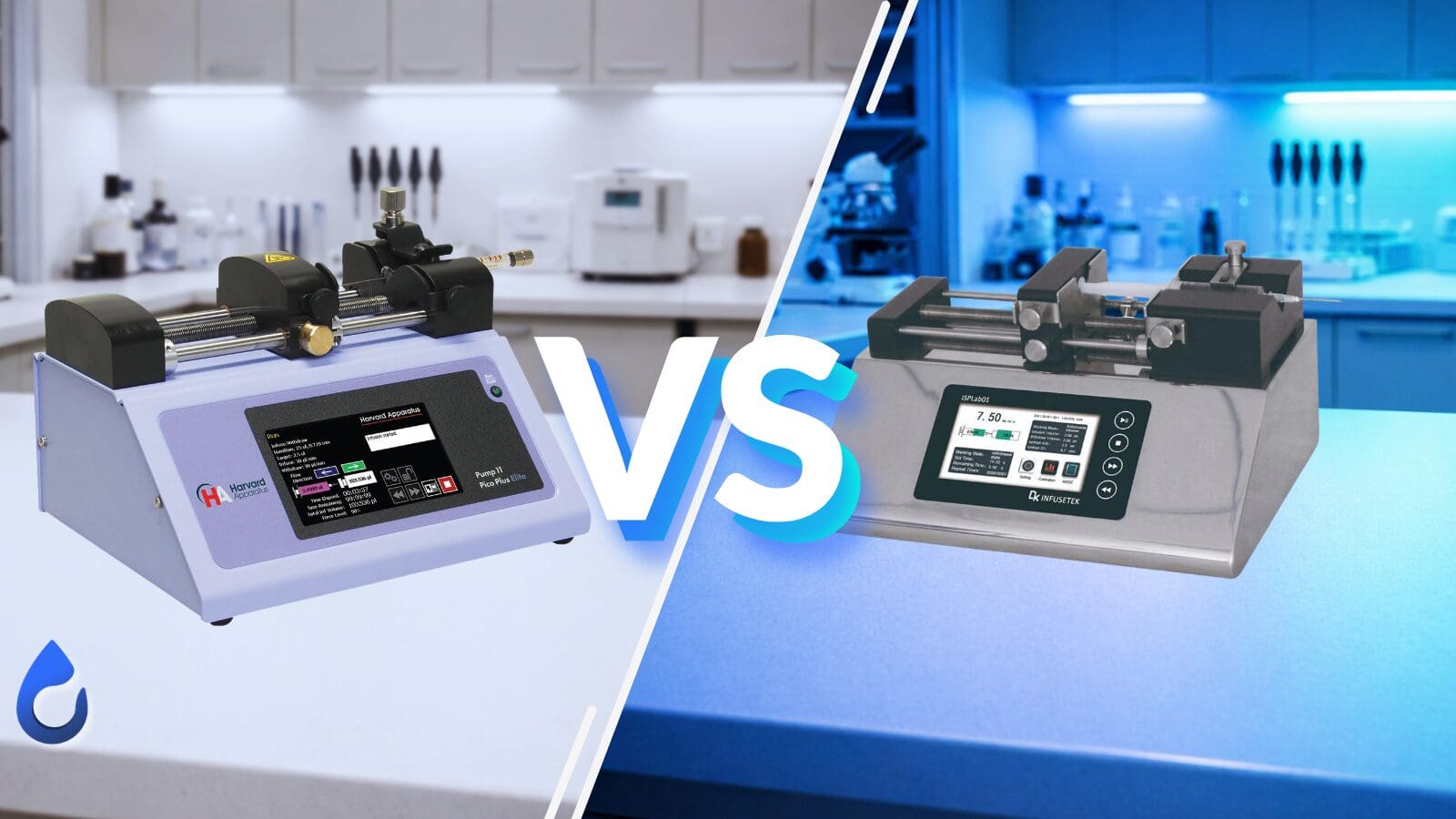
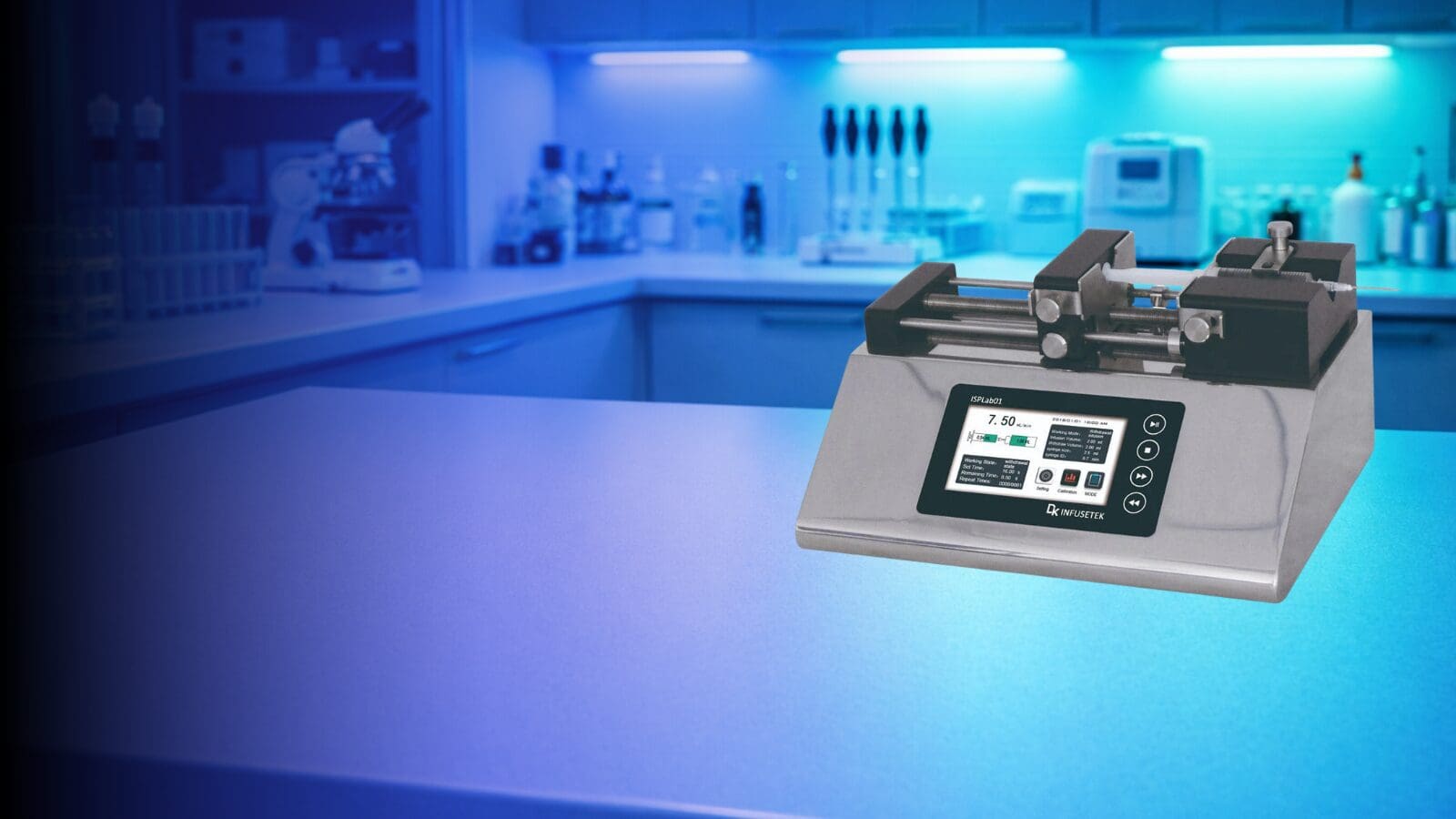
11 Pico Plus Elite vs ISPLab: Quick Verdict
The Harvard Apparatus 11 Pico Plus Elite wins for researchers who need ultra-precise picoliter-level flows and superior accuracy for demanding microfluidic applications. Its 0.35% accuracy and 0.05% reproducibility make it the clear choice for pharmaceutical research, single-cell analysis, and any experiment where precision cannot be compromised.
The ISPLab Touch Screen Syringe Pump takes the lead for labs requiring multi-channel capability, higher flow rates, and budget-conscious purchasing. With configurations from 1 to 12 channels and pricing starting around $1,400, it delivers excellent value for general laboratory work, teaching environments, and applications where picoliter precision isn’t essential.
If your work involves droplet generation, organ-on-chip systems, or nanoparticle synthesis, the Harvard Apparatus justifies its premium pricing. For routine infusion work, chemical dosing, or parallel sample processing, the ISPLab offers more capability per dollar spent.
Harvard Apparatus 11 Pico Plus Elite Syringe Pump vs ISPLab Touch Screen Syringe Pump (1 – 12 channels) at a Glance
| Feature | Harvard Apparatus 11 Pico Plus Elite | ISPLab Touch Screen Syringe Pump |
|---|---|---|
| Price Range | $4,299 – $4,430 | $1,429 – $2,530 |
| Channels | 1-2 | 1-12 |
| Flow Rate Range | 0.54 pl/min – 39.77 ml/min | 0.01 µL/min – 127 ml/min |
| Accuracy | ±0.35% | ±0.5% |
| Reproducibility | ±0.05% | Not specified |
| Best For | Microfluidics, ultra-low flows | Multi-channel, general lab work |
| Warranty | 2 years | Standard manufacturer warranty |
The comparison reveals two fundamentally different design philosophies. Harvard Apparatus prioritized precision engineering for specialized microfluidic applications, while Shenchen designed the ISPLab for versatility and accessibility. The Harvard unit’s picoliter-level minimum flow rate is roughly 18 times lower than the ISPLab’s minimum, a difference that matters enormously in certain applications and not at all in others.
Description of the Harvard Apparatus 11 Pico Plus Elite
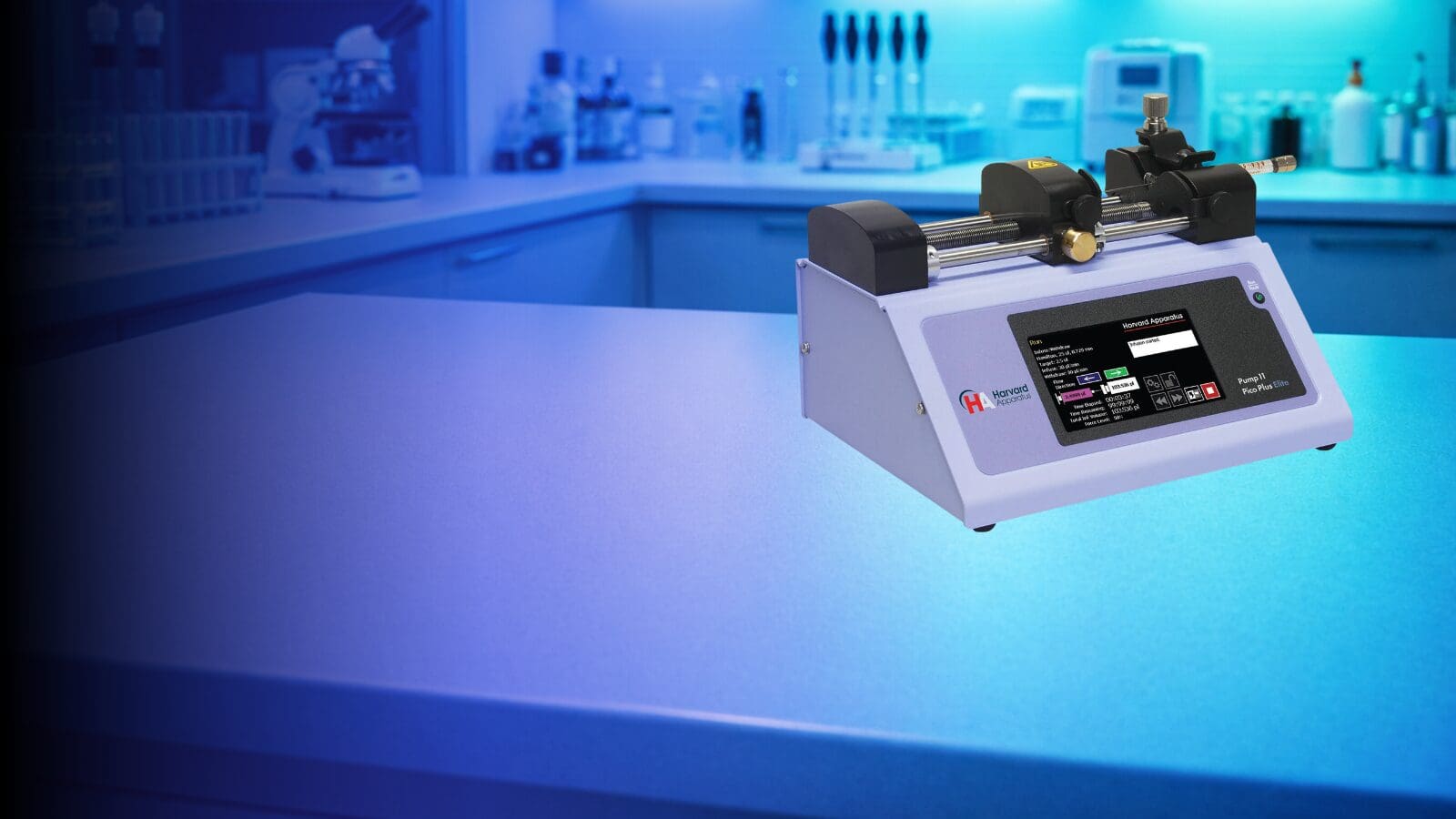
Harvard Apparatus, a division of Harvard Bioscience with over 100 years in laboratory instrumentation, developed the Pump 11 Pico Plus Elite specifically for microfluidic applications requiring extreme precision. This programmable infusion/withdrawal syringe pump delivers flow rates from 0.54 picoliter per minute up to 39.77 ml/min in single-syringe configuration.
The pump targets researchers working in microfluidics, pharmaceutical development, and biomedical research where flow accuracy directly impacts experimental outcomes. Its 0.35% accuracy and 0.05% reproducibility specifications exceed what most syringe pumps offer, making it suitable for droplet microfluidics, organ-on-chip platforms, and precision drug delivery studies.
Key capabilities include advanced programming with four pump operation profiles (constant rate, ramp, gradient, and autofill), user-defined methods with up to 50 steps, and extensive connectivity options including USB, RS-485 for daisy-chaining up to 99 pumps, and TTL I/O for external device integration. The 4.3-inch color touchscreen allows standalone operation without computer control.
The single-channel version accommodates syringes from 0.5 µL to 50/60 mL, while the dual-channel configuration handles syringes from 0.5 µL to 10 mL. Pricing ranges from $4,299.75 to $4,429.62 depending on configuration, positioning it firmly in the premium research instrument category.
What is ISPLab Touch Screen Syringe Pump (1 – 12 channels)?
Innofluid, a Chinese manufacturer with 13 years of experience in precision fluid handling, produces the ISPLab series as their touch screen syringe pump line. The company built its reputation on peristaltic pumps before expanding into syringe pump technology.
The ISPLab targets laboratories needing flexible, multi-channel fluid delivery at accessible pricing. Flow rates span 0.01 µL/min to 127 mL/min for 1-2 channel configurations, with 4-12 channel versions reaching 21.997 mL/min maximum. This range covers most standard laboratory applications from chemical dosing to biological sample handling.
The pump operates in four working modes: infusion, withdrawal, infusion/withdrawal, and withdrawal/infusion. Two measurement modes allow users to set parameters based on either volume/rate or volume/time combinations. A built-in protection system stops the pump and triggers an alarm if the drive mechanism encounters resistance.
Syringe compatibility ranges from 10 µL to 140 mL for 1-2 channel models, dropping to 10 µL to 10 mL for higher channel counts. The 4.3-inch industrial-grade LCD touchscreen provides real-time parameter display and control. Communication interfaces include RS232 and RS485 with ModBus protocol support.
Pricing starts at $1,428.80 for single-channel configurations and reaches $2,530.48 for 12-channel setups, representing significant savings compared to premium alternatives.
Feature-by-Feature Comparison
Flow Rate Range and Precision
The Harvard Apparatus achieves picoliter-level minimum flows at 0.54 pl/min, enabling applications like single-cell injection and nanoliter droplet generation. The ISPLab’s minimum of 0.01 µL/min (10 nanoliters) works well for most laboratory applications but cannot match the Harvard unit’s ultra-low flow capability.
At the high end, the ISPLab reaches 127 mL/min compared to Harvard’s 39.77 ml/min, giving it an advantage for higher-volume applications.
Winner: Pico Plus Elite for precision applications; ISPLab for high-flow needs.
Accuracy and Reproducibility
Harvard Apparatus specifies ±0.35% accuracy and ±0.05% reproducibility, backed by advanced microstepping techniques that eliminate flow pulsation. The ISPLab offers ±0.5% accuracy with no published reproducibility specification.
This 0.15% accuracy difference matters significantly in pharmaceutical formulation and quantitative microfluidic experiments where cumulative errors affect results.
Winner: Harvard Apparatus
Channel Capacity
The ISPLab scales from 1 to 12 channels in a single unit, enabling parallel sample processing or multi-reagent delivery. The Harvard Apparatus maxes out at dual-channel operation, though up to 99 units can be daisy-chained via RS-485.
For labs running parallel experiments or needing synchronized multi-channel delivery from one instrument, the ISPLab offers immediate capability without additional hardware purchases.
Winner: ISPLab
Programming and Methods
Harvard Apparatus provides four built-in pump operation profiles plus user-defined methods with 50 steps each, including time delays, repeating steps, TTL triggers, and event-based control. Methods can be named, stored, exported to computers, and transferred between pumps.
The Harvard Apparatus Existing Methods and User Defined Methods consist in Pump Operation Profiles that can be selected along with a syringe selection, commands, and I/O triggers to create a Method. There are four Pump Operation Profiles available for selection:
Operation profiles available in the Pico Plus Elite.
The ISPLab offers four working modes with parameter storage but lacks the Harvard unit’s sophisticated multi-step programming, method management, and inter-pump method transfer capabilities.
Winner: Harvard Apparatus
Connectivity Options
The Harvard Apparatus includes USB, RS-485 for daisy-chaining, footswitch input, and 15-pin D-Sub TTL I/O. Optional RS-232 ports are available. The ISPLab provides RS232 and RS485 with ModBus protocol, plus external start/stop and fast withdrawal/infusion signals.
Both pumps offer adequate connectivity for most laboratory setups, though Harvard’s footswitch input and more extensive TTL I/O provide advantages for hands-free operation and complex system integration.
Winner: Harvard Apparatus
Build Quality and Design
The Harvard Apparatus features a compact design that can operate vertically to reduce bench footprint by 55%, with a tiltable display for vertical mounting. It weighs 2.1 kg and carries CE, ETL, and CB Scheme certifications.
The ISPLab uses industrial-grade components with IP31 protection rating. Its dual control method (touchscreen plus mechanical keypad with rotary encoder) provides backup input options.
Winner: Tie – different design priorities serve different needs.
Pricing: 11 Pico Plus Elite vs ISPLab
The Harvard Apparatus 11 Pico Plus Elite ranges from $4,299.75 for single-channel to $4,429.62 for dual-channel configurations. This pricing reflects the precision engineering required for picoliter-level flows and the Harvard Apparatus brand reputation in research instrumentation.
The ISPLab series starts at $1,428.80 for single-channel units and reaches $2,530.48 for 12-channel configurations. At maximum configuration, you get 12 channels for roughly 60% of what a single Harvard dual-channel unit costs.
For budget-conscious academic labs, the ISPLab delivers substantial capability at accessible pricing. A teaching laboratory could equip multiple stations with ISPLab units for the cost of one Harvard Apparatus pump. Core facilities with diverse user needs might find the ISPLab’s flexibility and lower replacement cost more practical.
Research groups performing cutting-edge microfluidic work often find the Harvard Apparatus pays for itself through reduced experimental failures and higher data quality. The 2-year warranty and established service network also factor into total ownership cost calculations.
Labs needing both precision and multi-channel capability might consider a hybrid approach: Harvard Apparatus for critical microfluidic experiments and ISPLab units for routine sample preparation or less demanding applications.

The Verdict: Harvard Apparatus 11 Pico Plus Elite Syringe Pump or ISPLab Touch Screen Syringe Pump (1 – 12 channels)?
Choose the Harvard Apparatus 11 Pico Plus Elite if you:
- Work in microfluidics requiring picoliter-level flow control
- Need accuracy better than ±0.5% for quantitative experiments
- Develop pharmaceutical formulations or drug delivery systems
- Require advanced multi-step programming with method transfer capability
- Plan to integrate pumps into automated systems via TTL triggers
- Value the 2-year warranty and established manufacturer support
Choose the ISPLab Touch Screen Syringe Pump if you:
- Need more than two channels for parallel processing
- Work with flow rates above 40 mL/min
- Operate within limited equipment budgets
- Equip teaching laboratories or training facilities
- Perform routine laboratory work where ±0.5% accuracy suffices
- Want backup control options via mechanical keypad
The decision ultimately comes down to application requirements. Microfluidic researchers will find the Harvard Apparatus’s precision indispensable. General laboratory users will appreciate the ISPLab’s value and versatility.
Frequently Asked Questions
Which pump is better for microfluidic droplet generation?
The Harvard Apparatus 11 Pico Plus Elite excels at droplet generation due to its picoliter-level minimum flow rate and pulsation-free delivery. The ISPLab can generate larger droplets but lacks the precision for sub-microliter applications.
Can I use the ISPLab for pharmaceutical research?
Yes, for applications where ±0.5% accuracy meets requirements. For GMP environments or precision formulation work, the Harvard Apparatus’s tighter specifications and regulatory certifications provide better documentation support.
How many pumps can I connect together?
The Harvard Apparatus supports daisy-chaining up to 99 pumps via RS-485. The ISPLab supports multiple pump connection via RS485 with ModBus protocol, though specific limits depend on network configuration.
What syringes are compatible with each pump?
The Harvard Apparatus accepts glass or plastic syringes from 0.5 µL to 50/60 mL (single) or 0.5 µL to 10 mL (dual). The ISPLab accommodates 10 µL to 140 mL syringes for 1-2 channels, or 10 µL to 10 mL for 4-12 channel configurations.
Do these pumps require computer control?
Both pumps operate standalone via their touchscreen interfaces. Computer control is optional for both, with the Harvard Apparatus offering more extensive external control options through its TTL I/O and USB connectivity.
What maintenance do these pumps require?
Both pumps require minimal maintenance: periodic cleaning, lead screw lubrication per manufacturer guidelines, and inspection of syringe holders. The Harvard Apparatus manual provides detailed maintenance schedules.